
What is Planetary Health?
Planetary Health is the understanding that human health and civilization depend on flourishing natural systems and the wise stewardship of those systems. Clean air and water, healthy soils and food systems, biodiversity, and stable climate systems are essential foundations for human well‑being. When these systems are degraded, human health is harmed; when they thrive, people and communities can flourish.
“We cannot have healthy people on a sick planet.”
-- Thomas Berry, The Determining Features of the Ecozoic Era (1998)
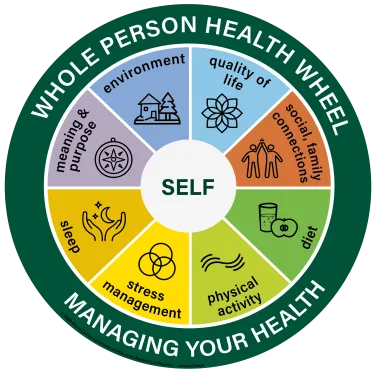
Planetary Health and Whole Person Health
Whole Person Health (WPH) is a holistic approach to understanding health that incorporates factors such as physical and mental health, social connectiveness, stress, and sleep. At the Osher Center for Integrative Health at the University of Vermont, we embrace Planetary Health as a core dimension of Whole Person Health. We recognize that individual health, community well‑being, and the health of the Earth’s living systems are inseparable — and that healthcare has both a responsibility and an opportunity to support all three.
By emphasizing prevention, resilience, and the interconnected physical, mental, social, spiritual, and ecological dimensions of health, the Osher Center seeks to model a transformative and equitable approach to care that benefits both people and the planet.

Nature as Medicine
Human health is deeply connected to our relationship with the natural world. Nature as Medicine is an integrative health approach that recognizes time in nature as a necessity for physical, mental, emotional, and spiritual well being.
Learn More about Nature as Medicine at UVMPlanetary Health Belongs in Integrative and Whole Person Healthcare
Whole Person Healthcare focuses on restoring health, promoting resilience, and preventing disease by addressing the interconnected biological, behavioral, social, and environmental determinants of health. This same approach offers a powerful pathway to planetary health.
Healthcare systems must respond to the health impacts of environmental change, while also acknowledging their own contributions to climate change, pollution, and resource use. By emphasizing prevention, health promotion, and lifestyle‑based care—such as plant‑forward nutrition, physical activity, mindfulness, and nature connection—whole person care can improve health outcomes while reducing the environmental impacts of health care delivery.
Caring for people and caring for the planet are not competing priorities—they are deeply linked goals.

“The things we need to do to be healthy, truly healthy — in mind, body, and spirit — are the same things that will heal the damage we have caused to the earth.”
-- Christine Vatovec, PhD, Planetary Health Lead, Osher Center for Integrative Health at the University of Vermont
Why Planetary Health Matters for Human Health
Environmental change is already shaping patterns of disease, well‑being, and health equity. Climate change, air and water pollution, biodiversity loss, and ecosystem disruption contribute to increased physical illness, mental health challenges, and social inequities, disproportionately affecting vulnerable populations.
At the same time, nature plays a vital role in promoting health. Healthy ecosystems provide the foundations of life and support mental and emotional well‑being through stress reduction, restoration, and connection. Planetary health invites us to care for these systems not only for environmental reasons, but as a fundamental public health strategy.

Planetary Health Through a Whole Health Lens
At the Osher Center, our approach to serving planetary health is grounded in Whole Health principles and recognizes multiple, interrelated dimensions of well‑being:
- Physical health – Environmental conditions influence disease risk, resilience, and recovery
- Mental and emotional health – Climate stress and environmental degradation affect psychological well‑being, while nature connection supports resilience
- Social and community health – Environmental harms and benefits are unevenly distributed, raising critical issues of equity and justice
- Spiritual health – Planetary health invites reflection on meaning, values, and relationship with the natural world
- Ecological health – Healthy ecosystems are essential for human survival and have intrinsic value deserving of stewardship
This integrated perspective reflects the understanding that human and ecological well‑being are shared outcomes.

Whole Person Health as a Pathway to Planetary Health
Whole Person care has the potential to reduce health care utilization and its environmental footprint while improving outcomes and lowering costs. By supporting:
- Plant‑based and plant‑forward nutrition
- Physical activity and active transportation
- Mindfulness and stress regulation
- Nature connection and reciprocity
- Healthcare that integrates evidence-based conventional and complementary therapies
These approaches generate co‑benefits for individual health, community well‑being, and planetary systems—contributing to the broader societal transformation needed for a flourishing future.

Planetary Health Resources from the Osher Collaborative
Connect with national and international organizations advancing Planetary Health.
How the Osher Center Advances Planetary Health
The Osher Center integrates planetary health across research, education, clinical care, community engagement, and policy, in alignment with UVM’s Strategic Plan. Through whole person approaches, we aim to support healthier people, stronger communities, and a thriving planet—now and for future generations.
Research. We explore the bidirectional relationships between health care and planetary health, including whole person care as a strategy for reducing environmental impacts, prevention‑focused co‑benefits, and the role of food systems, pharmaceuticals, and health care supply chains.
Education and Training. We prepare health professionals to address the health challenges of a changing planet through integrated curricula, clinical education, and interprofessional learning.
Clinical Care. Osher clinical programs emphasize prevention, resilience, and self‑care practices that support both human health and environmental sustainability.
Community Engagement. We partner with communities to implement place‑based actions that promote health, equity, and ecological well‑being together.
Policy and Systems Change. We support science‑informed, economically viable solutions that advance human and planetary health at institutional, state, and national levels.

From Knowledge to Action: A Hopeful Path Forward
Planetary health is ultimately about relationships, responsibility, and hope. It challenges the idea that humans are separate from nature and affirms our deep interdependence with living systems. By integrating planetary health into Whole Person care, education, research, and policy, the Osher Center seeks to help build a health system that not only treats illness, but actively contributes to a healthier, more just, and more sustainable world.
We believe that caring for people and caring for the planet are one and the same.

UVM's Planetary Health Summit
Research, clinical, and educational efforts connecting human & environmental health.