Secondary tabs
Submission information
| Study Title | White Ash Preservation Patches at Smokey House Center, SAP-Ne Demonstration Site (Danby, VT) |
|---|---|
| Case Study Type | Forest type, Forest health |
| Site Photo |
|
| Lay Summary | This project focused on preserving white ash trees' presence across Smokey House Center’s landscape in the face of emerald ash borers spread by using a combination of silviculture and chemical treatments. Smokey House staff attempted to regenerate two pockets of white ash within half acre canopy gaps while injecting 20 mature ash trees around the gaps perimeters. |
| Location | Danby, Vermont |
| Location Description | The project area was a northern hardwoods stand at Smokey House Center called NH-11. |
| Latitude | 43.353544 |
| Longitude | -73.063473 |
| Directions | The site resides in forest stand NH-11 at Smokey House Center’s property in Danby, VT. Smokey House Center is located at 426 Danby Mountain Rd, Danby, VT, 05739. Park in the main parking lot in front of the blue woodshop. To reach the project site by foot, walk up the Northern Loop Trail starting at the parking lot. The site resides about 1.5 miles down the Northern Loop Trail, after passing through an open meadow that has views of Killington Mountain. |
| Accessibility | Foot or Vehicle, but best for the vehicle to be able to drive on dirt forest roads and only with Smokey House Center approval. |
| Landowner Name | Smokey House Center |
| Landowner phone | +1 802-293-2300 |
| Landowner email | info@smokeyhouse.org |
| Stand Area with Units | 38 acre stand with roughly 2 acre treatment area |
| Cover Type | Northern Hardwoods |
| Natural Community Classification | Rich Mesic Forest |
| Primary Forest Health Threat | emerald ash borer |
| Primary Pests/Disease | emerald ash borer |
| Soils | Dutchess silt loam, Massena silt loam, Stockbridge gravelly silt loam |
| Estimated Stand Year Origin | 1920 |
| Stand Origin Year Note | Stand was shown to be mostly forested on aerial photographs in 1941. Stand was likely initiated through pasture abandonment a few decades before then. |
| Site Index with Units | 60 |
| Start date | Thu, 01/01/2026 - 00:00 |
| End date | Mon, 06/15/2026 - 00:00 |
| Stand History | In the early 1970’s a marked timber sale was implemented in Stands RNH-1, RNH-2, and RNH-3, and over 1,000M of sugar maple sawlogs were removed. The residual stand was uniformly spaced and similarly sized hardwoods (sugar maple dominant), with little structural diversity and few cavity or den trees. No cutting has taken place since, and no other historical facts are known. |
| Species 1 | Acer saccharum (sugar maple) |
| Species 1 Percent(%) | 49% |
| Species 2 | Fraxinus americana (white ash) |
| Species 2 Percent(%) | 20% |
| Species 3 | Prunus serotina (black cherry) |
| Species 3 Percent(%) | 16% |
| Pre-Treatment Growth Stocking | 119 |
| Pre-Treatment Forest Health Issues | Emerald ash borer, invasive shrubs in understory |
| Case Overview | Smokey House Center is a non-profit organization in Danby, Vermont, dedicated to conservation, education, and sustainable land stewardship. The land was purchased by the Currier family and later transferred to their foundation, the Taconic Foundation, before Smokey House Center was established in 1974 to oversee its ongoing stewardship. Since then, the property has been managed in alignment with the organization's mission of connecting people to the land through hands-on conservation work, education, and agriculture. |
| Silviculture Objectives | Smokey House Staff were interested in reducing stand basal area to 80 while retaining high quality growing stock and regenerating white ash. |
| Landowner Objectives | Climate resilience, wildlife habitat, wood production, education, research, recreation. |
| Silviculture Prescription | In an attempt to regenerate a cohort of desirable species, capture the value of high risk/declining trees, and increase the growth rates and vigor of developing AGS, a combination of single tree selection and group selection harvests were implemented. Stand areas dominated by shade intolerant hardwoods or bordered by insecticide-treated ash trees (not more than 10% of stand area or 3.8 acres in total) was regenerated using gaps about 1/2th acre in size. With the exception of cavity/den trees or selected seed trees, all stems 2”+ in diameter were felled in the gaps. The matrix will be tended as needed to favor future crop trees and leave an average of 80ft² of basal area per acre including both the gaps and the matrix. |
| Regeneration Targets/Goals | The long range silvicultural objective of Stand NH-11 is to manage for periodic yields of high quality hardwood sawtimber. This will be accomplished by implementing unevenaged harvesting techniques. Harvests will attempt to naturally regenerate sugar maple, yellow birch, black cherry, white ash, and other commercial hardwood species. |
| Factors Influencing Prescription Choice |
|
| Climate Adaptation Considerations | We are committed to keeping a diversity of species present on the Smokey House landscape to create as much resilience as possible in the face of climate change. As such, this project was an attempt to regenerate white ash as a method for keeping it on the landscape as emerald ash borer wipes out the majority of white ash trees in the next five years in our area. |
| Equipment used | Hand felling and harvesting with skidder. |
| Prescription Notes | A local father and son team hand felled and skidded out trees during the dry summer months of June, July, and August in 2026. Conditions stayed dry enough for a relatively straightforward harvest to take place. |
| Post-Treatment Assessment Expected | yes |
| Post-Treatment Assessment | Stand will be continuously re-inventoried by our Future Forest Apprentices in future summer of 2027. |
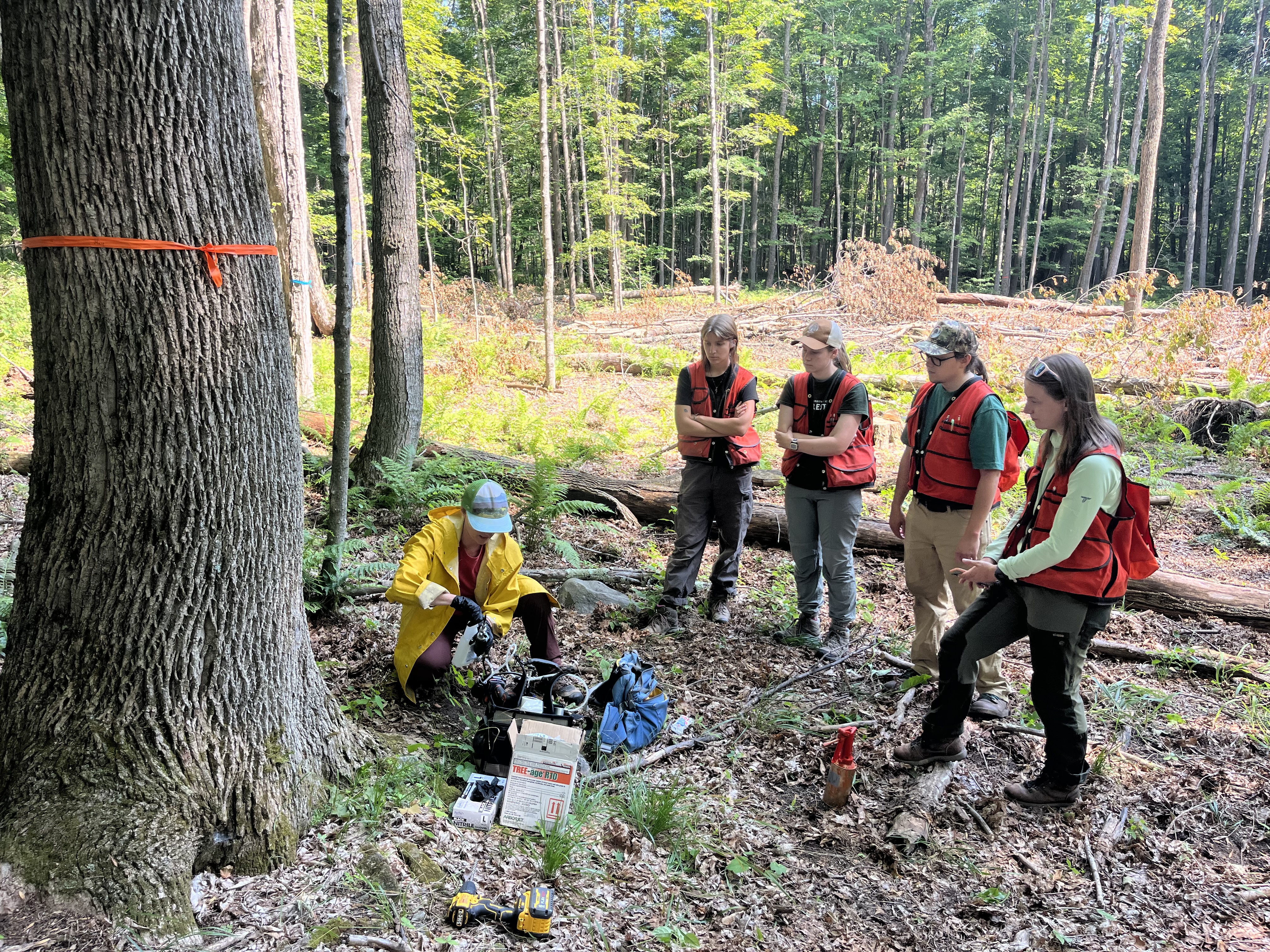
| Treatment Notes | Our Future Forester Apprentices helped Vermont Land Trust Forester Caitlin Cusack inject the 20 mature ash trees surrounding the gaps with Emamectin Benzoate. |
| Treatment Total Time | 30 hours of harvesting (paid for by operator receiving, 8 hours injecting trees (7 people) |
| Treatment Total Cost | $5,581 |
| Treatment Cost Notes | Operators took approximately 30 hours to harvest the patches = $3,000 6 apprentices plus 1 Smokey House Staff member spent 1 day injecting trees. This was largely an educational experience, so it was not necessarily representative of how long it actually takes to inject 20 trees. = $1,341 Tree AGE & Arbor Plugs = $1,240 |
| Future Treatment Plans | We will continually monitor invasive species and manage as needed. The stand will be on a 20 year cutting rotation. |
| Basal Area Pre-Harvest | 119 |
| Basal Area Post-Harvest | 80 |
| Basal Area Acceptable Growing Stock | 75 |
| Basal Area Units |
|
| Trees Per Acre | 173 |
| Mean Stand Diameter | 12 inches |
| Primary Contact | Walker Cammack |
| Contact Title | Program Director, Shared Leadership Team |
| Contact Organization | Smokey House Center |
| Contact Email | walker@smokeyhouse.org |
| Contact Phone | +1 802-293-2300 |
| Contact Address | 426 Danby Mountain Road Danby, Vermont. 05739 United States |
| Biography | For over fifty years, Smokey House Center has been successfully dedicated to its mission of maintaining a working landscape that promotes sustainable agricultural and forestry practices while engaging people in meaningful ways. |
| Additional files |