Secondary tabs
Submission information
Shutesville Ledges, SAP-Ne Demonstration Site (Stowe, VT)
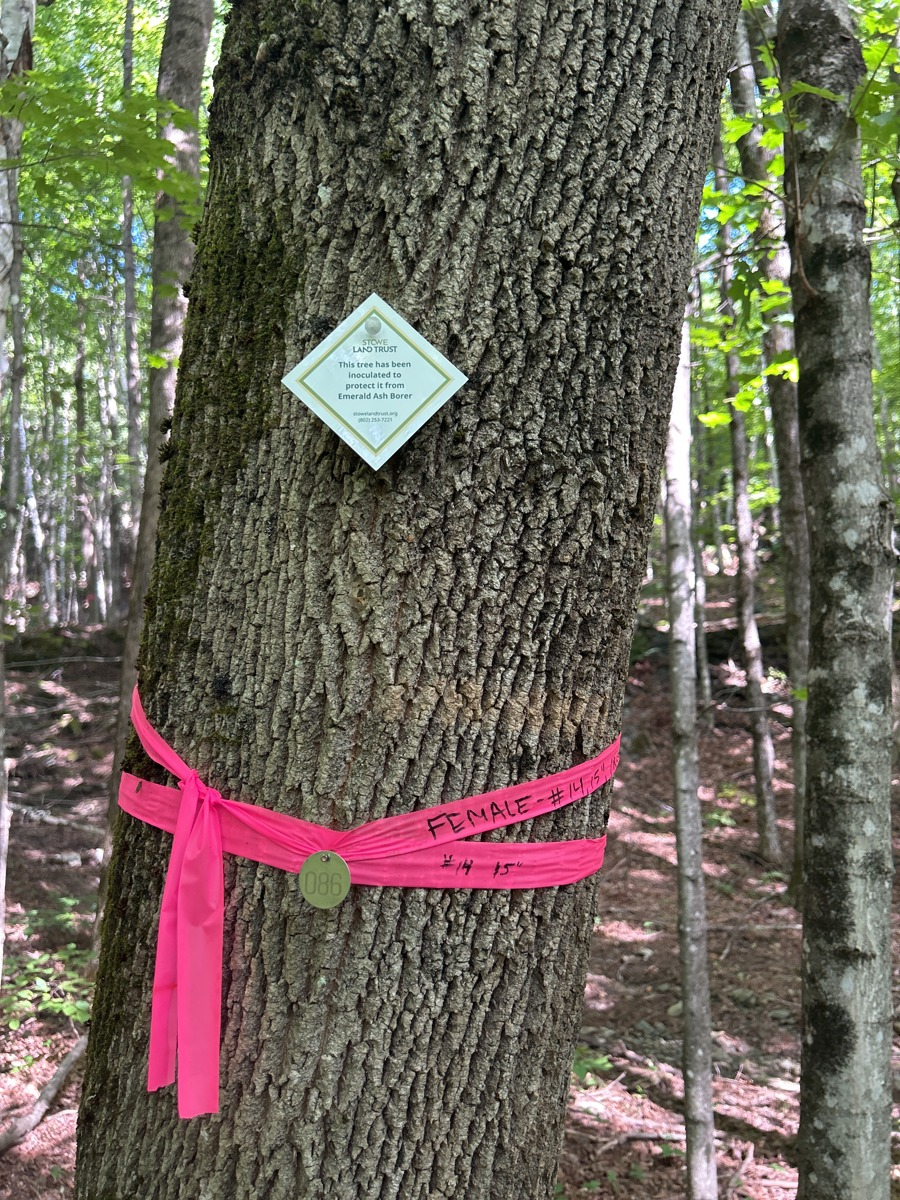
Stowe Land Trust treated a preservation patch of fifteen mature white ash, including nine female trees, four male trees, and two vigorous unsexed trees at the Shutesville Ledges property in Stowe, Vermont. The trees were inoculated in July 2026 with emamectin benzoate to protect them from the emerald ash borer. They will be retreated every 3 years to preserve genetic diversity and to protect seed trees for future ash regeneration. This preservation patch is located in the heart of the Shutesville Hill Wildlife Corridor, the only viable connection between the Green Mountains and the Worcester Range. It is one of the five most important wildlife crossings in Vermont and a critical part of an international network of connected forest habitats in the northeast. Forest stewardship practices at this site are supported in part by the Sustaining Ash Partners Network (SAP-Ne), through a demonstration site network showcasing effective approaches for preserving future generations of ash in the face of emerald ash borer.
Site Location
Stowe, Vermont
This preservation patch is located on the 86-acre Stowe Land Trust-owned Shutesville Ledges property, which is adjacent to Route 100 and accessible on foot via a legal right-of-way off Megan’s Way. Shutesville Ledges is open for dispersed public recreatio
44.425469
-72.712223
To reach the white ash preservation patch, enter the property on foot via the Megan’s Way right-of-way, which appears as an old woods road track opposite a private home at 110 Megan’s Way. Walk along the right-of-way through the woods, then turn south to head towards the southern-central part of the property using this dropped Google Maps pin to navigate to the preservation patch: https://maps.app.goo.gl/2C4gtVtipgcLLz1g7. Distance from the right-of-way entry point to the preservation patch is approximately a half mile. Tree tags are attached to all treated white ash trees.
The site is accessible by foot and the property is open to the public year-round, but there is no public parking and there are no maintained recreational trails on the land due to the property's primary conservation value for wildlife movement.
Stowe Land Trust
+1 802-253-7221
Stand Information
Approximately 1.5 acre preservation patch with fifteen treated mature white ash trees
Ash
emerald ash borer
emerald ash borer
Pre-treatment Conditions
The southern portion of Shutesville Ledges, where the white ash preservation patch is located, does not show signs of recent human-caused disturbance or timber harvest, although trace skid trails and evidence of soil compaction in other nearby stands point to some evidence of historic timber harvest on the land. The forest in this unit likely became established on open agricultural land at least 70-80 years ago. At some point in the 1800s, most of the property was probably part of one of Stowe’s numerous cleared hill farms, and may have been used as a woodlot and/or for the grazing of animals, including sheep, at various times.
Emerald Ash Borer
Silviculture Prescription
Emerald ash borer threatens the long-term existence of all species of ash native to North America. In 2024, Emerald Ash Borer (EAB) was detected in Stowe, Vermont for the first time. This property is heavy to white ash, with white ash accounting for up to 31% of trees in one stand inventoried in 2024. We identified nine healthy female white ash, four healthy male white ash, and two unsexed ash ranging in size from 12” to 20” diameter at breast height (DBH). These fifteen white ash trees were injected with emamectin benzoate in July 2026 to preserve genetic diversity and protect seed trees for future ash regeneration. The trees will be reinoculated every three years, and Stowe Land Trust may identify up to five additional lingering ash in close proximity to the stand for inoculation. This is one site in a network of sites owned by non-profit and state and federal partners where ash preservation patches have been established to conserve ash genetics.
Conserve a reproducing population of white ash, preserve the genetics of white ash, and identify lingering white ash.
SLT manages the Shutesville Ledges property for the following objectives: Maintain dispersed public access to the land. Maintain and enhance important characteristics and values of the forest, including wildlife connectivity, native biodiversity, wildlife habitat, forest health, water quality, soil health, structural complexity, and resilience to climate change and other stressors. Administer a lease on an active 12-acre sugarbush in the northern part of the property.
Fifteen white ash trees (nine female, four male, two unsexed) were treated with a systemic trunk injection of emamectin benzoate 4.0% (trade name: Mectinite) at an application rate of 5 mL per inch of DBH. Trees were sexed in May 2026 and treatment occurred in July 2026. We plan to continue to treat these trees every three years.
- forest health
- species or ecosystem restoration
Application was administered by SLT’s contractor, Acer Tree Care. Mectinite is applied via basal trunk injection, drilling small holes in the base of the tree to allow the insecticide to then be drawn up into the upper canopy through the tree's natural processes.
This treatment was done following SLT staff best efforts to sex ash trees in May 2026. During sexing, we were able to see old seed pod stalks on many female ash trees. We were also able to observe spring ash flowering, although tree height made using flowers to sex trees somewhat difficult. Additionally, female ash do not flower every year, which limited our ability to sex some trees for treatment. To meet genetic conservation goals, UVM Professor Tony D’Amato recommends a 30% male, 70% female inoculation ratio spread across 12-20 grouped trees. Ability to pollinate between male and female white ash trees is generally effective when there is no more than three hundred feet between flowering trees. We selected nine female trees, four male trees, and two unsexed trees that appeared to be very vigorous.
Post-treatment
yes
We check on tree health annually and can adjust the treatment timing as needed.
Miscellaneous
$2,410, not including staff time
The fifteen white ash trees in this preservation patch will be retreated every 3 years. Stowe Land Trust may choose to treat up to five additional lingering white ash if some are found in close proximity to the preservation patch once emerald ash borer moves through the forest.
Statistics
Contact Information
Carolyn Loeb
Stewardship Director
Stowe Land Trust
PO Box 284
Stowe , Vermont. 05672
United States
Stowe Land Trust is a non-profit land trust that currently protects about 5,000 acres of land. Our mission is conserving the land and waters we love to enhance quality of life for all connected to the Stowe area.