Secondary tabs
Submission information
Mass Audubon: Elm Hill Forest Management Project
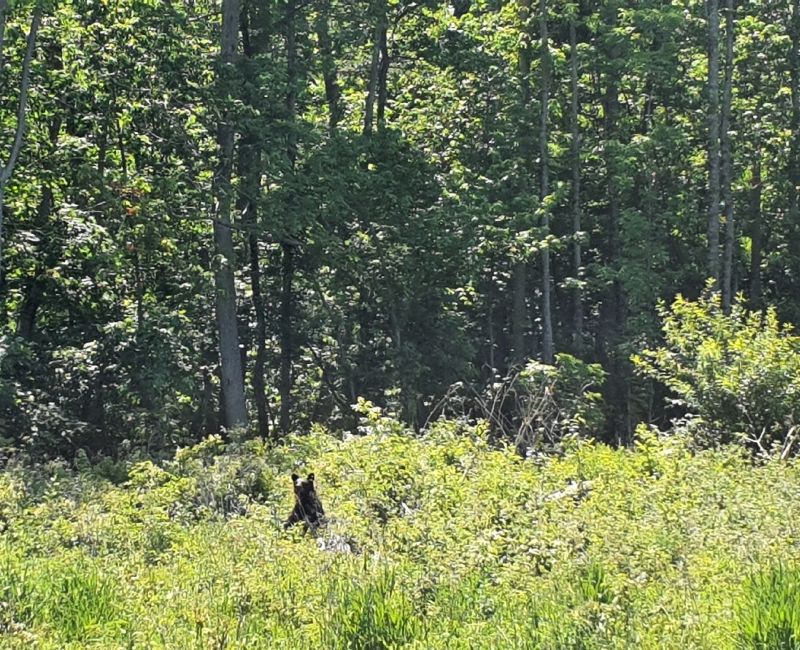
The goal of the project was to increase habitat for shrubland birds of conservation concern such as ruffed grouse, chestnut-sided warbler, and eastern towhee with sustainable forestry practices. Shrubland bird habitat was expanded by a partial harvest that created gaps in the tree canopy where diverse shrubs and saplings are now thriving. A less dense forest with a more variable age structure and diverse trees is also believed to be more resilient to future disturbances including climate change.
Site Location
North Brookfield, Massachusetts
Elm Hill Wildlife Sanctuary consists of a cluster of drumlin hills topped by fields that offer sweeping views over the surrounding forests. It is fully covered by an Agricultural Preservation Restriction, which requires at least some harvesting.
42.228486
-72.080419
From Route 9 / W. Main Street in Brookfield, continue East onto Main Street, then turn North onto Route 148 / N Brookfield Road. Continue North until you get to Buxton Hill Road where you can park at the gate to Elm Hill Wildlife Sanctuary.
This wildlife sanctuary is not open to the public. To arrange a visit of the project site such as a field trip for a university class or for a professional conference, please contact Tom Lautzenheiser tlautzenheiser@massaudubon.org.
Mass Audubon
+1 781-259-9500
Stand Information
80 acres (32 hectares) – see Stand 1 on accompanying maps.
Transition Hardwoods
Oak-Hickory Forest
Stand 1 is a mature transition hardwood forest (Northeast Dry-Mesic Oak-Hickory forest and Red oak-Northern hardwood forest). The tree species composition is diverse including both long-lived early successional species such as various oaks and late successional species such as hickories and maples, but the forest had little structural diversity prior to the partial harvest reported here.
deer
,
,
chestnut blight
emerald ash borer
The soils are classified as freely-drained Inceptisols. The soil texture is an extremely stony fine sandy loam. The soil water holding capacity is around 20 cm in the top 150 cm of soil. The soil has a pH that is in the range between 5.1 and 5.4.
Chestnut sprouts attest to the forests age predating the spread of chestnut blight over a century ago. The 1830’s Massachusetts land use/land cover map indicates the area of stand 1 as having been forested at that time.
Pre-treatment Conditions
The site index for red oak, the dominant canopy tree species, is 62 feet (19 m).
The management history prior to Mass Audubon’s acquisition of the property in 1996 is unknown. Although the site may have been forested continuously for the last two centuries, it has no doubt been subject to multiple harvests over that time, as indicated by an absence of 200-year old trees.
Quercus (Quercus rubra, Quercus velutina, Quercus alba): 58% Acer (Acer saccharum, Acer rubrum): n/a Fraxinus americana: n/a
Greater than 80% canopy closure; few canopy gaps occurred
The forest canopy was in good health, but nonnative plants had invaded along the field edges on the southwestern corner of the stand.
Silviculture Prescription
Over 80% of the project area had a closed canopy of relatively uniformly aged mature trees. The associated lack of light in the understory in combination with relatively severe browsing by deer prevented the development of tree seedlings and shrubs in the understory. Dense patches of shrubs in canopy gaps provide safe nesting sites for ground and shrub layer nesting birds such as ovenbird and wood thrush, respectively, as well as ample berries for wildlife such as black bears. Forests with multiple vegetation layers and diverse trees not only support a greater diversity of birds but are also more productive and resilient to disturbances. A partial harvest of canopy trees created canopy gaps that allowed a thriving shrub layer to develop and diverse tree species to regenerate. The existence of more open habitats in adjacent and nearby fields provides synergies for species that thrive in a range of early successional and semi-open habitats.
The silvicultural objective was for a sustainably implemented partial harvest that improves habitat for birds of shrublands and young forests. Sustainability goals included avoiding impacts to the small streams and vernal pools embedded within this upland forest, restricting harvest operations to frozen ground conditions, and retaining the healthiest trees of species that are likely to thrive under future climate conditions. Indeed, canopy gap sizes were designed to favor recruitment of diverse trees including oaks which are well-adapted to a warmer future climate. Prevention of nonnative plant invasion by controlling the previously existing populations around the edges of the site before the harvest and controlling any individuals that recruit from the seedbank in the canopy gaps post-harvest was integral to the silvicultural objectives.
The project's main goal is to demonstrate sustainable forestry practices that increase wildlife habitat value, particularly for shrubland birds of conservation concern.
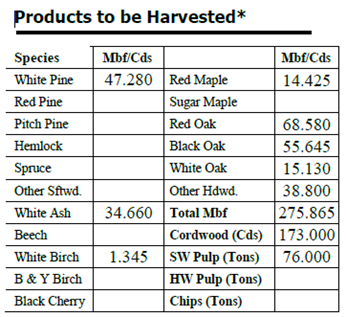
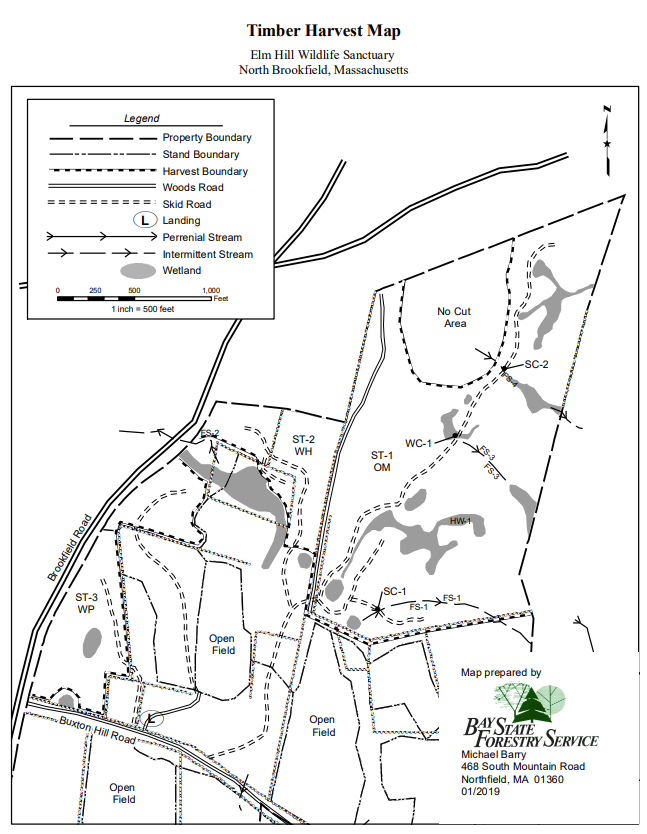
Please refer to ST-1 on the timber harvest map below and the summarized cutting plan for the shelterwood harvest in the attached table below.
The primary regeneration goal was to promote the recruitment of tree species that are well adapted to a warmer future climate, particularly a variety of oaks, which also benefit wildlife. Before the treatment, oaks occurred mainly in the forest canopy due to a lack of canopy gaps with sufficient light for regeneration. Invasion of canopy gaps by lianas such as grape and bittersweet as well as by a variety of nonnative shrubs was a risk of opening the canopy because invasion could interfere with regeneration of desired trees and diminish habitat value. A key goal was to mitigate the risk of invasion by controlling nonnative plants where they occurred prior to the harvest and subsequently.
irregular shelterwood
- invasive species
- climate change
- wildlife habitat
Prior to the harvest, Stand 1 was already dominated by trees that are well adapted to a warmer climate such as oaks, hickories, and maples. The shelterwood harvest method was selected because it both created patches of shrubland bird habitat and can promote the regeneration of oaks. The harvest plan also targeted trees that are less well adapted to future conditions such as eastern white pine and white birch, while it favored retention of diverse oak species. (See more considerations in the forestadaptation.org link below.)
The primary equipment used was grapple skidders and feller-bunchers.
The harvest generated more revenue than expected but the need for nonnative plant control, particularly around the nearby fields, was also greater than expected. The surplus revenues were invested in nonnative plant control consistent with Mass Audubon’s status as a not-for-profit and with the project goal of enhancing shrubland bird habitat.
Post-treatment
yes
yes
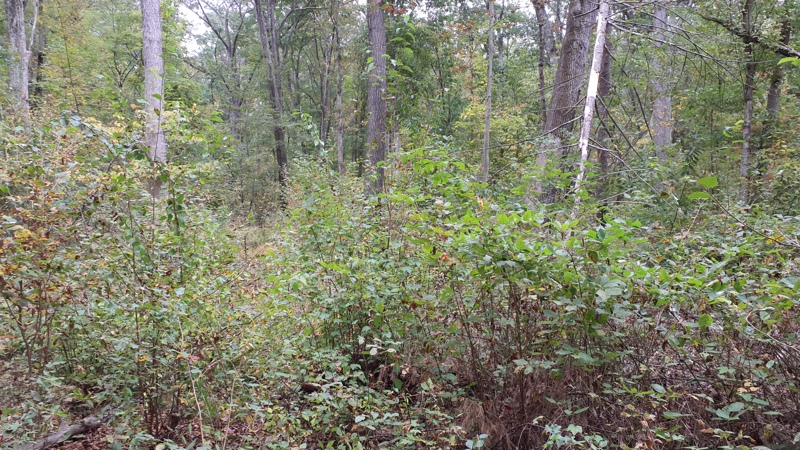
Dense native shrubs such as blackberries, raspberries, blueberries, mapleleaf viburnum, hophornbeam, musclewood, and hazelnuts have filled canopy gaps, which has created high quality habitat for shrubland birds and wildlife that feeds on berries. The abundant regeneration in canopy gaps includes diverse tree seedlings such as red maple, white ash, red oak, white oak, black oak, bitternut hickory, shagbark hickory, black cherry, and sugar maple. It remains to be seen which of these species will dominate when a closed canopy is re-established. In the immediate future, there will be follow up control of nonnative plants such as multiflora rose and round-leaved bittersweet that have recruited in small numbers from the seedbank that existed in the southwestern corner of the stand.
The ground was insufficiently frozen to implement harvest activities the first time that harvest equipment was mobilized onto the site in the winter of 2019-2020. With more favorable weather in January-February 2021, the tree harvest was completed in only a few days by several large grapple skidders and feller bunchers.
Mass Audubon will continue to monitor the regeneration in the stand.
Miscellaneous
In 2025, Mass Audubon organized a deer hunt for the first time at Elm Hill. The purpose of deer hunting is to reduce the severity of browsing on the shrub layer and support growth of desirable tree seedlings such as oaks. The plan is to continue to hold an organized deer hunt annually.
Transition hardwood forest, sustainable forestry practices, shrubland birds
no
Statistics
116
84
feet squared per acre
Contact Information
Tom Lautzenheiser
Senior Conservation Ecologist
Mass Audubon
Supplementary Content