Secondary tabs
Submission information
| Study Title | U.S. Fish and Wildlife Service and University of Vermont: Nulhegan Basin, Silvio O. Conte National Fish and Wildlife Refuge |
|---|---|
| Case Study Type | Forest type, Forest health, Management type |
| Management Subcategory | forest adaptation, wildlife habitat |
| Site Photo |
|
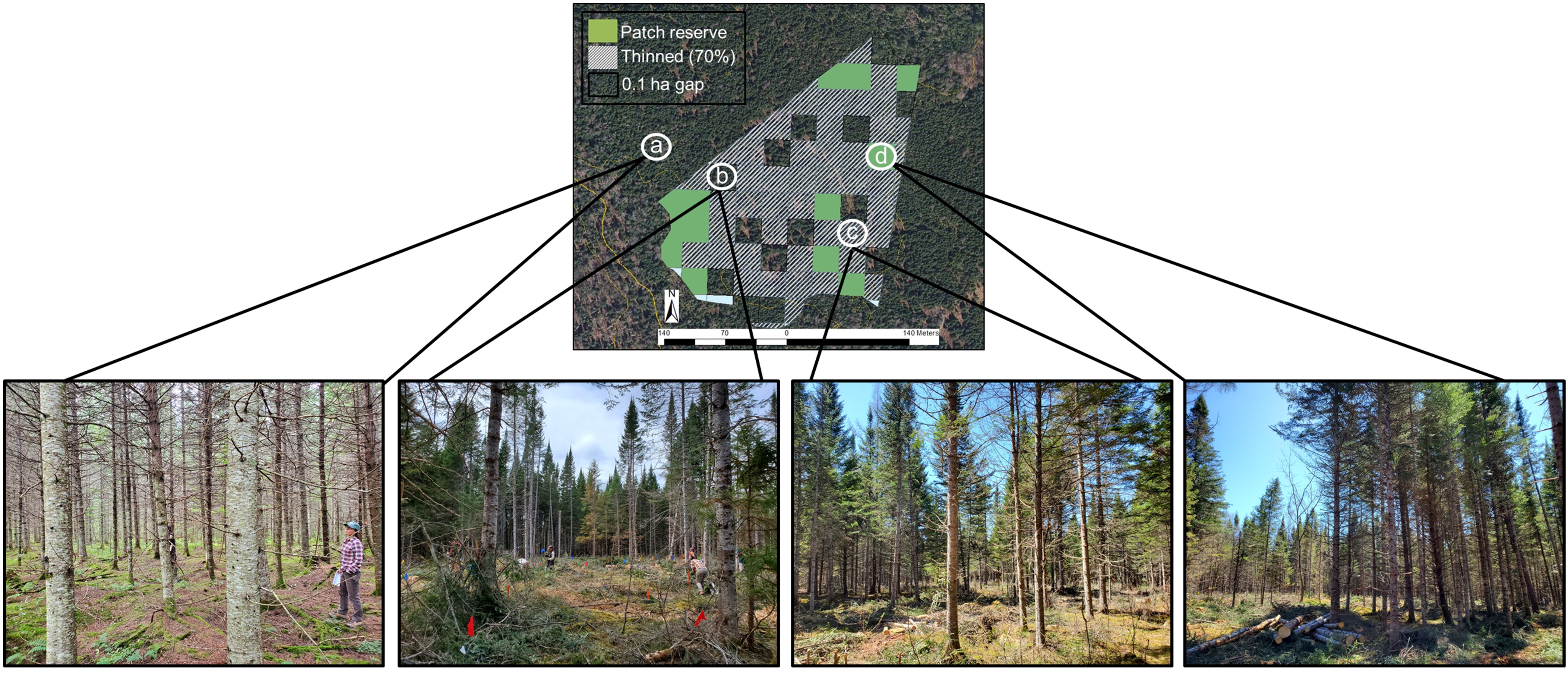
| Image caption | Site map with treatment images. Treatments shown from left to right: No harvest control; Variable density thinning gap, thinned matrix, and patch reserve. (Image: Tony D'Amato) |
| Lay Summary | A variety of adaptation treatments were implemented at this site within the Silvio O. Conte National Fish and Wildlife Refuge, and are being monitored by researchers with the University of Vermont. The treatments are designed to test various approaches intended to increase structural complexity and species diversity within the forest, with the ultimate goal of improving habitat for specific wildlife species and forest adaptation to a changing climate. |
| Location | Brighton, Vermont |
| Location Description | Nulhegan Basin Division of the Silvio O. Conte National Fish and Wildlife Refuge |
| Latitude | 44.820102 |
| Longitude | -71.721658 |
| Directions | From Brighton, VT travel east on VT Route 105 approximately 12 miles to Stone Dam Road. Turn north on Stone Dam Road and follow for 4 miles. Continue on Canal Road for an additional mile. |
| Accessibility | Seasonal access by vehicle; year-round access by foot. |
| Landowner Name | United State Fish and Wildlife Service |
| Landowner phone | +1 802-962-5240 |
| Landowner email | jeremy_goetz@fws.gov |
| Stand Area with Units | 550 acres |
| Cover Type | Spruce-fir |
| Plant Community/Habitat Class Growth Stage | Depending upon the past harvest intensity, portions of the forest are in: stem exclusion, understory reintiation, and stand initiation. |
| Primary Pests/Disease | spruce budworm |
| Secondary Pests/Disease | balsam woolly adelgid |
| Soils | Hydric, Tunbridge-Dixfield-Wilmington complex; Cabot-silt loam |
| Estimated Stand Year Origin | 1980 |
| Site Index with Units | 3 |
| Start date | Fri, 12/10/2021 - 00:00 |
| End date | Thu, 03/10/2022 - 00:00 |
| Stand History | This stand initiated after a widespread spruce budworm salvage harvest between approximately 1975 and 1985 by St. Regis Paper and Pulp and Champion International. |
| Species 1 | Abies balsamea (balsam fir) |
| Species 1 Percent(%) | 50% |
| Species 2 | Picea rubens (red spruce) |
| Species 2 Percent(%) | 25% |
| Species 3 | Acer rubrum (red maple) |
| Species 3 Percent(%) | 25% |
| Pre-Treatment Growth Stocking | Overstory basal area ranged from 95-175 ft2/ac and averaged 133 ft2/ac |
| Pre-Treatment Forest Health Issues | hymenomycetes |
| Case Overview | A variety of adaptation treatments were implemented at this site within the Silvio O. Conte National Fish and Wildlife Refuge, and are being monitored by researchers with the University of Vermont. The treatments are designed to test various approaches intended to increase structural complexity and species diversity within the forest, with the ultimate goal of improving habitat for specific wildlife species. |
| Silviculture Objectives | Promote diverse age classes; Maintain and restore a diversity of native species; Retain biological legacies like dead downed wood and standing snags; Improve vertical and horizontal canopy structure; Reduce impacts to soils and nutrient cycling; Protect, favor, and restore native species that are expected to be adapted to future conditions. |
| Landowner Objectives | Specific management goals for the project area include: Improve vertical and horizontal canopy diversity; improve tree species diversity in both overstory and understory; increase desirable species such as red spruce, white pine, northern white-cedar; reduce the preponderance of balsam fir; increase structural complexity (including downed woody material, tip-up mounds, and legacy trees); and create a greater diversity of wildlife habitat. |
| Silviculture Prescription | 3 research treatments were applied: 1) Patch cuts (3 acres in size) with approximately 10% of the existing overstory left as reserves. 8-10 trees per acre were felled or tipped and left for downed dead wood. 2) Variable density thinning with 20% of the stand area in gaps approximately ¼-1/2 acre in size, 20% of stand in skips approximately ¼-1/2 acre in size, and 60% of stand thinned to approximately 120 sqft of basal area. Retention was left in gaps. 8-10 trees per acre were felled or tipped and left for downed dead wood. 3) No harvest controls. |
| Regeneration Targets/Goals | Regeneration goals are focused on promoting future adapted species like white pine, red spruce, northern white-cedar while reducing balsam fir. |
| Regeneration Method | Variable density thinning and clearcut |
| Factors Influencing Prescription Choice |
|
| Climate Adaptation Considerations | The prescription was developed in part by following the Adaptation Workbook as part of the NIACS Climate Change Response Framework. Learn more at the link below. |
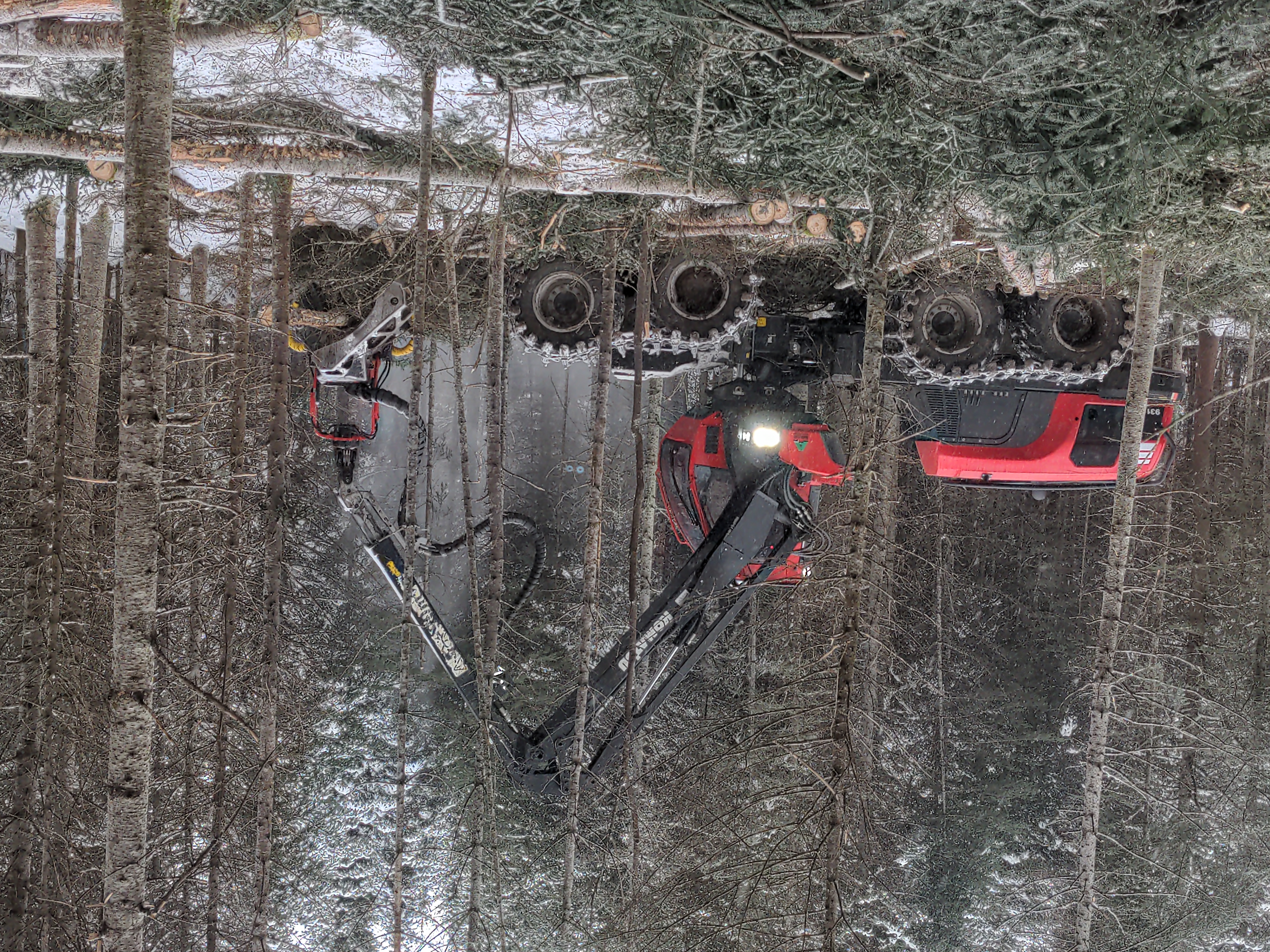
| Equipment used | Komatsu dangle-head processor; TimberPro TF830 forwarder |
| Prescription Notes | The harvest was largely uneventful, though the hydric soils did pose some challenges with rutting in places due to the large forwarder used. Temperatures remained below freezing during harvest for the most part. |
| Additional Resources / External Links | https://forestadaptation.org/adapt/usfws-nulhegan-basin |
| Post-Treatment Assessment Done | yes |
| Post-Treatment Assessment Expected | yes |
| Post-Treatment Assessment | Patch clearcut units averaged 64 ft2/ac at the treatment level, with patches averaging 31 ft2/ac and unharvested areas around patches averaging 112 ft2/ac. Variable density thinning units averaged 86 ft2/ac at the treatment level, with unharvested skips averaging 110 ft2/ac, thinned matrix areas averaging 94 ft2/ac, and gaps averaging 39 ft2/ac. |
| Post Harvest Regeneration Monitoring Data | Planting seedling survival ranged from 46-88% over the first three years with highest rates of survival for containerized red spruce planting stock (76-88% survival depending on the source). |
| Future Treatment Plans | Future treatment plans include long-term research and monitoring. No future entries are proposed. |
| General Notes | Basal Area Pre Harvest: 95-175 ft2/ac (averaged 133 ft2/ac); Basal Area Post Harvest: Patch clearcut units averaged 64 ft2/ac at the treatment level, with patches averaging 31 ft2/ac and unharvested areas around patches averaging 112 ft2/ac. Variable density thinning units averaged 86 ft2/ac at the treatment level, with unharvested skips averaging 110 ft2/ac, thinned matrix areas averaging 94 ft2/ac, and gaps averaging 39 ft2/ac. |
| Keyword(s) | Spruce, fir, adaptation, climate, silviculture, research, variable density thinning, Canada warbler, US Fish and Wildlife |
| Data Available? | no |
| Basal Area Pre-Harvest | 133 |
| Basal Area Units |
|
| Primary Contact | Jeremy Goetz |
| Contact Title | Forester |
| Contact Organization | U.S. Fish and Wildlife Service |
| Contact Email | jeremy_goetz@fws.gov |
| Contact Phone | +1 802-962-5240 |
| Contact Address | Silvio O. Conte National Fish and Wildlife Refuge – Nulhegan Basin Division 5396 Route 105 Brunswick, Vermont. 05905 |
| Additional Photo 1 |
|
| Additional Photo 2 |
|
| Additional Photo 3 |
|