Miles to Go
March 9, 2025
After 41 years, Paul Jarris has reached the border again. “I’m just going to touch this marker,” Jarris says, and slides one ski slowly over the snow toward a stone block that marks the line between the United States and Canada. “I’ll be good. But I’ve got my passport just in case,” he says, a hint of a smile showing under his mostly gray mustache. His ski buddy, Ben Rose, steps back, laughing. Jarris’s red boot stops at the northernmost edge of Vermont—the final inches of 320 miles of backcountry skiing. Did the tip of his long ski lift into airspace claimed by Quebec? Even the camouflaged security camera, just feet behind him, probably couldn’t tell. Its lidless lenses all point south.
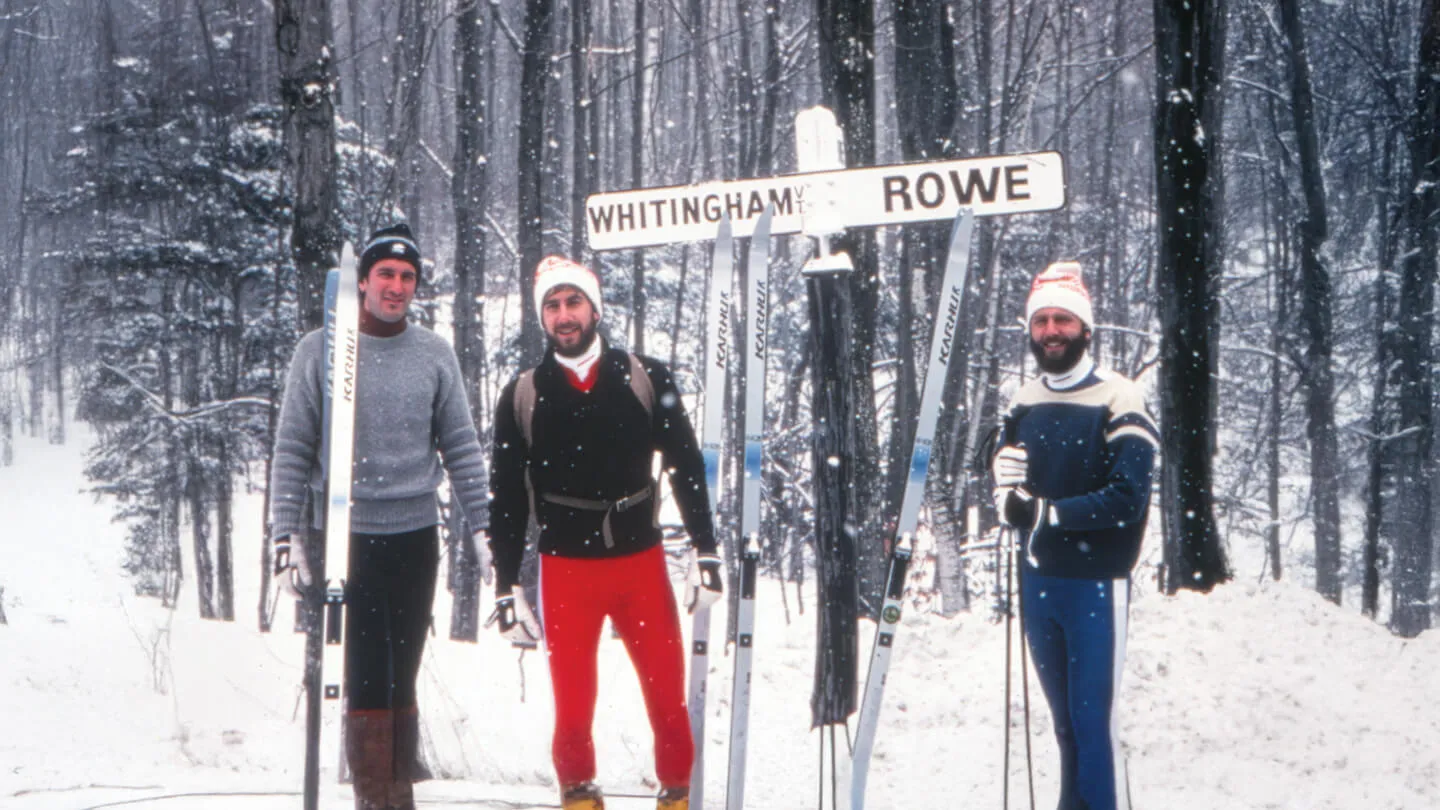
On March 1st of 1984, Jarris, Rose, and their pal, Steve Bushey, stood on another border and all pointed north. They had gotten it into their heads to see if they could ski from Massachusetts to Canada, winding their way up the spine of Vermont’s Green Mountains. Pushing off, south of Harriman Reservoir, clad in one-piece, red-white-and-blue Gordini ski-suits (ah, the 80s) these twenty-something dreamers began a successful, self-directed, three-week ski adventure that led them from inn to inn, through forests and farm fields, along logging roads and snowmobile routes, until they passed Jay, Vt., and tried to explain themselves to a befuddled border agent in the middle of an ice storm.
Along the way, they also launched the 320-mile Catamount Trail, North America’s longest backcountry skiing trail.
Jarris had graduated from UVM in 1980 and was then a medical student at Penn. His UVM adventure-buddy, Steve Bushey, had graduated with a degree in geography the next year. And Bushey’s friend from their days at Champlain Valley Union High School, Ben Rose, had graduated from Yale in 1982. (He completed a master’s degree at UVM in 1990). As undergraduates, they’d skied with sleds into Maine’s remote Baxter State Park and summited Mount Katahdin in the dead of winter. Bushey and Rose had ridden their bikes together across the United States in 1981. Out of money, Bushey took a job as a chimney sweep back in Vermont.
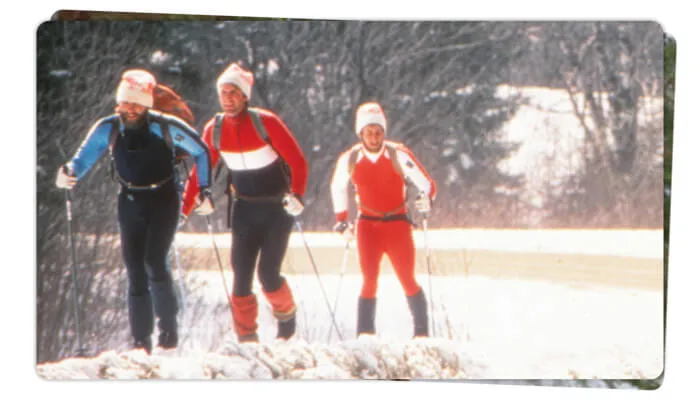
“In October, I was working at a house in Charlotte, and you could see from Camel’s Hump down through the Monroe Skyline, and it was all covered in beautiful snow. And I thought, ‘gosh, I’m broke, but here’s a trip staring me in the face. I can ski from Canada to Massachusetts. I just have to figure it out.’” He spent two years scouring maps, scouting sections, and completing a master’s thesis at Carleton University in Ottawa that laid out a route and rationale for the trail. They gathered equipment, lined up local businesses as sponsors, called newspaper editors, and made the case for free room and board to innkeepers (in the way that only penniless college grads with a good idea can). And then the three friends started skiing north. “A lot of it was pure orienteering,” Jarris recalls. “Sometimes we had no idea where to go.”
Four decades later, under the umbrella of the Catamount Trail Association that they founded (Rose was its first director, at $75 per week), hundreds of landowners, innkeepers, state officials, local “trail chiefs,” cross-country-ski-area staff, and volunteers have built a winding, snowy wonder, a winter-only backcountry passage, divided into 31 sections, stretching the full length of Vermont. It roughly follows the route of its more-famous older cousin, the Long Trail. Sometimes they crisscross, as the hiking trail runs along the top of ridges and over mountaintops, while the ski trail winds through sheltered, skiable mid-elevation terrain—allowing some 12,000 people each year to get out for an hour or a weekend of skiing, traveling under their own power, in quiet woods, lovely, dark and deep.
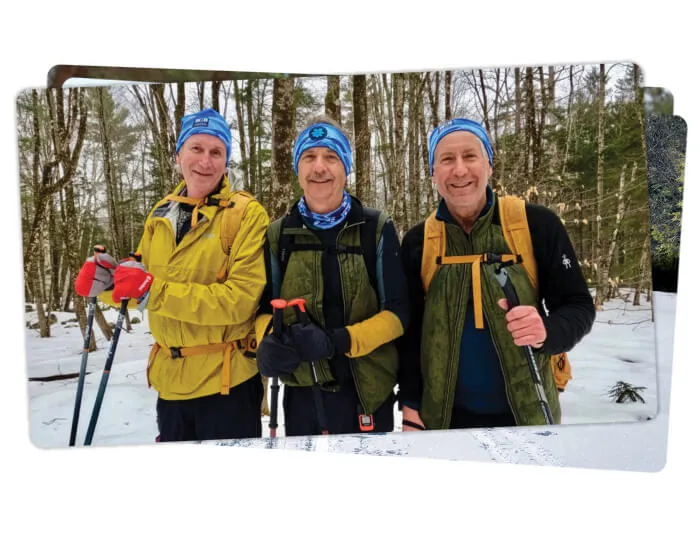
A few set out to repeat the founders’ journey and ski the whole trail. I aspire to be one of them, but on this gray March afternoon I have a broken ski pole, a broken thumb, and have only covered 93 miles of the trail over 11 scattered day-trips—while Jarris and Rose have just finished their second complete end-to-end run. They began in 2024 and skied for 24 days, about two-thirds of the trail, until the spring snow ran out when they neared Bolton, Vt. So, their 40th anniversary tour, the Ruby Run, as they styled it, become the Ruby Run Redux in 2025—a 100-mile, nine-day trip from Trapp Family Lodge to the border. (Sadly, Steve Bushey hurt his knee on the first day and will have to wait to complete his second tour another year.) Organized by the Catamount Trail Association, they invited anyone to come along for a few miles or the whole adventure, so I’ve joined them for a couple of days, including this joyous, final 13-mile ski, along the flank of Jay Peak, that ends with a champagne toast in Dixie cups.
Earlier in the day, we slabbed up from Jay Pass in falling snow and through soaring birch glades with a pack of 13 other Ruby Run participants and friends. Two wore pink and purple tutus, the rest more sober Gore-Tex. A few inches of new powder swirled over a firm base, with blown-off portions and hidden drifts. It made for beautiful skiing through the wide-spread trees. “Every time I see one of the blue Catamount Trail signs, it’s a drip of happiness,” Rose said. One rolling steep glade called out for some telemark turns, so I left the trail and caromed off a rise, my own drip of happiness, gracefully airborne in the falling flakes. A few people on the trail did, unfortunately, see the landing: ski tips disappeared into a drift, then I followed, headfirst, like a Navy diver, falling on my pole and snapping it. Spluttering to the surface, my glasses, ears, and camera were full of snow. I already had a broken thumb. (The week before, skiing with the Ruby Run gang on Elmore Mountain, I had, again, gone off-trail and smacked a branch—it didn’t hurt much. “A tiny fracture,” the urgent-care doctor reported the next day.) This time, the only bruise was on my ego, which recovered with help from proffered chocolate and a spare pole that two members of the tour, Catamount Trail veterans Michelle and Bob Brandt, carry for such an occasion.
At six miles, we stopped for lunch at the Jay Country Store. Some of the skiers went in, venturing past two carved bears, for coffee and burgers. I bought a roll of Gorilla tape to fix my pole. It worked about as well as a banana, my “repair” getting softer with each passing mile of the scrappy, bumpy, sprucey, semi-boggy woods that lead through North Troy, Vt., to the border. The pace rapidly accelerated by mid-afternoon. At one tea break, Ben Rose was gone before the cookies. “He can smell the border,” said Paul Jarris. And I can believe it. These guys first completed this trip as youngsters, driven by a multi-year dream of getting here. An older and wiser version of the dream drove them to try it again, but Ben’s now a retired grandad to three toddlers and, after he’s done with this day, must go help with dinner and diapers.
February 15, 2025
It’s 13 degrees Fahrenheit, and the sun is entirely obscured behind steely clouds on this fourth day of my exploration of the Catamount Trail. It’s writer Bill McKibben’s 78th day of skiing this year. He completed an end-to-end ski 37 years ago with his friend, the late renowned Vermont cartoonist Ed Koren, and has agreed to show me a favorite nine-mile section of the trail near his home in Ripton, Vt. Having previously seen him in comfy vests and collared shirts, I’m surprised when he strides from his house—built on land once owned by Robert Frost—decked out in racer’s Lycra and clicks his boots into a pair of super-skinny, waxed Nordic skis. I quickly ditch my heavy backcountry boots and steel-edged skis for light kick-and-glide gear and take off after him. Despite slippery, hard-pack conditions, we’re climbing and diving along a frozen track at a delightfully fast clip. Soon a view of the main line of the Green Mountains opens through the trees. It’s nothing but forest and snow. “That’s Breadloaf straight ahead of us,” he says. “I was through here in a snowstorm last week and you couldn’t see a thing.”
We come to the end of a windy and narrow section of trail and turn onto a wider track, a corridor shared by snowmobilers and skiers. “This is Fire Road 59, it’s a VAST trail,” McKibben says. “The Catamount goes with it for about half a mile that direction and then off into the woods.” While he stops to rub some more kick wax onto his skis, he points down the other way, in the direction we’ll be heading. In the 1930s, he explains, the federal government wanted to develop a tourist highway, just like Virginia’s Skyline Drive, along the spine of the Green Mountains. “This, right here, would have been a four-lane highway, with hotels and gas stations,” he says, gesturing with his ski. The state legislature had approved the project and was ready to start digging, but the citizens of Vermont put it to a vote on Town Meeting Day in March 1936—and rejected the job-creating Green Mountain Parkway, despite being in the depths of the Great Depression. “I think the Catamount Trail is one of Vermont’s real wonders,” McKibben says. “Unlike the Long Trail, which is mostly on government land, most of this trail is about people cooperating.”
Soon we’re double-poling at high speed, half-racing like two high school kids, down the snowmobile-packed road and then back into the forest. We stop on the brow of a hill near Middlebury College’s Rikert Outdoor Center, where, today, 400 college athletes are actually racing. It’s one of eight Nordic ski centers along the Catamount Trail where travelers can ski on machine-groomed tracks. I listen for roars and cheers, but all we can hear is the wind and some woodpeckers. “Normally this is a real beautiful sweep downhill, but today it’s icy and technical,” McKibben says. “If you get out of the track, it’s just going to be crash and burn.” I stay in the track and on top of my skis.

Right: Passing under a sap pipeline, a skier on the Catamount Trail benefits from Vermont's working forest, making tracks and maple syrup at the same time.
But I am thinking about burning. Earlier in our ski, McKibben—the author of, in 1989, The End of Nature, the first popular book on climate change—had reveled in this winter’s deep snows. “It’s incredible,” he said, reminiscing about being young in the Adirondacks, “when it was 20 below at night for two weeks, and we could hear the sap cracking in the trees.” This has been a cold winter in Vermont, “but it’s hot in the rest of the world,” he said.
“Do you feel like you’re at the end of something?” I asked him.
“Yeah,” he said, after a silence.
“There will still be a thing called skiing. We’ve already learned how to make snow. I don’t know if we’ll see any more winters like this,” he said, scanning his 64-year-old, kind-and-penetrating eyes across the quiet woods, lovely, dark with hemlock, and still-deep snow. “I have a ten-month-old grandson that we’ve been pulling in the pulk sled all winter, and it makes me sad to think about what’s coming for him,” McKibben said. Which helps explain why he wrote his newest book, his 21st, Here Comes the Sun: A Last Chance for the Climate and a Fresh Chance for Civilization. McKibben is not even remotely a Pollyanna about what may be in store, not just for Vermont winters, but for all of humanity under runaway, fossil-fuel-stoked climate change. And yet, he says, “solar and wind are now the cheapest power on the planet. They’re growing faster than any energy source in history. If we pick up the pace, we have a chance.”
We skitter and snowplow down a last terrifying hill and turn sharply to pass the site of what was, apparently, an old building. “In the 30s, there was a bar there, a roadhouse called the Wagon Wheel,” McKibben says. “Dancing and, mostly, fighting went on there.” Now all that’s left of the structure and human strife is an opening in the forest, closing, as Robert Frost wrote, “like a dent in dough.”
MARCH 13, 2025
One thing Kae Zaino—UVM Class of 2009—likes about winter camping is that she can bring cookies into her tent. “Because the bears are hibernating,” she explains, as we ski south on the Catamount Trail, through National Forest land, toward Blueberry Hill Inn and Outdoor Center in Goshen, Vt. Today she’s only got a small fanny pack, a rain jacket, and some wind pants she dug out of the “avalanche that is my car,” she says. She’s not wearing a hat or mittens either—it’s 40 degrees and we’re only going four miles on the last ribbons of snow that remain in the woods. But in February—on winter vacation from her job as a physical education teacher at Waitsfield Elementary School—she traveled north on the trail, for nine straight days, often in sub-zero windchill, sometimes carrying a pack, sometimes pulling a homemade sled. “You burn a lot of calories staying warm, so you often wake up hungry,” she says. Which is why, one night, sleeping alone in her tent near Zac Woods Pond, west of North Wolcott, Vt., she ate “about a third” of a boxful of cookies. And, because she is a Girl Scout troop leader, the cookies were Thin Mints.
I saw some frosty-looking photos of Zaino’s adventure on her blog, “Camping, Climbing, Chaos”—a wide-ranging site including “an honest narrative on navigating life after recurrent pregnancy loss.” One photo showed her skiing alone, encrusted in ice, on the Bolton-to-Trapp’s tour, a remote and rugged trail from Bolton Mountain to Trapp Family Lodge. So I messaged her to see if she’d tell me more. Where had her urge to sleep in the snow come from? As we thread down a gentle hill toward Widow’s Meadow, along a line of snow no wider than a toboggan, she provides an answer: the UVM Outing Club. “I never would’ve winter camped if I hadn’t done Outing Club trips when I was a student,” she says. “They made me think, ‘oh, this is a reasonable thing to do,’” she says, pausing. “I’m not sure it is,” she says, now laughing, but, in either case, soon she’d become a self-described “Catamount Trail groupie.”
In February she aimed to get to Canada, camping, and pulling her sled. Instead, she ended up sleeping on a lot of friends’ couches, hitchhiking into town, ditching her sled, ending at Jay Peak, and having other “encounters with reality,” she says. “It was all great. Some of it was Type II fun, some of it was just fun.” Turning off the Catamount Trail, at Widow’s Meadow parking lot, we haven’t reached Blueberry Hill Inn. I know they have amazing chocolate chip cookies there, having eaten one earlier this year. Sometime, I’d like to stay in one of their famously hospitable rooms after a day of skiing, but I’ll have to save that trip for another year. Two days after the Ruby Run ski to the U.S./Canada border, I saw a hand specialist. My “tiny fracture” turned out to be a ruptured ligament. I’ll need thumb surgery and a Kevlar patch next week. At first, I was disappointed that I wouldn’t be able to even try to finish the trail in 2025—but Zaino has reminded me that navigating, not arriving, is the best cookie.
The evening is arriving as we toss our boots, poles, and sweaty jackets in the back of Zaino’s station wagon. I’m thinking about another day trip: A few weeks ago, Ben Rose and I were skiing slowly over a glittering meadow in impossible sunshine, discussing old-man baseball and the prospects of his squad, the Williston Armadillos. “I’m about the 13th best Armadillo,” he estimated. Our ski tracks were white lines on a white sheet, disappearing in both directions, thin reminders that our trip, and the whole Catamount Trail, is a delicate thread held together by generous landowners and cold air. “Last year, this Ruby Run trip seemed important, a conversation starter about climate change, and saving winter, and the importance of wild landscapes,” Rose said, after a career engaged with conservation and outdoor recreation, including a decade as the director of the Green Mountain Club. “This year, it seems indulgent in light of the global political dumpster fire. Maybe I should be out protesting, instead of skiing.” He’s wrong, of course. Going out into the still-frozen woods, gliding over snow, huffing up hills, bombing down chutes, pausing to hear the easy winds and downy flakes, watching where bobcat prints cross your path, looking down into a snug valley filled with homes and hopes is not indulgent. It’s an encounter with reality.