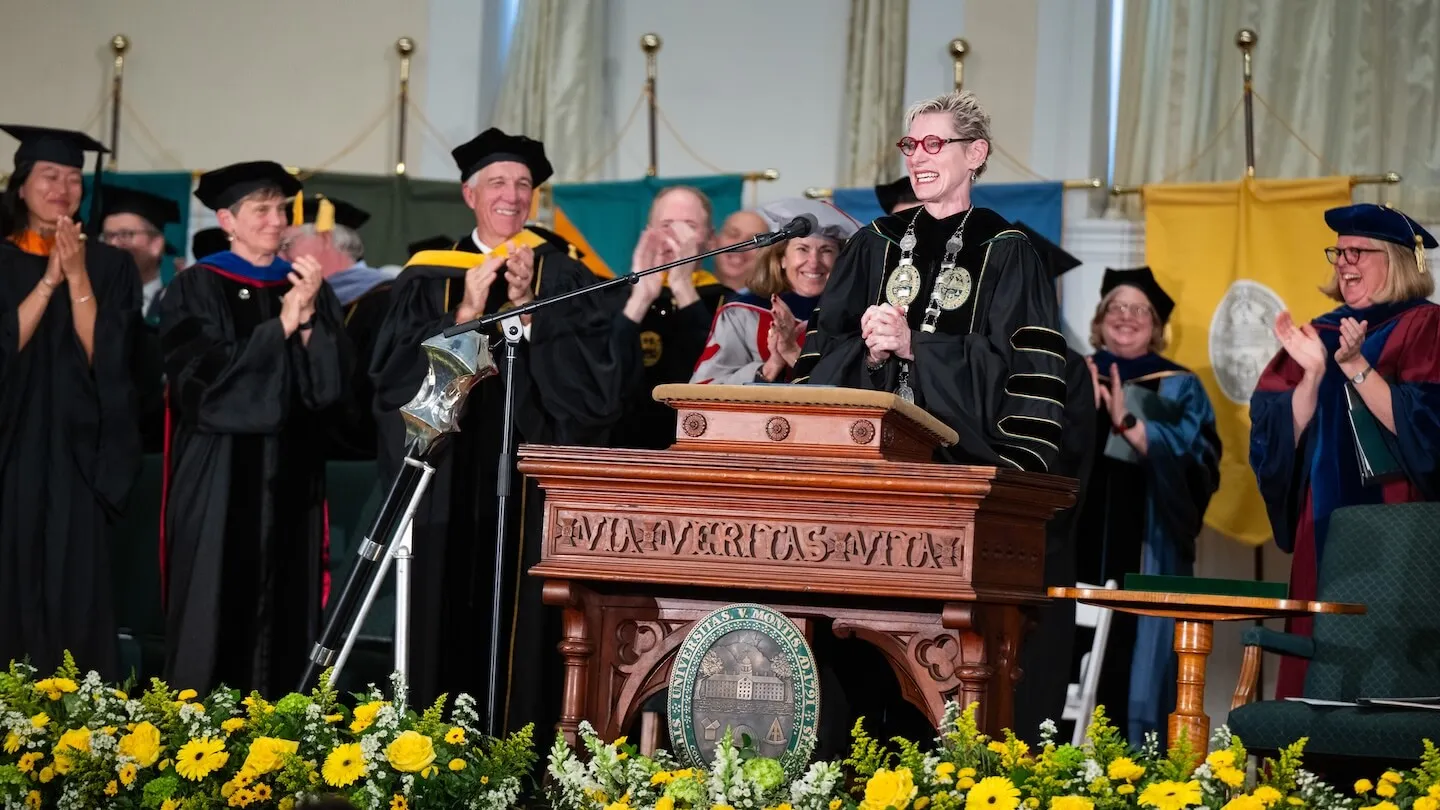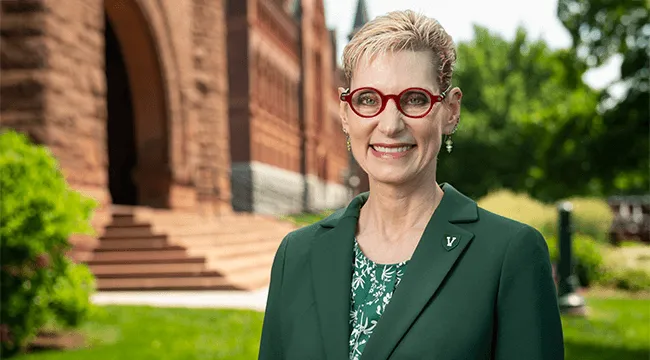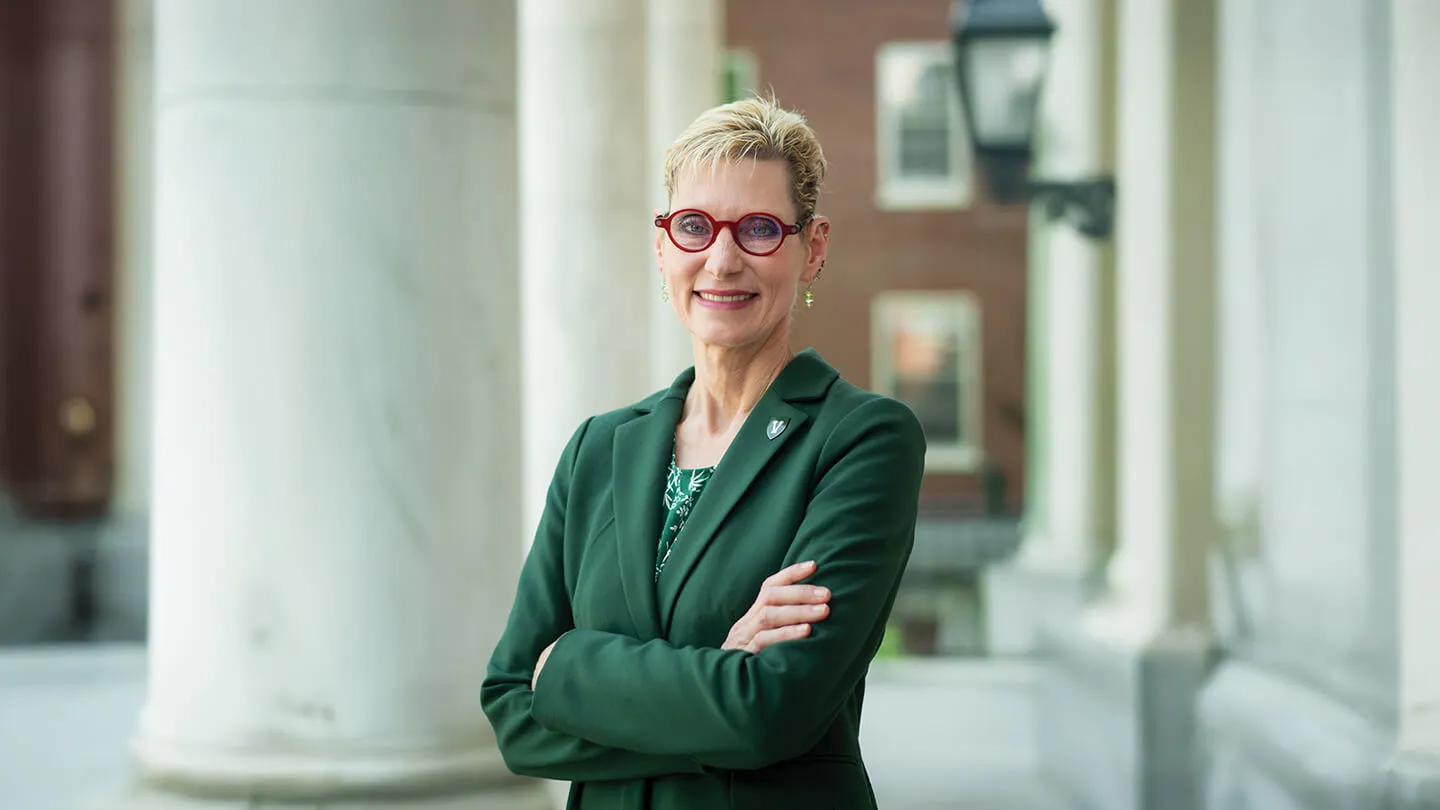
As she begins her tenure as the leader of the University of Vermont, Marlene Tromp has big goals for UVM, an institution she feels “has the power to truly lead the nation and even the world on several fronts.” But to get a deeper feeling for where that expansive vision comes from, it helps to look at the small place under a big sky–the town of Green River, Wyo.–where UVM’s 28th president was formed.
Set about a third of the way along the banks of its namesake waterway, the chief tributary of the mighty Colorado, Green River began in the 1860s as a division point and watering station for the steam locomotives of the nascent Transcontinental Railroad, and the rails have continued to define the town. Exit Interstate 80 today in your car and drive into Green River from the east side, and you’ll first pass over the expansive Union Pacific yards, a webbing of dozens of sidings. From that bridge over the railyards, the Green River basin stretches out, bounded by eroded limestone hills dotted with sagebrush and presided over by the towering Castle Rock, a classic western layer-cake butte.
Born in Ohio, Tromp moved to Green River as a young child. Her parents, Hans and Eileen, were drawn to the area, as were thousands of others, by a mining boom. Deep under those ancient hills around town was coal, and even deeper was something more precious: one of the world’s largest deposits of trona, the source mineral for sodium carbonate, an important component in the making of all modern glass. In the course of the decade from 1970 to 1980, the town tripled to a population of 12,000. Hans Tromp worked for years as a mechanic in the coal and trona mines of the region.
Marlene Tromp recalls the beauty of her little western hometown, but also its remoteness. “Nowadays, you can look at and order things online, but before the internet, if we wanted school clothes for the new school year, then we’d get in the car and drive three hours to Salt Lake City. Because the store we had in town was a mercantile–if you wanted a hammer, you had a place to get it, but not school clothes. Life was a little bit like Little House on the Prairie.”
School clothes were hard to come by in Green River, but good schooling was a different story. “I had awesome teachers,” Tromp says. “Sweetwater County was mineral rich, so it paid well to be a teacher there. I had some teachers who were Ph.D.s. The school district was superb, and I had a lot of really smart peers. But most people didn’t go to college.”
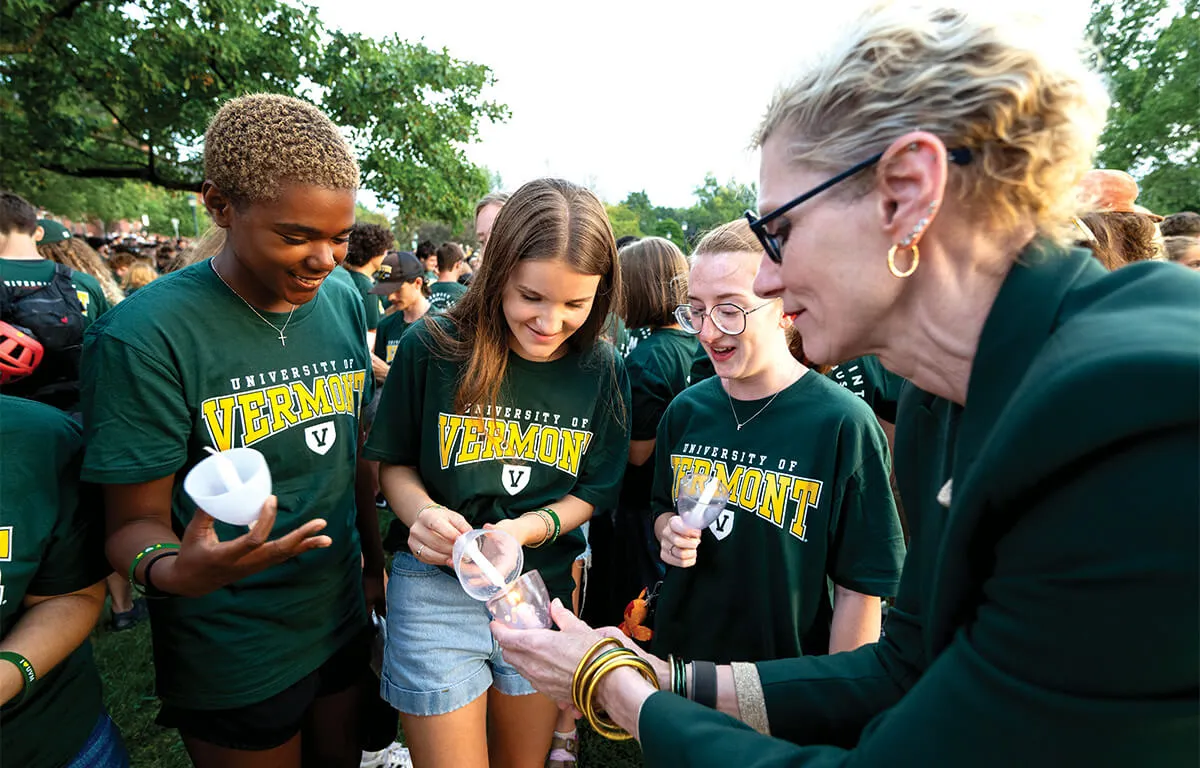
Tromp’s own path to college and advanced degrees was nearly diverted on more than one occasion, a common theme for first-generation students. “I know my dad always wished he’d had the chance to get a degree, and he definitely wanted that for my sister and I,” she says. “My mom had a little sewing room that began to fill with college catalogs that came after I’d done well on all the standardized tests. I had good grades, I ran track competitively, and I was president of many clubs–a really active student. But we just didn’t know what to do with all these catalogs and applications. Many of them had application fees of $80 or more. That was a lot of money for my family. My mom actually wept when she showed me this room. And I sat down in the middle of it and looked at all these beautiful catalogs with their gorgeous full-color pictures, and it was completely overwhelming.”
Luckily, a high school guidance counselor had taken notice of both young Marlene’s promise and her confusion. Near the beginning of her second semester of senior year, he called her in. “Marlene, I have great news for you,” he said. “I applied to seven schools for you. You got into all of them.” The counselor had paid the application fees himself.
“He pulled out this one particular letter, from a private liberal arts college, and he handed it to me. That school offered me a 100 percent free ride–tuition, housing, books, everything.”
That night, she excitedly showed her father the letter.
“Our family rule was that we didn’t speak to my dad about anything important until after dinner,” Tromp says. “I even remember what we were having that night: elk steak, which my dad himself had hunted.”
After dinner, she handed her father the letter. He read it and looked up. “No,” he said.
“He just could not believe it was real,” Tromp remembers. “And he said: ‘Honey, what happens if you get all the way across the country and this turns out not to be real, that it’s some scam to get some rural kid from way out in Wyoming all the way back there on the East Coast? And then you don’t have any of this and we’ll either have to get you home, or come up with the money to pay for this.’ He wouldn’t let me accept the scholarship. And I knew it was real, but I didn’t want to shame my dad. So I just didn’t apply to anyplace else.”
She made plans instead to go to Western Wyoming Community College, about 20 miles from home, for an associate degree. “One early summer day, our neighbor across the street, who had twins in my class, came marching over,” Tromp says. “She was a guidance counselor in the middle school. She pounded on the front door. I opened it, and she said, ‘I heard you’re going to Western Wyoming. You belong at a university.’ I said, ‘My dad won’t let me take the scholarship–it’s too far away.’ So she took out a Rand McNally atlas and a compass, and she put the pin in Green River, and drew a circle of the distance you could drive to-and-back in one day.”
And on the outer edge of that circle, in Omaha, was Creighton University.
Creighton accepted her, even though its formal application deadline had long since passed. “They actually had to call me on the phone to give me my acceptance–it was too late for me to get to orientation if they sent me a letter.”
Tromp’s father trusted Jesuit-affiliated Creighton to live up to its scholarship offer, and the school lay just within that crucial day’s-drive boundary. Marlene was on her way, following her plans to become as physician. That meant years of carrying a backpack filled with thick biology and chemistry textbooks across campus. But she also fed her humanistic side with courses in English literature. She was poised to submit her medical school applications when she took a literature course that exposed her to the poems of Robert Browning, particularly one of his dramatic monologues titled “Porphyria’s Lover,” a tale of obsessive, destructive love. The power of that poem haunted her. “It was like a psychological study–I was a psych minor–and I found it so interesting that literature could do such things,” she says.
I love being in Vermont...that independent spirit, the humility, the hard work, the earnestness, the values-driven way of thinking about the world around you. I feel truly lucky to be here.
Around the same time, she was tutoring a fellow student in calculus. “And he said to me, ‘Marlene, what do you want to do when you graduate? You’re so good at this, what do you think you want to do?’ And I said, ‘I don’t know. I just want to stay in college forever.’” It became clear that her heart lay in teaching and learning. She would stay in college, as a teacher and researcher.
The decision to switch from pre-med to English was not without its challenges. Chief among them: Hans Tromp’s reaction. “My dad said: ‘No, way! If you do that, I won’t give you another penny for college,’” she recalls. “And I know what he was trying to do. He was trying to save me from making what he thought was a terrible mistake–ruining my career, ruining my future.”
But it was clear to Tromp that she had to follow her passion. She persevered, and worked three jobs in addition to her studies to pay for her senior year at Creighton. From there it was on to the University of Wyoming for a master’s degree, followed by five years in a doctoral program at the University of Florida. Her doctoral thesis, “The Private Rod: Marital Violence, Sensation, and the Law in Victorian England,” would later be expanded into the first of her several books.
“I became really fascinated with this period of literature, that was about so much change,” she says. “It was about industrial change, changes in gender codes, massive cultural change, and how people were dealing with that change–partly by making stories.”
In the end, she became a different sort of doctor from the one her father had envisioned. “But I think my dad wound up being pretty proud of me,” she says.

Tromp spent 14 years at Dennison University in Ohio, where she rose to become chair and director of women’s studies and chair of the faculty. Teaching turned out to be as rewarding as she’d expected. “It was an opportunity for me to help other people experience the excitement and love of learning that I’d had,” she says. “I think what I always wanted was to be challenged intellectually and keep growing, and to help other people grow. And I pushed my students hard. I used to often have students say, ‘I know this class is going to ruin my GPA, but I know I’m still going to love it.’ I expected a lot from my students. I expected them to perform well, but I would stand alongside them to help them get there. And I kept pushing myself to figure out better ways to help them think and grow and learn.”
The chance to take on administrative duties left her questioning. “I really struggled, because I love my scholarship, and I love teaching,” she says. She talked to a close colleague and administrator. “I asked, is it worth it? Do you feel so far away from the students? And she said, ‘Well, you can either help hundreds of students, or tens of thousands–which would you rather do?’ That’s when I decided to become a full-time administrator.”
She moved to Arizona State University in 2011, where she was first director of the School of Humanities, Arts, and Cultural Studies, then vice provost of ASU’s West Campus, and finally dean of the New College of Interdisciplinary Arts and Sciences. “ASU, under its president, Michael Crow, is known as a hotbed of innovation,” she says. “I learned to not be held back by what other people have done before, or even what your own institution has done before, but to be open to the possibility of imagining new ways to do things better for your students, for your research, for your faculty, for your staff.”
That’s a lesson Michael Crow feels Tromp has absorbed in her bones. “The University of Vermont is gaining one of the most skilled individuals in helping to make an academic enterprise successful for the community, successful for the students, the staff, and the faculty committed to the core values of what academia is all about, yet at the same time working to innovate and move in new directions,” he says of Tromp.
Tromp has been a leader in higher education nationally, serving on the Association of Public and Land-Grant Universities board and the boards of the American Council on Education and National Collegiate Athletic Organization, as well as on the U.S. Council on Competitiveness.
Within her scholarly field, she’s held leadership positions at the Nineteenth-Century Studies Association and the North American Victorian Studies Association, serving as president of the latter from 2014 to 2017.
The work we are doing now will require enormous sisu, but it matters perhaps now more than ever.
“I still understand myself as a faculty member,” Tromp says. “My leadership in these professional organizations really allowed me to help us think in bigger and more broad ways, to ensure that we were operating as an inclusive organization, to ensure that we were thinking big about what we could do for our faculty membership all over the country, all over the world in many cases. NAVSA is the largest Victorian studies organization in the world. We did some bold things in that time in terms of thinking about how we reached our membership, how we invited our membership into dialogue, how we structured the organization so we could serve the faculty across the country, and serve independent scholars better.”
Tromp moved to the University of California, Santa Cruz in 2017, as campus provost and executive vice chancellor. Lorena Peñaloza, who was chief campus counsel of UCSC during Tromp’s tenure there, was “immediately struck by her energy, her sheer joy for life, and her blazing passion for students. Her commitment to students was evident from the start. Marlene was focused on meeting students exactly where they were, whether they were happy or unhappy with the administration.”
Two years later she was tapped by the search committee of Boise State University to be the seventh president of that institution, the largest four-year university in Idaho. BSU’s experience in the last few years was a sort of precursor to the current climate and challenges facing higher education institutions across the country. Tromp had to work with a state legislature that was often hostile to the notions of an inclusive academic community. She faced these headwinds straight on and pursued her commitment to supporting students and faculty, and broadening the university’s impact on the wider rural Idaho landscape, spearheading the Community Impact Program, bringing educational opportunities directly to rural students, and the Hometown Challenge, which connects graduates to career opportunities within their communities.
One such graduate is Chey Sheen, a 2023 BSU graduate who spoke at UVM during Tromp’s September 30 installation events. Sheen spoke about the difficulties of coming from a small Idaho city and finding her place in the university, especially during the rough waters of the pandemic and the politically fraught atmosphere in the state, and the value of having an institutional president who was there for the community. “She’s approachable, she’s warm, she’s so real. And that’s how she felt to us students,” Sheen said. Sheen even knew two students who got tattoos of Tromp’s distinctive eyeglasses “to show her ‘this is how much we love you.’”
Sheen at one point withdrew from BSU, but after talking to Tromp (who Zoom-called her with advice in the middle of the night when Sheen was traveling seven time zones away) she eventually returned to the school, and later became its student body president and a Truman Scholar. “The same care and attention Dr. Tromp gives to one person, she pours into an entire community,” Sheen said.
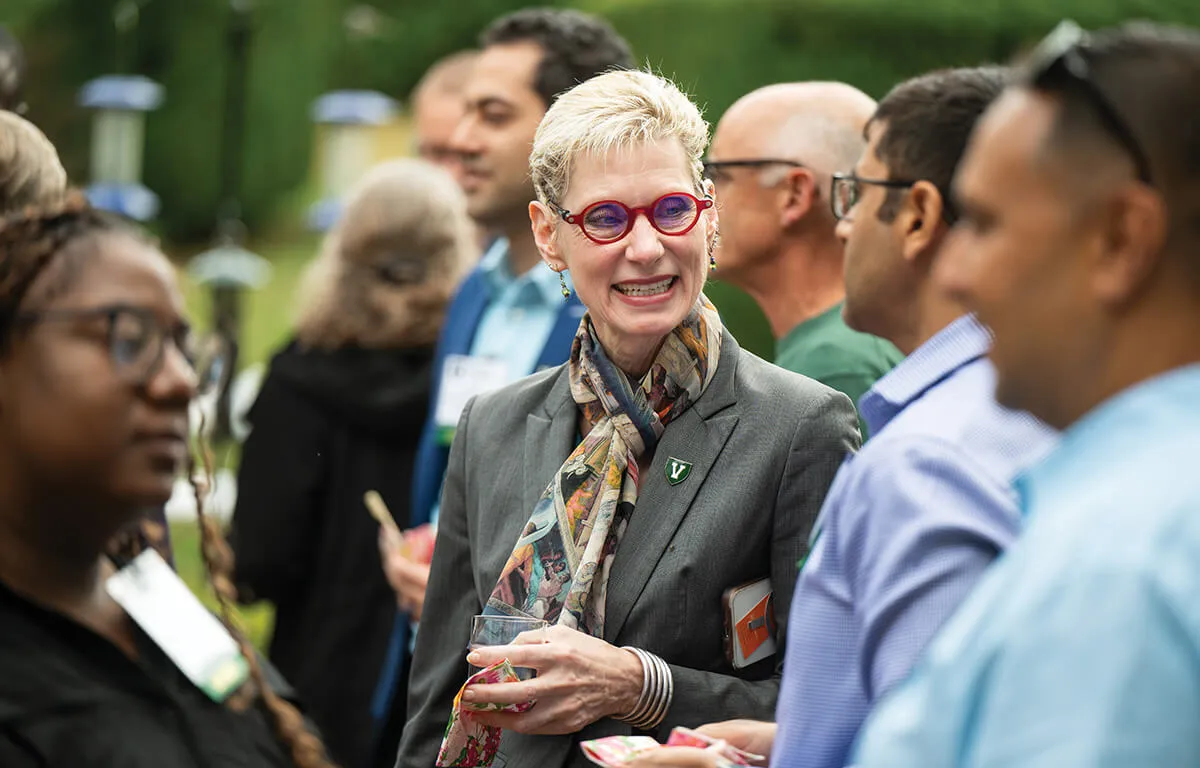
Tromp’s first few months on the UVM campus, as she and her son, Jacob, and other family members settled into life at Englesby House, have been a whirlwind of meetings—by design. “The very first thing I wanted to do was meet with the faculty senate and our staff council, our student government leadership, and our representative bodies,” she says. “And I’m very eager to meet with people who’ve partnered with the university to help us achieve excellence–our industry and nonprofit partners. I met with the mayor of Burlington, and I’ve met with donors who’ve given generously to the university to help it thrive.” In early October, she took part in her first White Coat Ceremony at the Larner College of Medicine, where this once-future-physician got to help the Larner Class of 2029 take their first symbolic step toward a medical career. “And I’d love to visit every student club eventually,” she says. “I want them to know I care about what they’re doing, and I care about their success.”
Most important, Tromp quickly initiated the collaborative process that will guide the university in its development of a new strategic plan–a process that has been fast-tracked to deliver by early in the spring semester of 2026. That effort and the hard work that will come after to realize the plan will need to be guided, Tromp says, by the spirit instilled in her by her Finnish American mother, Eileen, since Marlene was a little girl: the Finnish concept of sisu–defined by Tromp as “unflappable tenacity in the face of insurmountable odds.”
“The work we are doing now will require enormous sisu, but it matters perhaps now more than ever,” Tromp says.
“It’s exciting to me to again be at a land-grant institution,” she says. “And particularly significant to be here in Vermont, the home of Justin Morrill, the father of the land-grant movement–whose Senate desk is right in my office. This brilliant innovation of giving all people access to education and granting them the opportunity to bring their talents to the world transformed this country. It continues to hold out the brightest promise today, particularly when higher education and our nation are facing such real and profound challenges.”
“I love being in Vermont, and it resonates so powerfully for me, having grown up in Wyoming–that independent spirit, the humility, the hard work, the earnestness, the values-driven way of thinking about the world around you. I feel truly lucky to be here.”