Jane Molofsky
Professor of Plant Biology
Ph.D. 1993, Duke University
Email: Jane.Molofsky@uvm.edu
Phone: 802-656-0430
Office: 234A Marsh Life Science Building
Research Area: Evolution of Invasiveness, Population Dynamics, Coexistence in Plant Communities
Courses Taught: Plant Ecology (PBIO 160); Global Change Biology (PBIO 195/HCOL 196); Plant Population Biology (PBIO 260); Invasion Ecology (PBIO 295); Grant Writing for Ecologists (PBIO 295); Spatial Processes in Ecology and Evolution (PBIO 296)
Summary of Research Program
1. The role of spatial relationships in species coexistence and pattern formation in plant communities We have been studying how both positive and negative frequency-dependent feedbacks influence community temporal and spatial patterns. Contrary to current dogma, we have found that positive frequency dependent interactions (which are not predicted to promote diversity) can in a spatial model lead to coexistence of many species within plant communities. Current work is extending these results to multi-species communities. |
 |
2. Plant Population dynamics We have tested models of population dynamics using experimental populations of Cardamine pensylvanica grown in growth chambers over multiple generations. Using this experimental system, we investigate metapopulation dynamics in populations subject to different migration rates. We find that extinction risk increases with migration rate but that the relationship between migration rate and extinction is non-linear. Extinction risk sharply increased as the distance between local populations increased above a threshold value. Moreover, the most connected populations did not have the highest persistence levels. Current work is evaluating how increased nutrient levels affect population dynamics and whether such increases can alter dynamics from stable to cyclical to chaotic. |
 Extinction probability as a function of distance between adjacent populations. For further details see Molofsky & Ferdy 2005. PNAS 102:3726-3731.pdf |
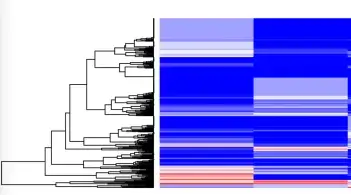
3. Traits leading to a species invasiveness I have been using the invasive grass, Phalaris arundinacea, reed canary grass, as a model system to ask questions about how different traits influence a species success and how this can affect a species ability to invade new habitats. We have identified 41 native and 49 invasive genotypes taken from Europe and North America for experimental work. |
 |
Selected Publications
- Broderson, C., S. Lavergne, and J. Molofsky. (2008). Genetic variation in photosynthetic characteristics among invasive and native populations of reed canarygrass. Biological Invasions. DOI. PDF
- Lavergne, S. and J. Molofsky. (2007). Increased genetic variation and evolutionary potential drive the success of an invasive grass. Proceedings of the National Academy of Sciences 104: 3883-3888. PDF
- See the commentary: Novak, S. J. (2007). The role of evolution in the invasion process. Proceedings of the National Academy of Sciences 104: 3671-3672. PDF
- Cited by Faculty of 1000. Link
- Featured in NRI Research Highlights. PDF
- Eppstein, M. J. and J. Molofsky. (2007). Invasiveness in plant communities with feedbacks. Ecology Letters 10: 253-263. PDF
- Eppstein, M. J., J. D. Bever and J. Molofsky. (2006). Spatio-temporal community dynamics induced by frequency dependent interactions. Ecological Modeling 197: 133-147. PDF
- Lavergne, S. and J. Molofsky. (2006). Control strategies for the invasive reed canarygrass (Phalaris arundinacea L) in North America wetlands: the need for an integrated management plan. Natural Areas Journal 26: 208-214.
- Molofsky, J. and J. B. Ferdy. (2005). Extinction dynamics in experimental metapopulations. Proceedings of the National Academy of Sciences 102: 3726-3731. PDF
- Cited by Faculty of 1000. Link
- Lavergne, S. and J. Molofsky. (2004). Reed canary grass (Phalaris arundinacea L.) as a biological model in the sudy of plant invasions. Critical Reviews in Plant Sciences. 23: 415-429. PDF
- Molofsky, J. and J. D. Bever. (2004). A new kind of ecology? Bioscience. 54: 440-446. PDF
- Molofsky, J. and J. D. Bever. (2002). A novel theory to explain species diversity in landscapes: positive frequency dependence and habitat suitability. Proceedings of the Royal Society of London. 269: 2389-2393. PDF
- Molofsky, J., J. D. Bever, J. Antonovics, and T. J. Newman. (2002). Inferring process from pattern: negative frequency dependence and the importance of spatial scale. Ecology 83: 21-27. PDF
- Molofsky, J., J. Bever, and J. Antonovics. (2001). Coexistence under positive frequency dependence. Proceedings of Royal Society of London B 268: 273-277. PDF
- Molofsky, J., S. L. Morrison, and C. J. Goodnight. (1999). Genetic and environmental controls on the establishment of the invasive grass, Phalaris arundincaea. Biological Invasions 1:1-8.