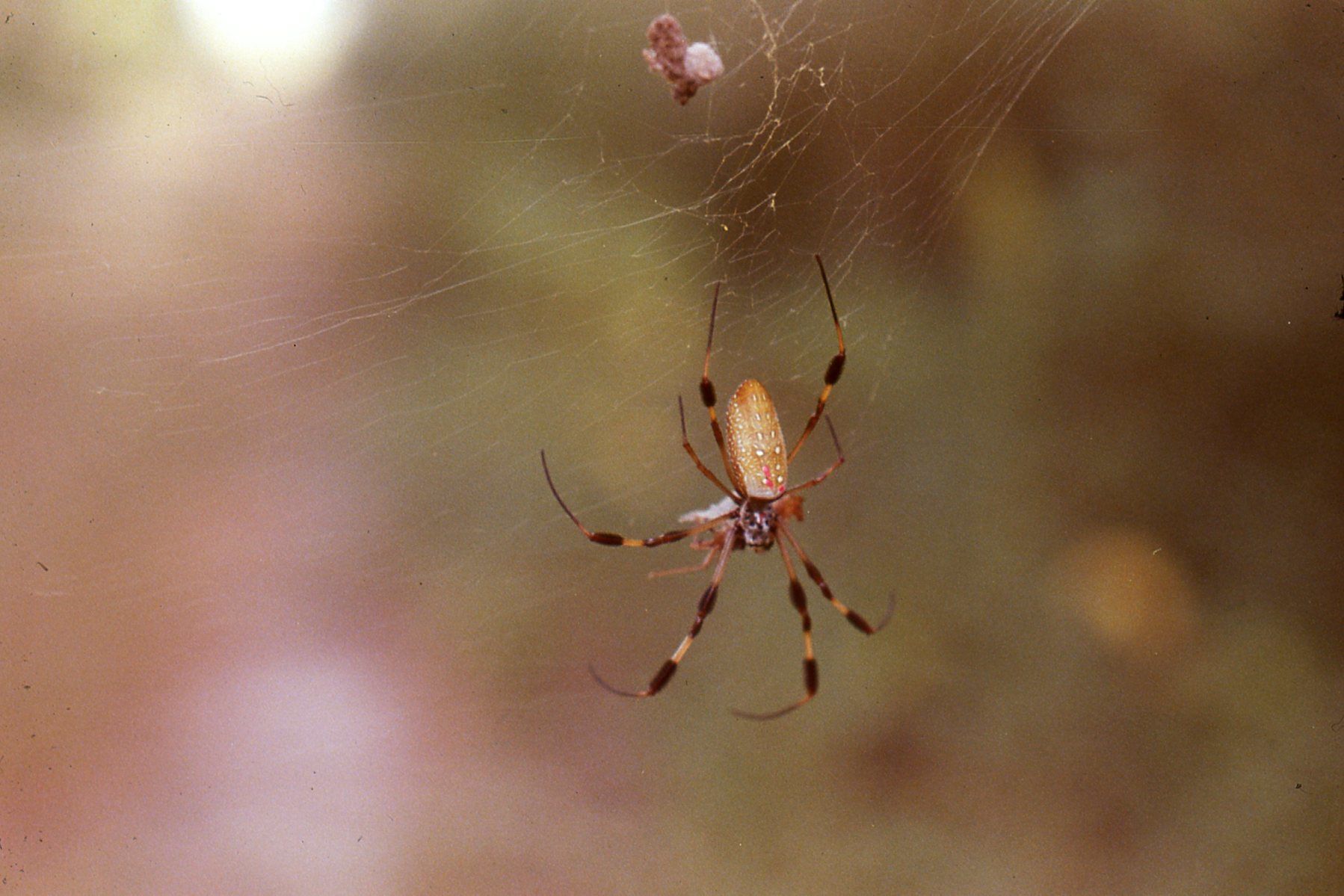
 Nephila clavipes is one of several
families of spiders that build orb webs - the classic garden spider
circular web.
Nephila clavipes is one of several
families of spiders that build orb webs - the classic garden spider
circular web.All spiders can spin silk, but not all spiders depend on silk to capture their food. We split spiders into two large groups reflecting how they capture prey. "Hunting" spiders may use silk to build retreats, but they hunt by direct attack. The common jumping spiders are in this group.
 Web
building
spiders
are dependent upon their
web for capturing prey. They eat insects that become tangled in
the threads or, in some
groups, stuck to special glue laid upon the silk threads. In addition
to orb-weavers like Nephila clavipes, common web-building
spiders include the
tangle-spinning widows and house spiders.
Web
building
spiders
are dependent upon their
web for capturing prey. They eat insects that become tangled in
the threads or, in some
groups, stuck to special glue laid upon the silk threads. In addition
to orb-weavers like Nephila clavipes, common web-building
spiders include the
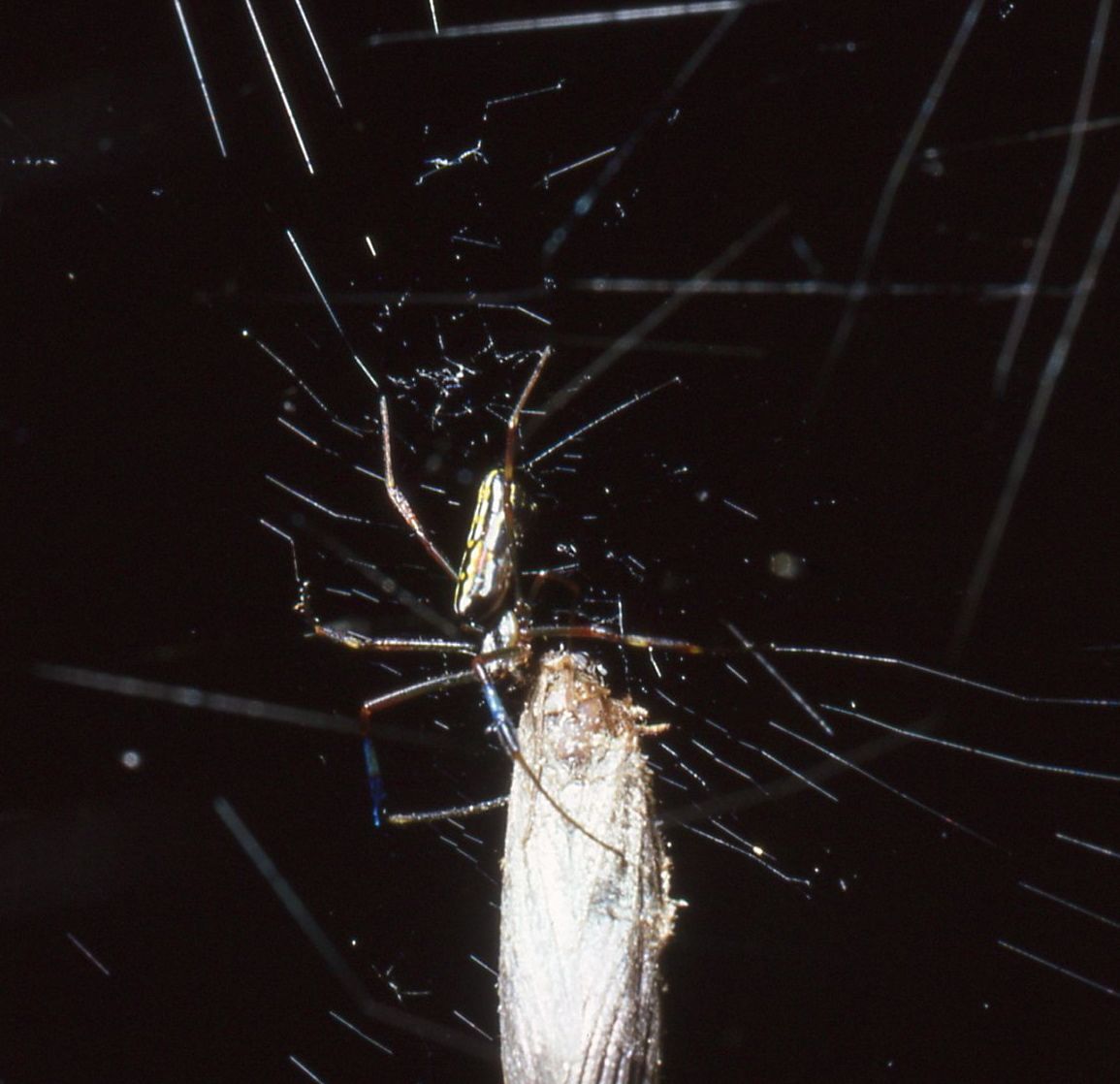
tangle-spinning widows and house spiders.Probably because the web halts an insect's movement, at least for a moment, web-building spiders can capture prey much larger than themselves, as in this very small juvenile eating a large moth.
What a Nephila web looks like
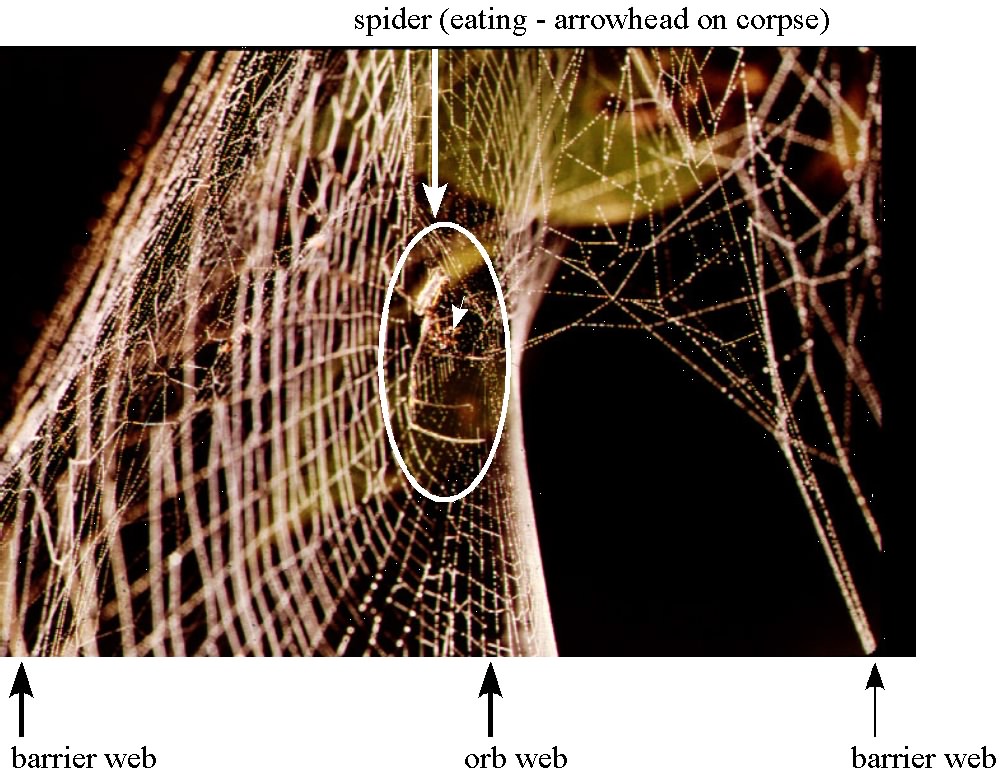
Nephila webs commonly have two separate components: the sticky orb web, a sheet woven in a very regular mesh, and the tangle-structure barriers. The barriers likely have several functions; here I list a few.
- Defense:
The
barrier
web
silk is very stiff. In the field, I've seen large
tropical damsel flies attacking juveniles like the one in the above
photo, and just bouncing off the barriers. Adult females build
barriers also. Birds can fly through the barriers spun by a
juvenile, but once I saw a tanager attacking a mature female Nephila but failing because it
could not fly through the barriers.
- Structure:
There
is,
if
you look closely, a connection
between the barrier and the area where the spider sits at the
web.
Maintaining tension in the web may be a second function of the barrier,
since tightly-stretched webs are more effective for capturing prey.
When my students cut this connection in an experiment, the orb web
relaxed.
- Prey capture: Lastly, George Uetz and his collaborators have documented in another species that insects can become disoriented when trying to fly through tangles of silk and more likely to hit the orb web, so the barrier may increase prey capture.
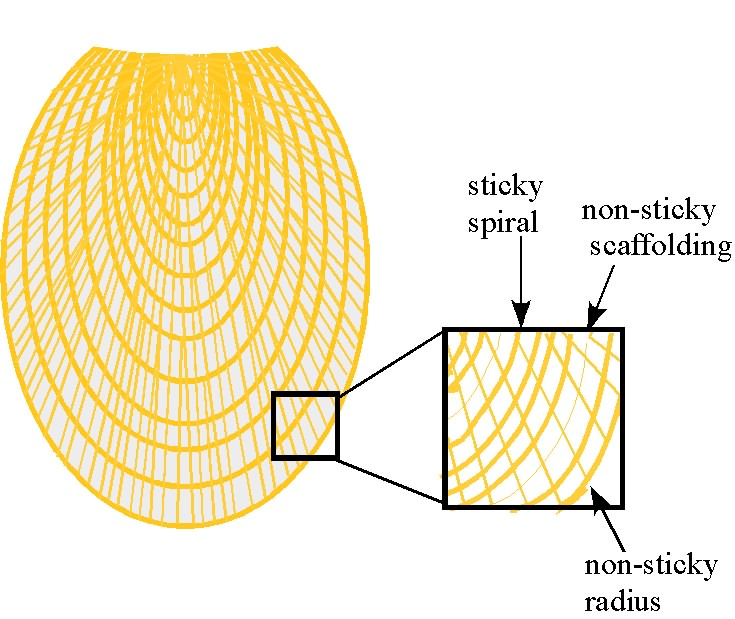
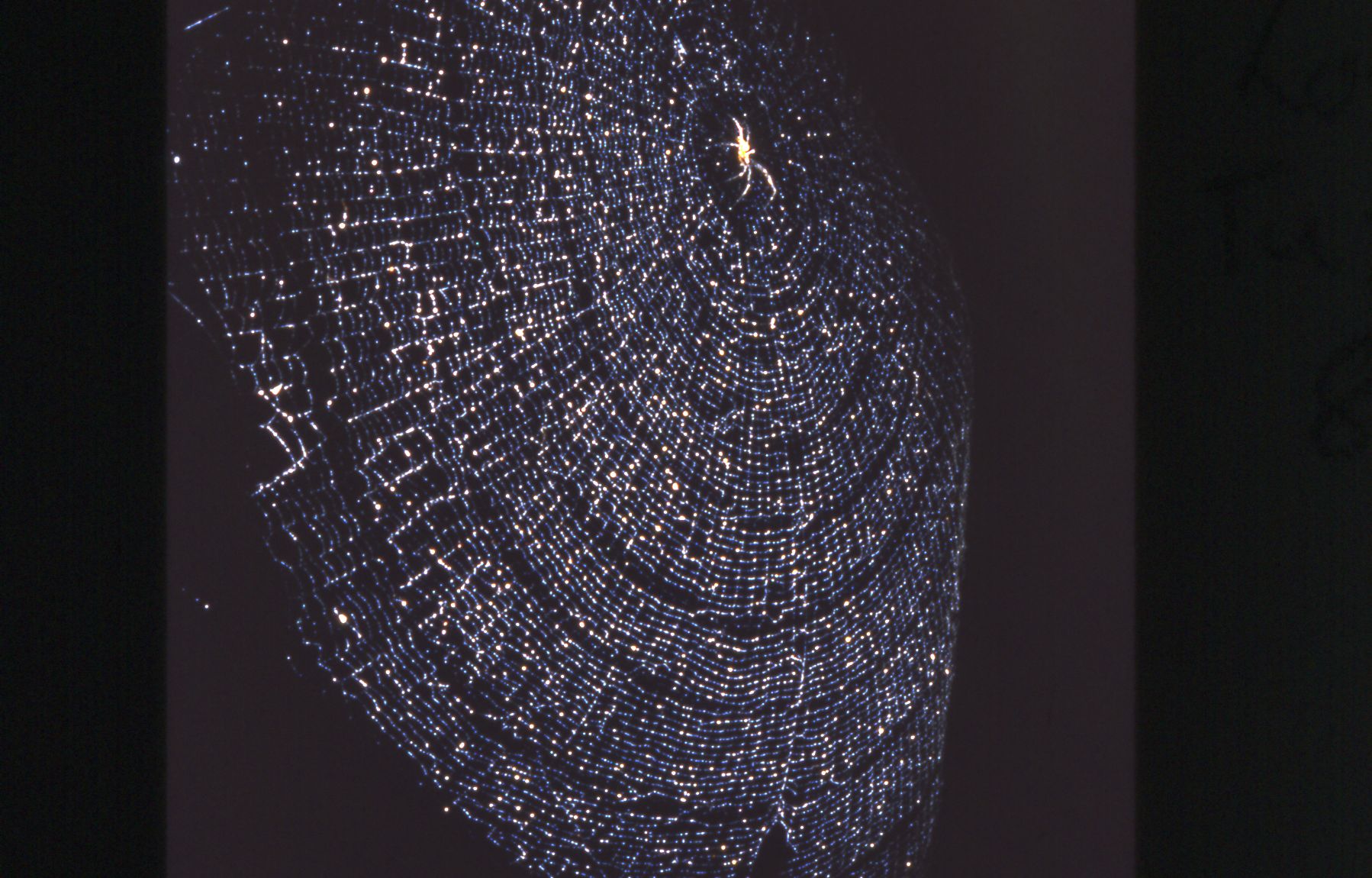
All orb webs have radii and sticky spirals. But Nephila spiders make a distinct orb. They leave the non-sticking scaffolding (which all other orb-weavers remove and consume when spinning the sticky spirals). This gives the web an appearance of "music paper" when seen in the sun (see top photo), because the sticky spirals reflect much more light than the non-sticky scaffolding.
Nephila commonly spins webs of yellow silk – hence their common name of "golden orb spider." The actual color depends on where in the forest they build: Cay Craig has demonstrated that spiders building on edges of clearings with bright light spin with more intensely colored silk.
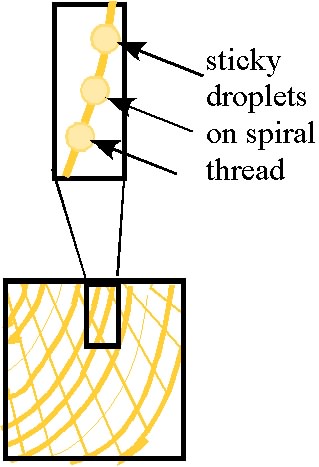 This
depends
on
the type of spider, but in Nephila
and many other orb weavers, the
stickiness comes from droplets of organic "glue" that the spiders
deposit on the spiral as they spin.
This
depends
on
the type of spider, but in Nephila
and many other orb weavers, the
stickiness comes from droplets of organic "glue" that the spiders
deposit on the spiral as they spin. 
Studying this in animals is exceedingly difficult. Building a budget, we use money as our common measure of the value of all things. But there is usually no common measure of the things an animal must do. For example, consider three things an adult female must do: produce offspring, maintain her own health, and hunt. How can we find a single measure for offspring, health maintenance, and effort of hunting?
We have a chance to tease apart the budgets used by spiders. The spiders must spin in order to eat and the threads are proteins (all silk is protein), which are also very necessary both for their own health and for making eggs.
I've found that spiders in populations where prey are relatively scarce tend to build bigger webs and mature at a smaller size (hunting effort up, growing down). In the laboratory, I've been able to reduce prey levels to the point where spiders build small webs to avoid loosing weight (hunting effort down, growing up). Lastly, I've used radioactive labels and demonstrated that under stress, they make "trade-off" decisions in one essential nutrient that they need to grow but also need to spin (choline).
More information
about silk and silk genes My publications about web building and prey capture in Nephila
L. Higgins (2006). Quantitative shifts in orb investment during development in Nephila clavipes (Araneae: Tetragnathidae). Journal of Arachnology 34: 374-386.
L. Higgins, M. Townley, E. Tillinghast and M.A. Rankin (2001). Differences in the composition of orb webs built by the spider Nephila clavipes (Linnaeus) (Araneae: Tetragnathidae) in the field and laboratory. Journal of Arachnology 29:82-94
L. Higgins and M. A. Rankin (1999). Nutritional requirements for orb-web synthesis in the tetragnathid spider Nephila clavipes. Physiological Entomology 24:263-270.
L. Higgins (1995). Direct evidence for trade-offs between foraging and growth in a juvenile spider. Journal of Arachnology 23:37-43
L. Higgins (1992). Developmental changes in the barrier web structure under different levels of predation risk in Nephla clavipes (Araneae: Tetragnathidae). Journal of Insect Behavior 5:635-655.
L. Higgins and R. Buskirk (1992). A trap-building predator exhibits different tactics for different aspects of foraging behavior. Animal Behavior 44:485-499