 Supported by a grant
from the
National Science
Foundation
Supported by a grant
from the
National Science
Foundation
Return to front page 
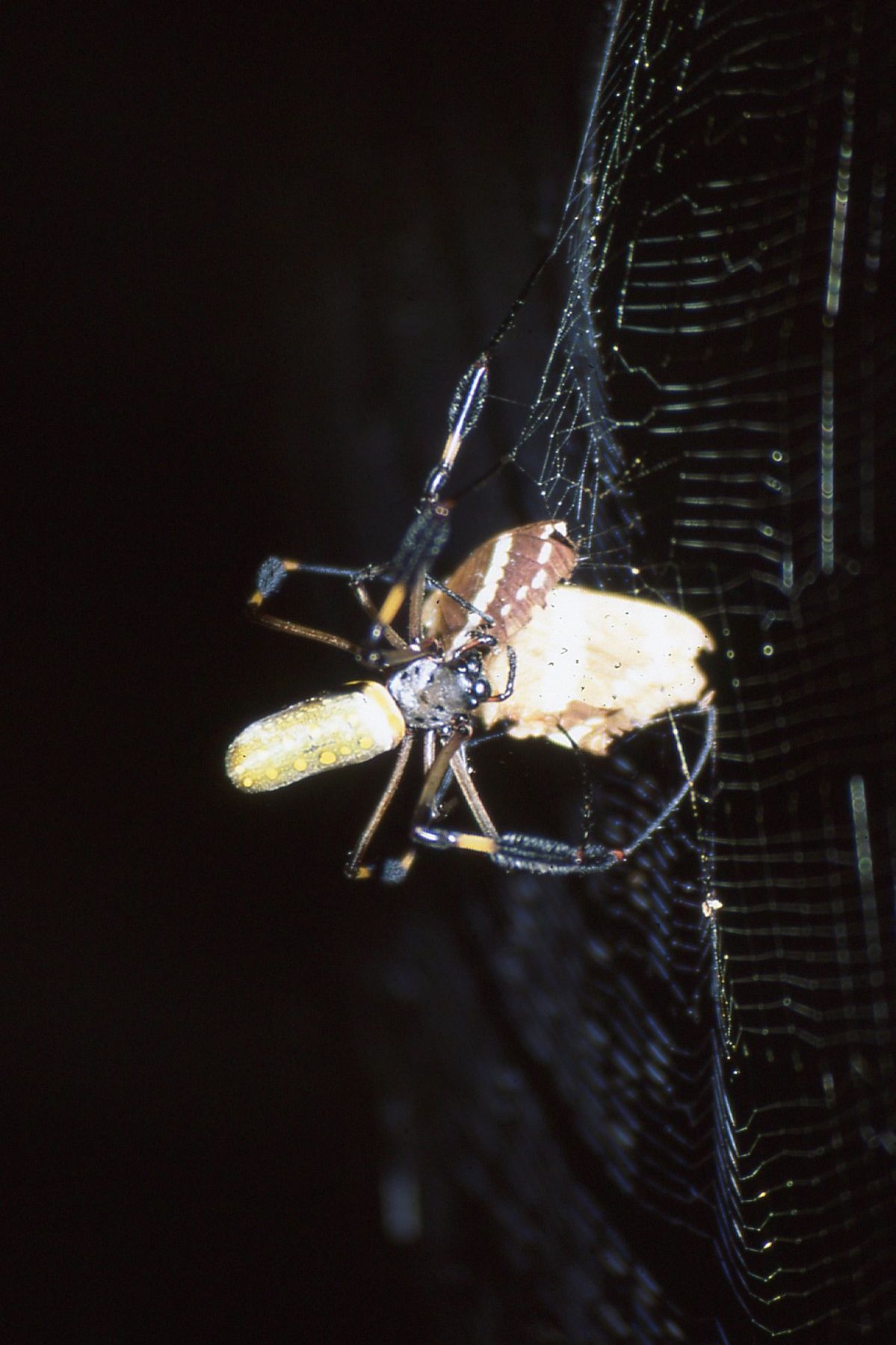 Spider silk
proteins and their genes are very attractive to scientists because they
link together many levels of
organization. The structure of the silk thread is determined in part by
the sequence of amino acids in the protein, which in turn is encoded in
the DNA of the spider. Working up, the structure of the thread
determines its physical properties (how stiff or stretchy it is and how
much weight it can carry). Threads of different proteins are put
together to make the complex structure of the orb web, with each part
of the web made from distinct kinds of silk. The structure and
physical properties of the web together with its location in the
habitat determine what kinds of insects it will trap.
Spider silk
proteins and their genes are very attractive to scientists because they
link together many levels of
organization. The structure of the silk thread is determined in part by
the sequence of amino acids in the protein, which in turn is encoded in
the DNA of the spider. Working up, the structure of the thread
determines its physical properties (how stiff or stretchy it is and how
much weight it can carry). Threads of different proteins are put
together to make the complex structure of the orb web, with each part
of the web made from distinct kinds of silk. The structure and
physical properties of the web together with its location in the
habitat determine what kinds of insects it will trap.I've only touched briefly in my own work on the genetics of silk: I hoped to be able to use the silk gene that encodes the spiral thread to detect how often spiders migrate among populations in Mexico. This is very challenging work, and I enlisted the help of Sheryl White, an expert in working with DNA and proteins.
 No one had, at that
time, attempted to look at genetic variation in a silk gene. We
sequenced one end of the very large FLAG gene (for Flagelleform, the
gland producing the spiral silk).
No one had, at that
time, attempted to look at genetic variation in a silk gene. We
sequenced one end of the very large FLAG gene (for Flagelleform, the
gland producing the spiral silk). Nearly every animal has two copies of each gene - one from the father and one from the mother. The two copies may be identical, or they may be slightly different. Most key genes are nearly identical among individuals simply because they are important. In this case, we found that most of the spiders had two different copies - their mom and dad had passed on to them distinct versions of the gene.
Unfortunately, this amount of variation - while in itself very interesting (it suggests that natural selection is not very strong in this trait) - means that these genes are not useful for studying migration patterns.
The different repeat motifs are identified by the following symbols, where G symbolizes glycine, P proline, and X or Y a variety of amino acids.
large oval: XGPGG;
medium oval: XGGY;
small oval: XGG;
box: low glycine (non-repetitive) spacer.
A colored oval or a bar in the spacer indicates an amino acid substitution. The nature of the substitution is indicated by the color.
Grey: same group;
Purple: exchange of glycine and long chain residue;
Blue: exchange of hydrophobic and hydrophilic residue;
Green: exchange of aromatic and straight chain residue;
Yellow: addition or deletion of cysteine;
Red: addition or deletion of proline.
Cheryl Hayashi is a leading expert in silk gene evolution
Todd Blackledge works on the biomechanics of silk and webs
Publication: L. Higgins, S. White, J. Nunez Farfan and J. Vargas. 2006. Patterns of variation among distinct alleles of the Flag silk gene from Nephila clavipes. International Journal of Biological Macromolecules 40: 201-216