The Field Naturalist Program
Giving Field Naturalists the tools they need to move the world
The Field Naturalist Program in the Landscape of Choices
It's not easy to describe the Field Naturalist Program in modest terms because there's not much to be modest about. We enroll only four or five students each year, but those few are truly the "environmental CEOs" of the future. Our track record - from academic profiles of our students to positions held by our graduates - is unmatched by any program anywhere. What are we doing that's different? The differences are easiest to see when the Field Naturalist Program is compared against thesis and non-thesis programs.
Non-Thesis Programs
Non-thesis programs (such as those at Yale, Duke, Virginia, Miami, and Montana - just to mention a few) are designed for people whose interests in "the environment" are still being defined. Non-thesis programs offer students a wide array of courses, with few restrictions or requirements on what they might take. People in life transition, or who aren't quite sure what they wish to do or how they wish to do it, can use a non-thesis Master's program to explore how they might best make their mark. Should it be environmental policy? Environmental planning? Environmental education? Science education? Environmental law? Environmental journalism? Environmental consulting? Ecotourism? Environmental advocacy? By sampling courses that sound interesting, students have two years to develop a more focused vision for where their careers may go.
Because non-thesis programs cater to a student body whose environmental interests and backgrounds run the gamut, admission is not dependent on a strong undergraduate background in science or environmental studies. In fact, many non-thesis programs enroll students who have no background whatsoever in science or environmental fields of study.
Non-thesis environmental programs tend to be tuition-driven rather than research-driven, and that means that entering classes tend to be large (usually 25-100 students). It also means that students can expect to pay all or most of their way (tuition, fees, and living expenses), just as they did as undergraduates. Some students take internships during their second year; some of these pay modest stipends. Apart from loans, other sources of funding such as grants, scholarships, and fellowships tend to be few and far between.
Thesis Programs
Thesis programs, which are offered at almost every university, are very different from non-thesis programs: they are research programs rather than coursework programs. Prospective students officially apply to a program, but the application and admission process is more like applying for a job or apprenticeship: if no faculty member is interested in mentoring the applicant, the applicant is denied admission. The student's "advisor" is therefore the master - the mentor who directs the student's research and education. The advisor is more important than the program. For these reasons, it's critical that a prospective student identifies (and excites) at least one specific faculty member who has the interests and expertise that the student seeks.
Students in thesis programs take relatively few courses, and those courses focus on the student's area of specialization. That's because the educational focus of thesis programs is research and development of new knowledge - not coursework. As a result, a thesis program is not completed until the selected research question has been answered to the satisfaction of the advisor and studies committee. College catalogs often claim otherwise, but the degree is rarely awarded in less than two-and-a-half years for Master's candidates and five years for Ph.D. candidates.
Unlike students in non-thesis programs, students in thesis programs are generally supported financially through a combination of grants, contracts, and teaching fellowships. Depending on the availability of funding, and how many thesis students already are in the professor's lab, advisors usually take no more than a couple new students a year. There are some years when an advisor admits no new students, regardless of the qualifications of the applicants. It's therefore wise to ask prospective mentors whether or not they anticipate taking on any new students. If the answer is no, you should look elsewhere.
The Field Naturalist Program
The Field Naturalist Program is quite different from either type of program described above, but it has elements of each. The education offered in non-thesis programs is expansive whereas that in thesis programs is intensive. The FN Program certainly has an expansive dimension, because we ensure that Field Naturalists have a firm and substantive grounding in the many scientific disciplines - ecology, geology, botany, hydrology, soil science, and environmental chemistry - that collectively define and configure ecosystems and landscapes. But the Field Naturalist Program also has an intensive dimension, for we study, analyze, and interpret how landscape pieces fit together to create the whole. Scientific integration describes our specialty and our rallying cry. No other program has this focus.
Pedagogy
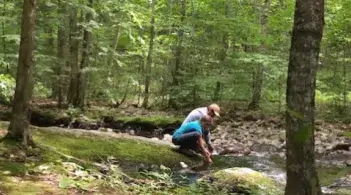
Learning in the Field Naturalist Program is hands-on, which is why entering classes are small in number. We have found that traditional course and lecture structures just don't work, so we experiment with a variety of other educational approaches. For starters, we spend many hours in the field each week asking, "What's going on here? How did this system become the way it is? What would happen if ...? How could a study be designed and analyzed to figure out the unknowns?" Basically, we break landscapes into their parts, study and try to understand the parts, and then reassemble the parts to see how the system works as a whole. We work on seemingly simple skills: observation, question asking, and synthesis. And we take "interdisciplinary" seriously - it's not the same thing as taking a bunch of courses in different disciplines.
Oral and written communication are central to the Field Naturalist program, as they should be in all environmental graduate programs - but they're not. Professional writers and editors work one-on-one with each Field Naturalist; public speaking coaches do likewise. We also work on mentoring skills so that, as leaders, the Field Naturalists will be able to help their staff members become better writers, public speakers, and leaders in their own right.
Learning By Doing (and with purpose!)
Another distinctive feature of the Field Naturalist Program is its emphasis on real-world problem-solving. Starting second semester (after a fall semester of Field Naturalist skill development), the programmatic emphasis shifts to working on meaningful environmental challenges. During the second semester, all Field Naturalists serve as pro bono environmental consultants for local and regional environmental non-profits while learning skills of "Landscape Inventory and Assessment" and "Environmental Problem-Solving and Consulting."
The first year of training in the Field Naturalist Program segues into "the final project," a cooperative consulting project where each Field Naturalist works with a chosen organization to tackle a challenge that requires Field Naturalist training. Working closely with the sponsoring organization, and with support from the graduate studies committee, each Field Naturalist yet again translates education into action. The final projects that the students produce (we call them "final projects" as opposed to theses to reinforce the reality that a final, professional product needs to be delivered by a specified deadline - in this case, May of the second year) are extraordinary. Ask any sponsoring organization!
Other Field Naturalist Field Marks
The Field Naturalist Program is known for its high energy and remarkably talented and engaged students. But our stimulating community is not sustained through casual participation: Field Naturalists have moxie and commitment - those are prerequisites for admission. In fact, a number of our returned Peace Corps students have likened the Field Naturalist experience to a Peace Corps experience. As a returned Peace Corps volunteer myself, I'd say that's an apt comparison.
Funding
The Field Naturalist Program is not a thesis program but we nonetheless have always been able to provide funding for every entering student. The exact funding package varies somewhat from one entering class to the next (as grants, contracts, and gifts vary), but it generally covers tuition and fees and provides a modest stipend. Most Field Naturalists are offered teaching assistantships for one or more semesters, and many Field Naturalists win prestigious fellowships that supplement or replace the Field Naturalist Fellowship.
Is the Field Naturalist Program For You?
In sum, the Field Naturalist Program is the educational equivalent of a Peace Corps or Marine Corps experience. If it's what you want, the Field Naturalist Program is the best. But it's not for everyone. Students spend two life-changing years becoming the conservation and stewardship leaders of tomorrow. If you think that's just a lot of talk, come visit us and see for yourself! Call (802) 656-2930 or write to Lillian.Reade@uvm.edu for more information, or to schedule a visit.
by Jeffrey Hughes, Field Naturalist Program Director
Field Naturalist Program - Department of Plant Biology
111 Jeffords Hall - 63 Carrigan Drive
University of Vermont - Burlington, VT 05405
(802) 656-2930 - Lillian.Reade@uvm.edu
Last modified October 05 2010 01:26 PM