South
Dakota
Number of victims
There were 789 victims of sterilizations in South Dakota. Almost two thirds of those sterilized were women, and almost all victims were considered mentally disabled. A small percentage of victims were considered “mentally ill.” Compared to other states with sterilization laws, South Dakota ranked 15th in total numbers of sterilization.
Period during which sterilizations occurred
Sterilizations occurred in South Dakota between the late 1920s and the early 1960s (see also Paul, p. 474).
Temporal
pattern of
sterilizations and rate of sterilization
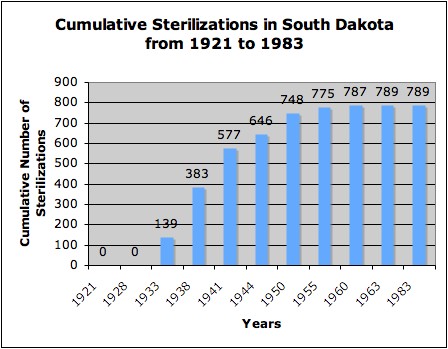
After the passage of the sterilization law in 1917, there were no recorded sterilizations until the late 1920s. There was fair steady number of sterilizations over the period from the early 1930s to 1947, and then the number of sterilizations quickly declined and leveled off to a total of 789 people. The rate of sterilization between 1933 and 1950 was about 6 people sterilized per 100,000 residents per year.
Passage of Law
South Dakota was the 15th state to pass a sterilization law in the United States. The first eugenic sterilization law passed in 1917. A South Dakota legislature bill was passed for the “prevention of the procreation of idiots, imbeciles, and feeble-minded persons.” The bill only applied to one institution, the State Institution for Feeble-Minded in Redfield (Laughlin, p. 34). As Julius Paul noted, “the law was compulsory and lacked provisions for notice, hearing, or appeal of a sterilization order. There were challenges to the constitutionality of this law, so the institution did not make use of the law for close to fifteen years.
Amendment in 1925/1927 established the authority of a State Commission for Control of the Feeble-Minded and county boards of insanity and extended the law extramurally. Another amendment in 1943 covered certain inmates at Yankton State Hospital (see below).
Groups identified in the law
The original South Dakota bill was an act to prevent “idiots,” “imbeciles,” and “feeble-minded persons” in the State Institution for Feeble-Minded in Redfield (Landman, p. 78). The 1925/1927 laws covered the “feeble-minded” and “insane” at large. The 1943 law identified those at Yankton State Hospital suffering from mental illness, sexual perversion, and syphilis (Paul, pp. 469-70).
Process of the Law
According to the text of the 1917 bill, the basis for selection was a procedure. The superintendent of the State Institution for Feeble-Minded in Redfield would examine a prospect’s mental and physical condition, the records, and family history of the inmate to determine whether it would be improper or inadvisable to allow the inmate to procreate. An annual report of the inmates was made to the State Board of Charities and Corrections. With the superintendent, the board would “carefully” examine each inmate’s record and write-up, and if a majority decided that it would be inadvisable to let the inmate procreate, than the physician of the institution or one selected by him would perform either a vasectomy or ligation of the Fallopian Tubes. The superintendent was to keep a record of all inmates operated on, with “statistics and notes or observations regarding its benefits, and make an annual report” to the Governor (Laughlin, pp. 34-35).
The 1925/1927 laws allowed for people with mental disabilities to be subjected to sterilization decisions by the county boards. Paul notes that sterilization could be “either a quid pro quo for avoiding commitment, or for those already in the institution [in Redfield], a basis for release,” and it provided “for notice, hearing, and the right to appeal to the courts” (Paul, p. 469). Apparently, anyone in the state could submit a complaint to a county subcommission concerning a sterilization, upon which an at large person could be committed for segregation from the general publication or sterilization (Paul, pp. 469-70).
In 1943, the law was amended inmates of Yankton State Hospital could be sterilized, provided they suffered from a) inherited mental diseases and were liable to pass them on to descendants; b) “perversion” of other departure from “normal mentality”; or c) a disease of a syphilitic nature (Paul, p. 470).
Precipitating factors and processes
The state’s motives were both
“therapeutic and eugenic”
(Laughlin, p. 13). The population was decreasing in the time period of
the most
sterilizations, declining from 694,000 people in 1930 to 652,000 people
in
1950. Some of the reason for emigration comes from the “commercialization in
agriculture, diminishing local control, and rural
migration” that occurred during this time (Dimit and Field, pp. 5-6).
Many of
the more affluent left the state to live in either California or the
Lakes
region to the East. This left a larger proportion of “feeble-minded,”
which
prompted people to take more action. Prosperity-depression
cycles affected the state after the boom of World
War I. The combination of droughts and the Great Depression brought
widespread
problems in the late 1920s and early 30s. Vigorous relief measures were
instituted under the New Deal. This decline in the economy created a
new desire
to “cleanse” the population. Also, in 1921 Congress passed the Snyder
Act to
establish free health care as a federal trust responsibility for tribal
members
of quarter-blood Indian heritage or more in all federally recognized
tribes.
This increase in medical awareness led to the assessment of many Native
Americans as “mentally ill” or “mentally deficient.” There may have
been a
higher proportion of Indians in the Redfield institution as the methods
of
mental retardation determination were skewed—those with more formal
education
did better on tests and may have appeared more intelligent.
Groups targeted and victimized
There is
little
information on the state institution’s population, which makes it hard
to
determine the groups targeted, but it is clear from the number of women
sterilized as compared to men that women were targeted. Nearly
two-thirds of
the people sterilized were women. There is also a high proportion of
Native
Americans in the hospitals, partially due to the 1921 Snyder Act that
gave
quarter-blooded or more Indians free health care (Sisson and Zacher, p. 48).
Subjective
assessment of Native Americans due to less education and less
socialization may
have led to a high proportion of Indians in the Institution in
Redfield, which
would lead to a greater chance of being selected to be sterilized.
There is no
information on restrictions on those identified in the law or with
disabilities
in general related to abortion, marriage, etc. (Lawrence, p. 404).
Major proponents
There
is very
little information available about major proponents of eugenics in
South
Dakota. It can be assumed that the executive agencies were the main
proponents
of eugenics, including the State Commission for Control of the
Feebleminded,
the county boards, the State Board of Charities and Corrections, and
the
Superintendent of the main institution. No definitive information is
available,
however.
“Feeder institutions” and institutions where sterilizations were performed
 (Photo
origin: Hand County, South Dakota, Genealogy and Family Research
Center, available at
http://freepages.history.rootsweb.ancestry.com/~handcosd/Spink/album/redf-sch-2.html)
(Photo
origin: Hand County, South Dakota, Genealogy and Family Research
Center, available at
http://freepages.history.rootsweb.ancestry.com/~handcosd/Spink/album/redf-sch-2.html)
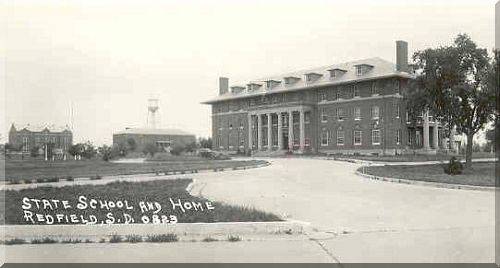
The main location where sterilizations were performed was the State Institution for Feeble-Minded, Redfield, whose main function of the institution was to house and monitor those classified as “feeble-minded.” It is now called the South Dakota Developmental Center. The South Dakota Developmental Center’s web site does not mention any involvement of the place with sterilizations (South Dakota Developmental Center).
Opposition
There is little information on opposition to eugenic sterilizations in South Dakota. It is known, however, that religion was closely intertwined with education in the 1930s through the 1950s and it is likely that there was some opposition from religious leaders, as birth control was rejected in some of the Catholic regions. Also, small groups within the state that thought the sterilizations were too radical were also opposed (Sisson and Zacher, p. 48).
Bibliography
Dimit,
Robert M.,
and Donald R. Field. 1970. “Population Change in South Dakota Small Towns
and
Cities.” Unpublished paper. South Dakota State University.
Landman,
J. H. 1932. Human
Sterilization: The History of the Sexual Sterilization Movement.
New York:
MacMillan.
Laughlin,
Harry H.
1922. Eugenical Sterilization in the
United States. Chicago: Municipal Court of Chicago.
Lawrence, Jane. 2000. "The Indian Health Service and the Sterilization of Native American
Paul, Julius. 1965. “'Three Generations of Imbeciles Are Enough': State Eugenic Sterilization Laws in American Thought and Practice.” Washington, D.C.: Walter Reed Army Institute of Research.
“Redfield
State
Hospital and School.” Historic Asylums. Available at <http://www.rootsweb.ancestry.com/~asylums/redfield/index.html>.
Sisson,
Richard,
and Christian K. Zacher. 2007. The American
Midwest: An Interpretive Encyclopedia. Indiana: Indiana
University Press.
South
Dakota Developmental Center. “The History of SDDC.”
Available at <http://dhs.sd.gov/sddc/history.aspx>.