Pennsylvania
Number of victims
There were 270 sterilizations done in Pennsylvania, all without benefit of the law (Paul, “Three Generations,” p. 606).
Period during which sterilizations occurred
Sterilizations occurred in Pennsylvania between 1905 and 1931 (Paul, “Three Generations,” p. 606).
Passage of Law
Although
Dr. Harry
Sharp of Indiana claims he was the first one to use vasectomies in a
public
institution in America, Pennsylvania had the first known sterilization
(castration)
in a public institution )in 1889/92; see Paul, “Three Generations,” p.
604) and
passed the first sterilization law in 1905.
This
first bill was entitled
"An Act for the Prevention of Idiocy" and was passed on March 21,
1905 (Laughlin, p. 37). This act read as follows:
"Whereas,
Heredity plays a most important part in the transmission of idiocy and
imbecility; therefore, Section 1. Be it enacted... That on the first
day of
July after the passage of this bill, it shall be compulsory for each
and every
institution in the state, entrusted exclusively or especially with the
care of
idiots and imbecile children, to appoint upon its staff at least one
skilled
surgeon, of recognized ability, whose duty it shall be, in conjunction
with the
chief physician of the institution to examine the mental and physical
condition
of the inmates. If, in the judgment of this Committee of Experts and
Board of
Trustees, procreation is inadvisable, and there is no probability of
improvement of the mental condition of the inmate, it shall be lawful
for the
surgeon to perform such operation for the prevention of procreation as
shall be
decided safest and most effective: but this operation shall not be
performed
except in cases that have been pronounced non-improvable after one
year’s test
in institution" (Laughlin, p. 35).
This bill
was
vetoed by Governor Samuel W. Pennypacker on March 30, 1905. In his
speech, he
said: "To permit such an operation would be to inflict cruelty upon a
helpless class in the community which the state has undertaken to
protect"
(Laughlin, pp. 35-36).
Efforts
to pass a
bill continued in 1911, 1913, 1915, 1917, 1919, and in 1921.
The next
bill that
was passed was Pennsylvania Senate Bill 560, and was introduced by Dr.
George
Woodward. It was passed by the senate on April 11, 1921: “To provide
for the
sterilizations of inmates of institutions having the care and custody
of
idiotic, imbecile, epileptic, feeble-minded and insane persons in cases
where
such sterilization would materially improve the mental or physical
condition of
such persons and in cases where owing to the idiocy, imbecility, or
feeblemindedness
of such persons not being in permanent custody procreation by such
persons
would produce offspring similarly affected” (Laughlin, pp. 36-38).
This bill
was
vetoed by Governor William Sproul on May 24, 1921 (Laughlin, p. 38).
>From 1929
to 1951, that state legislature did not pass legislation presented by
the
superintendent at Elwyn (see below; Paul, “Three Generations,” p. 606).
Groups identified in the law
The Pennsylvania bills identified “idiotic,” “imbeciles,” “epileptic,” “feeble-minded,” and “insane” (Laughlin, pp. 35-38).
Process of the Law
No legal sterilizations are known to have occurred between March 21 and March 30, 1905 (the only legal period). The process was as follows: Each institution was to appoint at least one skilled surgeon, of recognized ability, to examine the mental and physical condition of the inmates with the chief physician of the institution. If, in the judgment of this Committee of Experts and Board of Trustees, procreation was inadvisable, and there was no chance for improvement, the surgeon would perform the method of sterilization decided safest and most effective. Sterilizations were only to be performed on inmates who had been at the institution, considered non-improvable, for one year (Laughlin, pp. 35-39).
Precipitating factors and processes
Pennsylvania
was one of the first states to recognize and identify
mental problems, and the link between these problems and crime. A
campaign to
place insane convicts into a separate asylum, which in the 1840s was
led by Dorothea
Dix, proposed the idea that crime was a symptom of a mental problem
(Jenkins,
p. 67). However, it was the last quarter of the 1800s in which eugenic
theories
started to impact the state. In this time period, “the eugenic movement
found
early support among the state's political and administrative elite”
(Jenkins,
p. 67). Two administrators,
the
superintendents of the Pennsylvania Training School for Feeble-Minded
Children
at Elwyn, were responsible for many of the sterilization proposals: “Many of the
institutional, medical and social authorities of Pennsylvania [worked]
for the
enactment of a satisfactory eugenical sterilization law” (Laughlin, p.
40).
Groups targeted and victimized
It is not possible to tell which inmates were targeted, as there is no data on gender or reasons for sterilization. It is also not clear if the sterilizations were voluntary operations in the sense that consent was obtained from the individuals (Paul, “State Eugenic Sterilization,” p. 31).
Major proponents
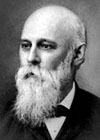
Dr. Isaac Newton Kerlin (Photo origin: Elwyn Institute, available at http://www.elwyn.org/About_Us/ History.html)
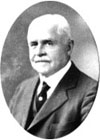
Dr. Martin W. Barr (Photo origin: Elwyn Institute, available at http://www.elwyn.org/About_Us/ History.html)
The major proponents were Dr. Martin W. Barr, who was a superintendent at Elwyn, and Dr. Isaac Newton Kerlin, both superintendents at Elwyn. Dr. Kerlin served as superintendent for 29 years, and after his death in 1893 Dr. Martin W. Barr, the medical director, superseded him (Elwyn Institute). There is little information on the personal lives of these two men. However, Julius Paul notes that they both pushed for sterilization laws fervently in their times as superintendents and oversaw sterilizations without benefit of law (Paul, “Three Generations,” pp. 604-606).
“Feeder institutions” and institutions where sterilizations were performed
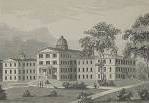 (Photo
origin: Lithographs Online; available at <http://www.lithographsonline.com/uploads/BU7.pdf>)
(Photo
origin: Lithographs Online; available at <http://www.lithographsonline.com/uploads/BU7.pdf>)
There
was only one location where sterilizations were
performed: the Pennsylvania Training
School for Feeble-Minded Children at Elwyn was the
location of all 270
sterilizations (Paul, p. 604). Elwyn, Inc. It is the second oldest care
facility for the mentally disabled in the United States, established in
1852 (“Elwyn
Inc.”). The building complex is currently in use as a service provider
for the
mentally retarded (Elwyn Institute). The
website does explain the eugenic aspect of its history, but does not
mention
how many sterilizations were done. The buildings are all located at
their
original locations on 111 Elwyn Road in
Elwyn, Pennsylvania.
Bibliography
“Elwyn Inc.” Wikipedia.com. Available at < http://en.wikipedia.org/wiki/Elwyn_Inc.>.
Elwyn
Institute.
2008. “The Story of Elwyn.” Available at
<http://www.elwyn.org/About_Us/
History.html>.
Jenkins, Philip. 1984. “Eugenics, Crime and Ideology: The Case of Progressive Pennsylvania.” Pennsylvania History 51, 1: 64-78.
Laughlin, Harry H. 1922. Eugenical Sterilization in the United States. Psychopathic Laboratory of the Municipal Court of Chicago.
Paul,
Julius. 1965. “‘Three Generations of Imbeciles are Enough’: State
Eugenic Sterilization Laws in American Thought and Practice.”
Washington, D.C.:
Walter Reed Army Institute of Research.
Paul,
Julius. 1973. “State Eugenic Sterilization History: A Brief History.”
Pp. 25-40
in Eugenic sterilization,
edited
by Jonas B. Robitscher. Springfield:
Thomas.