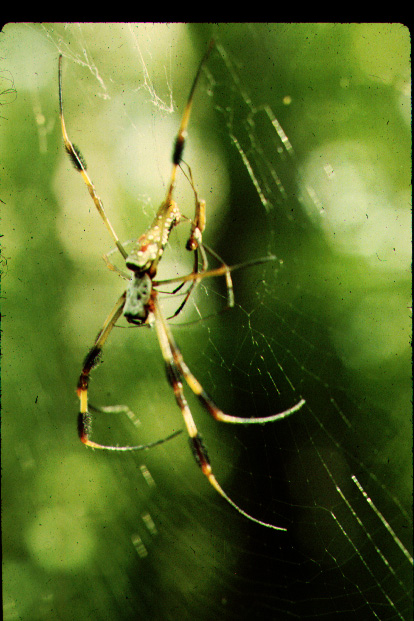
spiders in copula The spiders in the genus Nephila are famous (or infamous) for  extreme sexual size dimorphism:  females are much larger than males.  Current phylogenetic analyses from Gustavo Hormiga's laboratory suggest that this size dimorphism is due primarily to female gigantism, and the data I've collected indicate that there is strong fecundity selection on females.  Both the number of eggs per clutch, and the number of clutches (egg sacs) increase as female size increases.  This holds true for both N. maculata and N. clavipes.
N. clavipesin copula;  the male is on the right.


Female age at maturity and size at maturity vary within and among populations of Nephila clavipes in Mexico, and are major components of fitness.  These large spiders outgrow most predators but require most of the growing season to reach maturity.  The primary disadvantage of delayed maturation is the possibility of the season ending prior to reproduction.  Within a population, variation in adult female size is correlated with growth rates:  females that grow slowly mature late at a small size.  Among populations, variation in adult female size is correlated with season length:  smaller females are found in areas with shorter seasons. 

VERY large spider In Madang, on the north east coast of Papua New Guinea,  N. maculata experience an environment with relatively little seasonality.  Although some females mature early (for unknown reasons),  others reach remarkable size.  This spider, sitting on my hand, I nicknamed "Big mac". She weighed in at 6.8 g (larger than many small rodents and birds).  The night after this photo was taken, she laid an egg sac with nearly 10,000 eggs and reduced her wieght by 50%.
 

Relevant Publications:

L. Higgins (2002).  Female gigantism in a New Guinea population of the spider Nephila maculata.  Oikos 99:377-385

L. Higgins (2000).  The interaction of season length and development time alters size at maturity.  Oecologia 122:51-59.

L. Higgins and M. A. Rankin (1996).  Different pathways in arthropod post-embryonic development.  Evolution  50:573-582

L. Higgins (1993).  Constraints and plasticity in the development of juvenile Nephila clavipes in Mexico.  Journal of Arachnology  21:107-119

L. Higgins (1992).  Developmental plasticity and fecundity in the orb-weaving spider Nephila clavipes.  Journal of Arachnology 20:94-106