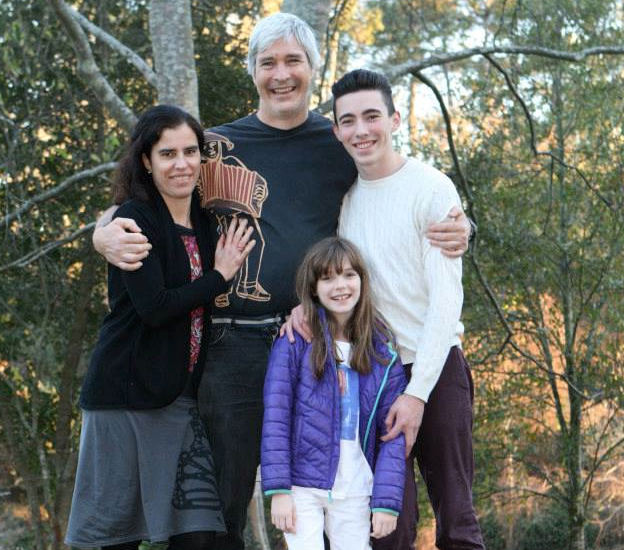
Joshua C. Farley
Professor, Community
Development and Applied Economics
Office: 205 B Morrill
Hall
Fellow, Gund Institute
for Ecological Economics
Work: (802) 656-2989
e-mail: joshua.farley@uvm.edu

|
|
Joshua C. Farley
|
|
|
|
|
|
|
| Open access teaching material |
|
|
I
have a very interdisciplinary academic background, with degrees in
biology, international affairs and economics. However, I disagree with
much of what I learned in my economics degree, both scientifically and
ethically. I believe that the economy is best modeled as a subsystem of
the finite global ecosystem, constrained by the laws of ecology and
physics. My broad research interests focus on the design of
economic institutions capable of balancing what is biophysically
possible with what is socially, psychologically and ethically desirable. I try to take an applied, problem solving approach to both research and teaching. Ecological economics is too important to focus primarily on academic studies that circulate among a group of disciplinary peers before slowly diffusing out to the broader public. Many policy makers, non-government organizations and businesses would benefit greatly from the insights and perspectives of ecological economics if only they could connect to its practitioners. I like to integrate teaching, research and service through problem solving workshops or skill-shares (to borrow a term from colleague David Batker) in collaboration with NGOs, governments, and local communities that simultaneously teach and apply ecological economics. Ultimately, applied problem solving gives us the opportunity to empirically test our hypotheses and values, falsify them at times, and develop our transdiscipline in a truly scientific fashion. I also enjoy conceptual work that in the long run can change
our paradigms concerning what is biophysically and behaviorally
possible, societal goals that guide our actions, and economic
institutions. I firmly believe that the economy is continually
co-evolving with the local and global ecosystem that sustain and
contain it. Our economy must continually adapt to its changing
environment, but the process of adaption further alters the
environment. Economic institutions that were well adapted
to the challenges of the 19th and 20th century are likely to be
woefully ill-adapted to the challenges of the 21st century.
Furthermore, human behavior is affected by the institutions we
adopt. Market economies for example seem to stimulate
self-interested behavior, while alternative economic institutions can
stimulate cooperation, reciprocity and altruism. The most serious
challenges of the 21st century can be modelled as prisoners dilemmas,
which are best solved through cooperation. | |||||