UVM Shooting Club Home
Sport Types

Clay Shooting Games

Trap

A trap field consists of one house containing an electronic target thrower that launches targets at random angles all at the same elevation. Shooters are positioned 16 yards behind the trap house on 5 different positions. A full squad consists of one shooter on each station (5 shooters). Shooters will only shoot single birds starting with the person on position 1 then moving on to positions 2,3,4 and 5. Once each shooter has shot 5 targets at their station, they move to the next station. A complete round consists of 25 targets, 5 at each station.
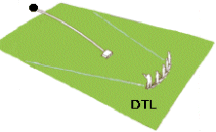
Trap

Skeet

The game of skeet has two "houses" from which the targets are electronically launched. The high house which is on the left and the low house which is on the right side of the field. There are eight stations located in a semi-circle between the two houses. A complete round consists of 25 targets. At stations 1,2,6 and 7 the shooter will shoot a single target from the high house and then a single target from the low house. Following the single targets the shooter will then shoot a double which is a target from each house thrown at the same time. When shooting a double, always shoot the bird that comes out of the closest house first. On stations 3,4 and 5 the shooter will shoot a single from both houses starting with the high house. The first target that is missed is shot again which is called an "option". Only one option is shot per round. If no targets have been missed upon the completion of shooting low house 8, a second target will be shot from here.

Doubles skeet consist of two targets per station. The first round of doubles consists of 24 targets by moving from station 1 through 7, and then working back to station 2 shooting 2 targets per station. The second round goes from station 1 to 7, then back to 1 and consists of 13 pairs for a total of 26 targets. The total for the two rounds is 50 targets.
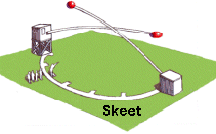
International skeet is much faster paced than American skeet. The targets are moving much faster, and a more complicated sequence of targets is thrown. The shooter must also start with their gun unmounted rather than on their shoulder.

Skeet

Sporting Clays and 5-Stand

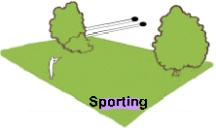
Sporting Clays is much different from trap and skeet. This game is shot on a course rather than a field and the number of stations may vary. Every sporting clays course is different. Many of the stations are set up to simulate hunting situations. Besides the standard 110mm targets shot in trap and skeet, sporting clays also use 90mm targets, 60mm targets, targetsthat turn in mid-air, and extremely rigid targets designed to bounce on the ground such as a rabbit or squirrel. Sporting clays courses use both manual and electronic target launchers. Although some sporting clays courses have single target shots, most stations have pairs of targets. True pairs release both targets at the same time. Report pairs throw one target, and the second is released when the first is shot. Releasing one target directly after the other is called a following pair.

Five stand, like sporting clays, is different on every course. There are five stations similar to trap, but there are 5 or 6 target throwers. A different sequence of targets is shot from each station, often in pairs. The order of the targets is listed at each station.

Clays

Description courtesy of the Iowa State Trap & Skeet Club

High Power Rifle Competition

Full High Power rifle description

Rifle

USPSA/IPSC Practical Shooting

Practical Shooting attempts to measure the ability to shoot rapidly and accurately with a full power handgun, rifle, and/or shotgun. Those three elements - speed, accuracy, and power - form the three sides of the practical shooting triangle. By design, each match will measure a shooter's ability in all three areas.

To do this, shooters take on obstacle-laden shooting courses (called stages) requiring anywhere from six to 30+ shots to complete. The scoring system measures points scored per second, then weights the score to compensate for the number of shots fired. If they miss a target, or shoot inaccurately, points are deducted, lowering that all-important points-per-second score.

If shooting has an "extreme" sport, USPSA-sanctioned practical shooting is it. Competitors move, negotiate obstacles, run, speed-reload, and drive their guns through each of several courses as fast as their skills will allow. Although most matches are held outdoors, in all weather, further taxing competitor skill, there are a growing number of indoor ranges conducting USPSA events.

USPCA

Description courtesy of theUnited State Practical Shooting Association