Montana
Number of Victims
In total, 256 people were sterilized by Montana’s eugenics program from 1923 until 1954. Of those sterilized, 184 (72%) were women, and 72 (28%) were men (Paul, p. 406). More than 80% of the sterilized were deemed mentally deficient, and the rest, mentally ill.
Period During Which Sterilizations Occurred
Sterilization began after the passage of the state’s eugenics law in 1923 and continued until 1954 (Paul, p. 406).
Temporal Pattern/ Rate of Sterilization
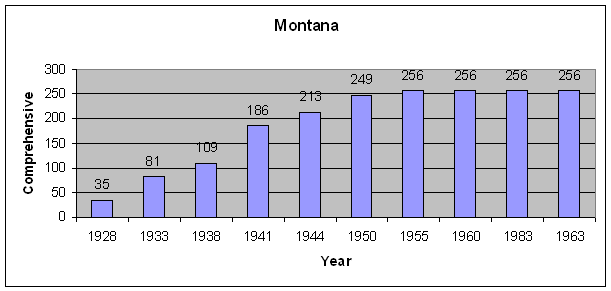
Sterilizations in Montana occurred at a fairly steady pace until the late 1930s. Between the beginning of 1938 and the end of 1940 77 people were sterilized, which represents the highest annual figures for Montana’s sterilization history. By the mid-1940s, a reluctance to enforce the law had caused the numbers of sterilizations to decrease. Yet immediate after World War II in 1946, 15 sterilizations did occur in a single year (Paul, pp. 404-405). The annual rate of sterilization per 100,000 residents per year was during the peak period of sterilizations in 1938-1940 was almost 5.
Passage of the Law
Montana’s eugenic sterilization law was passed by the State Legislature in 1923 and signed into law by Republican Governor Joseph M. Dixon (Paul, pp. 404-405). It was repealed in 1981 (see Roth, p. 10).
New Sterilization Law
In 1969 Montana’s eugenic sterilization law was replaced with a much
more lenient sterilization procedure (Schultz, p. 1). This new law
made mandatory sterilization illegal if the consent of the patient was
not obtained. Even so, sixty-six people were sterilized from
1969-1972; these people were all found incapable of caring for
children, or were expected to pass on undesirable traits to their
potential offspring (Schultz, p. 1).
Groups Identified in the Law
“The law provides for the prevention of the procreation of hereditary idiots, feeble-minded, insane, and epileptics, who are inmates of state institutions” (Landman, p. 82).
Process of the Law
Montana’s State Board of Eugenics
could approve applications
for sterilizations made by physicians at the institutions with state
custodial
inmates. If consent of the patient was not forthcoming, the Board was
to
conduct a hearing before approval but had final authority (Landman, p.
82). While
the law was technically compulsory, sterilizations in Montana did not
occur without
the consent of the patient and/or their families. As opposed to almost
all
other states, with the possible exception of Iowa, Julius Paul noted,
Montana
had a “higher sense of patient’s rights,” and regarded “consent as
mandatory.”
In addition, the law that enacted sterilization in Montana provided the
patient
the right of appeal in District Court if for whatever reason
traditional norms
of consent were disregarded (Paul, pp. 404-405). Doctor
G. D. Carlyle Thompson, a former chairman of the Montana Eugenics
Board, wrote that in no cases did the Board approve a sterilization
without receiving consent from a patient or a patient’s guardian,
“‘even though to do so has meant extensive effort to obtain such a
consent from, some time, at long distances…that is in
other states…’" (quoted in Paul, [. 404).
Court Cases
In 1924 Dr. Hathaway, superintendent of the Montana State Asylum, was
sued for sterilizing eleven patients without their consent. The Helena
Daily Independent ran the headline “Butchery of Helpless is Officially
Reported” during the trial. The precise outcome of the trial is
unclear (Lombardo, pp. 75, 313).
“Feeder Institutions”
 (Photo origin: Rootsweb.com; available at http://www.rootsweb.ancestry.com/~asylums/montanadev/index.html)
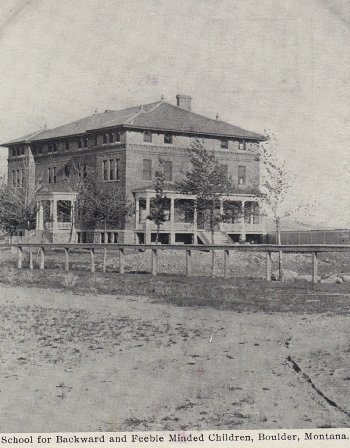
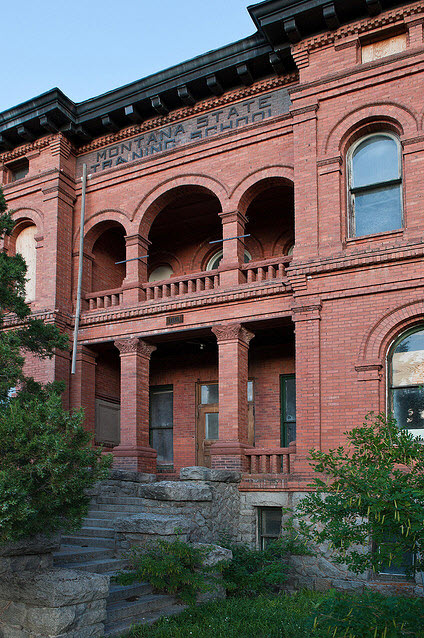
The two main “feeder institutions” from where sterilization victims were drawn were primarily the Montana State Training School and also the Montana State Mental Hospital. The State Training School was in Boulder (afterwards name Boulder River School and Hospital) and now appears to be part of the Montana Developmental Center there.
 (Photo origin: Rootsweb.com; available at http://www.rootsweb.ancestry.com/~asylums/warmsprings_mt/shericwarm1.jpg)
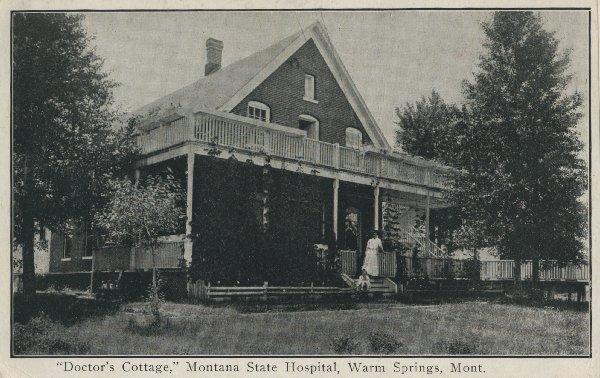
The Montana State Mental Hospital in Warm Springs is open to this day, and part of the complex is used as a prison as well as a psychiatric facility (Arehart-Treichel).
As of December 2nd, 1924, all sterilizations
performed in Montana under the new eugenics law were done at the
Montana State Hospital.
(Photo origin: Ron Armstrong; available at http://www.flickr.com/photos/montanapets/3745645736/)
Oftentimes guardian permission was difficult to secure because “no mater how apparent to others may be the mental deficiency of son, daughter, sister, brother, wife or husband, those to whom the patient is most dear can see no deficiency in that patient”(Montana State Hospital, p. 23). In fact, there were many instances at the Montana State Hospital in which a patient’s family members tried to remove the patient from the facility, while simultaneously the authorities pushed for sterilization (Montana State Hospital, p. 23).
Each of the first three patients who were sterilized under the new law
were young women who had children out of wedlock. These women
were released from the State Hospital after the procedure, because they
were able to financially support themselves in society (Montana State
Hospital, pp. 23-24). While more than 650 patients were released from the Montana State
Hospital in between the passing of the eugenics law (1923) and 1924,
“only twenty-three of their entire number, less than five per cent,
were subjected to sterilization” (Montana State Hospital, p. 24).
References to either institution’s eugenic past are absent from their websites.
Bibliography
Arehart-Treichel, Joan. 2001. “In Montana, State Hospital Opens New Door.” Psychiatric News (August 17): 14. Available at <http://pn.psychiatryonline.org/cgi/content/full/36/16/14>.
Landman,
J. H. 1932. Human
Sterilization: The History of the Sexual Sterilization Movement.
New York:
MacMillan.
Lombardo, Paul. 2008. Three Generations, No Imbeciles: Eugenics, the
Supreme Court, and Buck v. Bell. Maryland: The Johns Hopkins University
Press.
Montana State Hospital for the Insane. 1924. “Biennial Report of the
Montana State Hospital, Warm Springs, Montana.” Warm Springs, Montana:
The Hospital.
Paul, Julius. 1965. "'Three Generations of Imbeciles Are Enough': State Eugenic Sterilization Laws in American Thought and Practice." Unpublished Manuscript. Washington, D.C.: Walter Reed Army Institute of Research.
Roth, Tona. 1999. "Eugenic Sterilization in Montana from 1900 to 1999." Undergraduate paper, Carroll College.
Schultz, L. F., and Montana Developmental Disabilities Planning and
Advisory Council. 1986. Sterilization for Those Involved in Mental
Retardation: History, Issues and Options for Montana. Montana: Montana
State Developmental Disabilities Planning and Advisory Council.