Home
Wiesloch (Badische staatliche Heil- und
Pflegeanstalt fuer Geisteskranke Wiesloch)
The Kinderfachabteilung in Wiesloch operated from the end of 1940 (the first
child that had been admitted under Reichsausschuss procedure was admitted in
mid November 1940), until August 1941, after no admissions to the ward had
been made after April. It was the fifth or sixth of all "special
children's wards" to open, and the first to be established in what is today
the state of Baden-Wuerttemberg. Up to the late 1930s, the facility did not
typically admit children among its patients (see Peschke 2012, p. 603), and
as at the time Dr. Schreck (see below) began his appointment in October
1940, only a very small number of minors (at least six) between the ages of
2 to 14 were patients, children, in as much they were a physical presence on
site, must have stood out somewhat, as did the nurses of the
Reichsausschuss, who had been delegated there from Berlin. The clinic's
director was Dr. Wilhelm Moeckel, and the deputy director and
responsible for the Kinderfachabteilung was Dr. Arthur Schreck. After Dr.
Schreck found it impossible to continue with the killing personally, a
physician from the special children's ward in Eglfing-Haar, Dr. Fritz Kuehnke (see Eglfing-Haar), came to carry out the
murders. After the war, Dr. Schreck was sentenced in Freiburg in 1950 to 12
years in prison, but he was pardoned by the governor of the state in 1954
and worked as a physician in Pfullendorf. He died there in 1963. Dr. Moeckel
died in 1954.
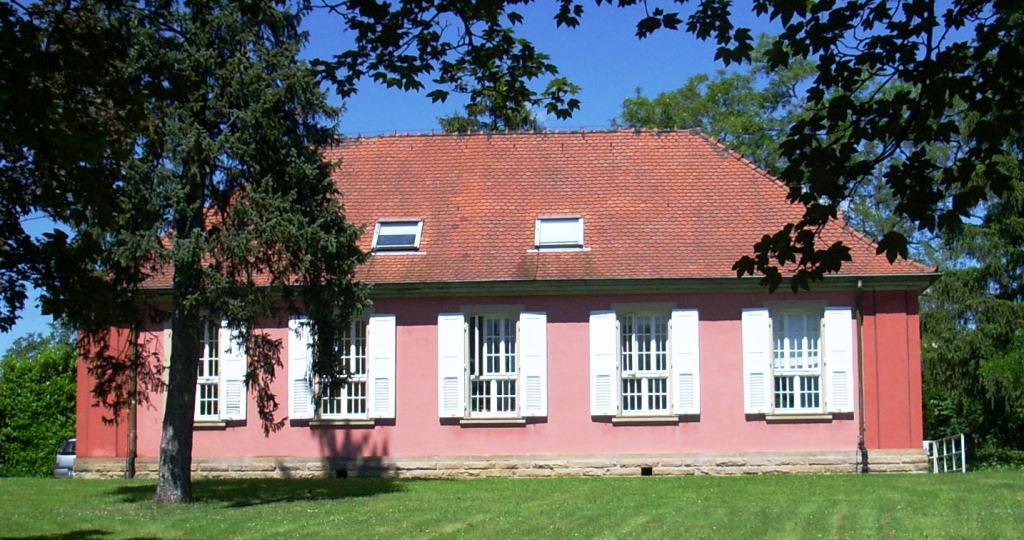 Source: author
The number of children who died in the special children's ward was
small. 12 small children who had been admitted by April 1941 had died
between March and August 1941; one more died after having been transferred
to the special children's ward in Eglfing-Haar. . Three of the children were
killed by Dr. Schreck; nine, by Dr. Kuehnke. Older
children and youth also had been admitted to Wiesloch and reported
on questionnaires used for the T4 action; after the sudden stop to T4 their
status likely changed to "Reichsausschusskinder," and six of them were
transferred to the special children's ward in Kaufbeuren in December 1941
(four of them died there). This ended the collaboration between Wiesloch and
the Reichsausschuss.
At the beginning of the 1943, four children/youths were admitted to the
"research station" on site. It was directed by Dr. Carl Schneider of the
University of Heidelberg and autonomous from the Wiesloch hospital in
matters of organization, finance, and personnel. As an organizational
arrangement, it existed between summer 1942 and spring 1943, for the
purpose of examining patients with certain medical and psychiatric
diagnoses and ultimately have the murdered so that their remains could be
'scientifically utilized.' To make space for an actual physical station,
80 patients were transferred from Wiesloch to other care facilities, of
whom only 13 were still alive by war's end. The physical station existed
between January and March of 1943 and housed 10 minors. The station was
closed after Dr. Schneider had become ill and funding by the 'T4'
organization dried up. Two of these four children/youths died there
or shortly after release, while two others were transferred to Emmendingen
and then Kaufbeuren, where one of them was killed.
Soon after the end of WWII the American major Leo Alexander, commissioned to
produce a report for the Combined Intelligence Objectives Sub-Committee,
visited Wiesloch and noted his impressions as well as the facts he
established in his report (see here: 1, 2, 3, 4). The full report contains an extensive appendix not
included in the version on the Internet (see Alexander 1945).
As has been argued in a new monograph on the subject matter (Janzowski
2015), the immediate afterwar period evinced few signs to come to terms with
the facility's Nazi past, at least in so far "children's euthanasia" was
concerned. In the context of the Grafeneck trial, a list of deceased
children was composed, but neither the slipshod denazification (civilian)
tribunals nor the Freiburg trial against Sprauer and Schreck, which led to
Sprauer's conviction for killing the children merely on charges of
manslaughter, nor the perfunctory subsequent investigations by the
Heidelberg state attorney's office or during the later trial against Kuehnke prompted to a local response of
recognition of the victims (2015, pp. 383-406). As Janzowski shows, a report
in the local newspaper in 1950 about the Wiesloch asylum omitted any mention
of the murder of patients, as did a commemorative event on occasion of the
50th anniversary of the facility in 1955--in part because the personnel had
remained little changed with the end of WWII, relatives of victims may have
feared being tainted by their disclosing of a disability in the family, and
a general concern that the shaken trust in the facility as a provider of
medical and psychiatric care might suffer as a consequence of such
revelations.
On occasion of the 40th anniversary of the transport of the first 42
mentally ill patients of the hospital Wiesloch to the T4 killing center
Grafeneck (see T4) in late February 1940 staff of the clinic assembled to
commemorate this event and to erect an almost 2 meter high wooden cross in
front of the hospital chapel, with the inscription "To the victims of the
'Program Merciful Death,'" and a first commemorative event took place. In
the same year, a pamphlet by the facility on occasion of its 75th
anniversary contained references to the "euthanasia" killings by way of
acknowledging the transfer of more than 1000 patients (to murder facilities
such as Grafeneck and Hadamar). Still, in 1986 a publication by the facility
stated that it was "still unclear whether a Kinderfachabteilung had existed
here" (Janzowski 2015, pp. 412-13).
In 1990, at the 50th anniversary of the above-mentioned event (the first
transport to Grafeneck), a larger audience witnessed the commemorative
event, and a heterogeneous group of staff, medical personnel, and
students formed as the "Committee Infirmary and Hospital Wiesloch During the
Period of National Socialism." It included the then medical director, Dr.
Hans Dieter Middelhof, who
actively supported their activities. The committee helped bring about a
variety of activities to shed light on the past, as well as create a
permanent memorial. A competition for a permanent memorial was held.
Source: author
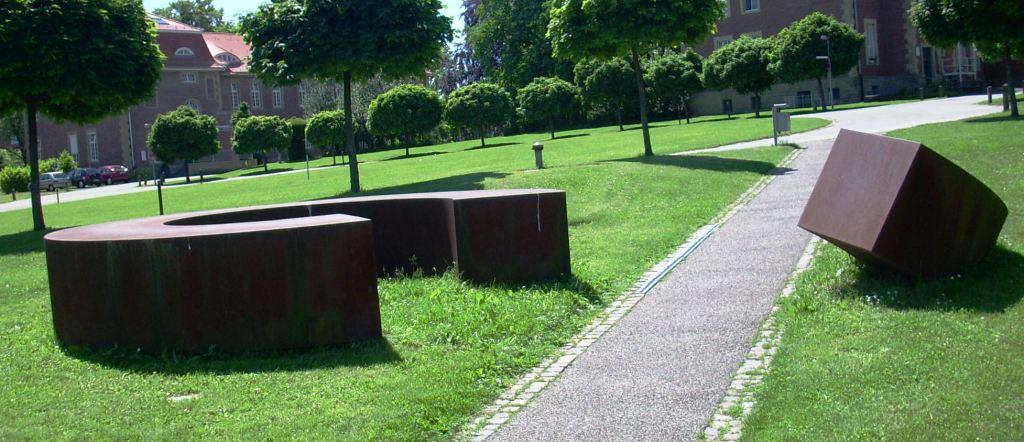
The memorial was established in April 1994, replacing the wooden cross. The
sculpture was created by artist Susanne Zetzmann. The inscription reads: "In
the years 1934 to 1945 more than 2,000 patients of the infirmary and
hospital Wiesloch were made to lose their dignity, [they were] mistreated,
and murdered. To them in commemoration, to us as a warning" (In den Jahren
von 1934 bis 1945 sind mehr als 2000 Patienten der Heil- und Pflegeanstalt
entwuerdigt, misshandelt oder ermordet worden. - Ihnen zum Gedenken, uns zur
Mahnung). The iron sculpture has the form of a circle, with a
small ring broken off, tilted upward and sunken in in part. A possible,
suggested interpretation of the memorial's shape and form is that the larger
part symbolizes the majority (bystanders, supporters, perpetrators), while
the smaller part, which sinks somewhat into the soil, represents the
minority (victims), who remain anonymous and largely unknown. The memorial
does not address the victims of the children's ward in particular.
Since 1996, Germany has had a Day of Commemoration for the Victims of
National Socialism on 27 January, and for some years on this day a variety
of commemorative activities have taken place at the hospital Wiesloch,
although it does not appear that any one of them has been specifically
dedicated to the victims of the special children's wards.
The web page
of the clinic, today the Psychiatrisches Zentrum Nordbaden, openly and
frankly addresses the events during the Nazi period, and there is a flyer
on the topic of commemoration.
In 2011, Dr. Janzowski presented new insights into "children's euthanasia"
in the context of a memorial event (see here: 1, 2)
and published a book chapter on the current state of knowledge. Dr. Peschke
has published a monograph on the asylum at Wiesloch in 2012, and Dr.
Janzowski in 2015.
There is a stumbling block for Adelheid Bloch, an adult victim of T4 who was
transported from Wiesloch to Grafeneck: http://stolpersteine-konstanz.de/index.html?adelheid_bloch.htm.
A biography of another T4 victim who resided at the Wiesloch institution and
died at Grafeneck, Oskar Bornhaeuser, has also recently been made available
(Bornhaeuser 2013).
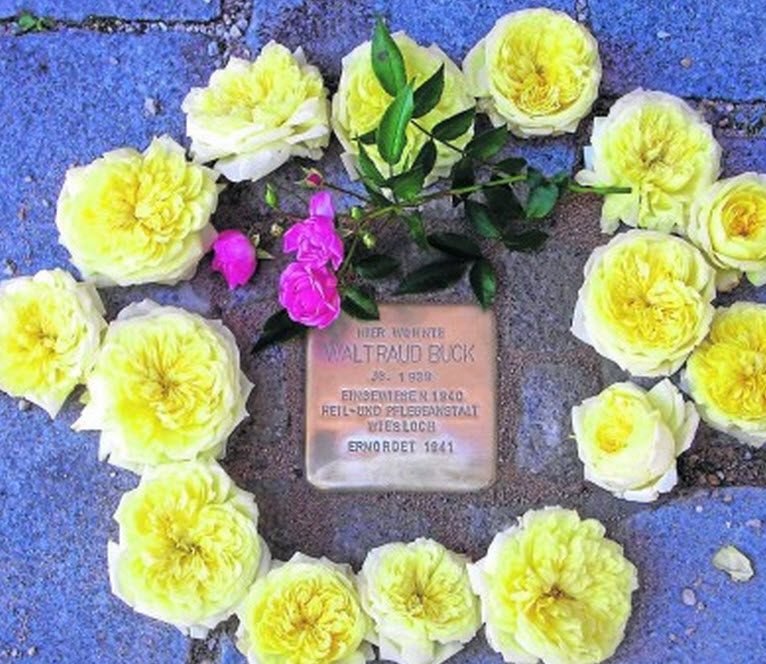
Another stumbling block was dedicated to a child victim, Waltraud Buck, in
2012 (see here).
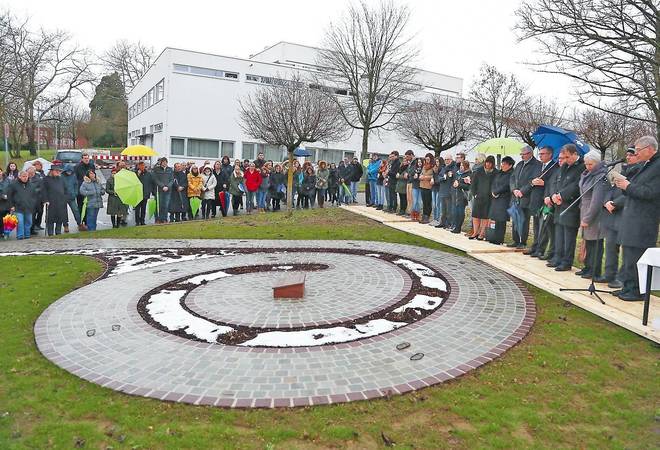
In January 2015 the dedication of new memorial occurred in close proximity
to the historical station MI, where the special children's ward was once
housed. The clinic has provided a detailed account (http://www.pzn-wiesloch.de/unser-zentrum/geschichte/kinderfachabteilung-1940-1941),
including references to two stumbling blocks for child victims who were
patients at Wiesloch (they were murdered elsewhere).
Source: Rhein-Neckar Zeitung
(http://www.rnz.de/nachrichten/wiesloch_artikel,-Wiesloch-PZN-weiht-Mahnmal-gegen-den-Nationalsozialismus-ein-_arid,72193.html)
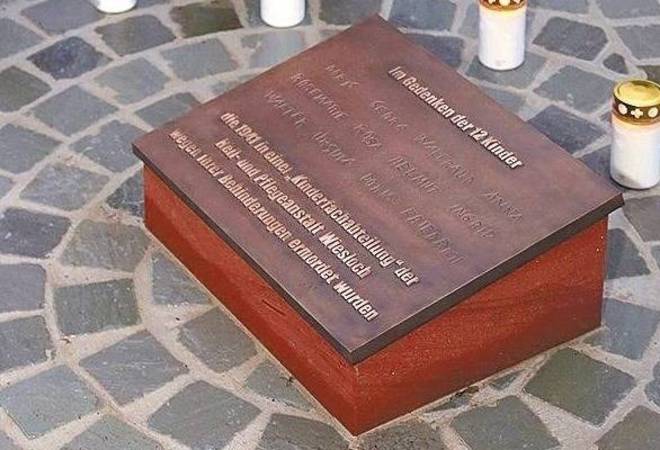
The memorial's designer is Elke Weickelt-Starzinski. The memorial consists
of a spiral path, "like a one-way street," that shows the footprints of 12
little feet in bronze and is bordered by 12 rose bushes, with a central
commemorative object, a plaque in bronze, in the middle. The inscription
reads: "In memory of the 12 children Anna, Doris, Friedrich, Helmut, Rosa,
Ursula, Waltraud, Georg, Ingrid, Rose-Marie, Walter, Doris who in 1941 were
murdered in a "special children's ward" of the Wiesloch asylum due to their
disability."
In her book on Esslingen during National Socialism, G. Siberzahn-Jandt
(2015) addresses the fate of children sent from Esslingen to Wiesloch (pp.
213-20). Based on records of the Grafeneck trial, she refers to Waltraud
Buck and Helmut Rilling (pp. 278-79).
An article by Franz Janzowski and Hansi Rau (2023) contains biographies of
victims as well as the most current research on the topic.
Digital reproductions of records of the Grafeneck trial relate to a
number of children from Wurttemberg who died in the Wiesloch facility in
1941 (http://www.landesarchiv-bw.de/plink/?f=6-902779).
Literature
Alexander, Leo. 1945. "Public Mental Health Practices in Germany:
Sterilization and Execution of Patients Suffering from Nervous or Mental
Disease." Cios Item 24 Medical. Armed Forces Supreme Headquarters: Combined
Intelligence Objectives Sub-Committee.
Arbeitskreis "Die Heil- und Pflegeanstalt Wiesloch in der Zeit des
Nationalsozialismus." 1992-1995. Schriftenreihe
des
Arbeitskreises "Die Heil- und Pflegeanstalt Wiesloch in der Zeit des
Nationalsozialismus. Wiesloch: Psychiatrisches Landeskrankenhaus
Wiesloch. Available here: vol. 1, 2, 3.
Benzenhoefer, Udo. 2003. "Genese und Struktur der
'NS-Kinder- und Jugendlicheneuthanasie.'" Monatsschrift
fuer Kinderheilkunde 151: 1012-19.
------. Kindereuthanasie in der NS-Zeit unter besonderer
Beruecksichtigung von Reichsausschussverfahren und Kinderfachabteilungen
(Ulm: Klemm & Oelschlaeger, 2020).
Bornhaeuser, Doris. 2013. Oskar
B.: Bruchsal 1899 - Grafeneck 1940: Eine biographische Annaeherung.
Grafeneck: Gedenkstaette
Grafeneck.
"Gedenken an Euthanasieopfer: 'Organisierte Selektion zum
Tode.'" Localmatador.de 06
February 2011. Available at http://www.lokalmatador.de/article/c06e3f61addc4e91b4ed590c4780e8d6/.
Janzowski, Frank. 2011. "Reichsausschusskinder und
andere Minderjaehrige in der Wieslocher Heil- und Pflegeanstalt
1940 bis 1944." Pp. 91-120 in Kindermord
und "Kinderfachabteilungen" im Nationalsozialismus: Gedenken und
Forschung, edited by Lutz Kaelber und Raimond Reiter. Frankfurt:
Lang.
--.2015. Die NS-Vergangenheit in
der Heil- und Pflegeanstalt Wiesloch: "... so intensiv wenden wir unsere
Arbeitskraft der Ausschaltung der Erbkranken zu." Ubstadt-Weiher:
verlag regionalkultur.
--, and Hansi Rau, "Die vergessenen
Reichsausschusskinder der Heil- und Pflegeanstalt Wiesloch 1940 bis
1941," Zeitschrift fuer Psychiatrische Pflege Heute 29 (2023):
243-253.
Peschke, Franz. 2009. "Die Heil- und Pflegeanstalt
Wiesloch im Dritten Reich." Public lecture. Available at http://www.ag-landeskunde-oberrhein.de/index.php?id=p492v.
--2012. Oekonomie, Mord und
Planwirtschaft: Die Heil- und Pflegeanstalt Wiesloch im Dritten Reich.
Bochum: projekt verlag.
Puvogel, Ulrike, and Martin Stankowski. 1996. Gedenkstaetten
fuer die Opfer des Nationalsozialismus, vol. 1. 2d ed. Bonn:
Bundeszentrale fuer politische Bildung. Available at http://www.bpb.de/files/5JOYKJ.pdf.
"Schreck, Arthur." Wikipedia
(German language) (http://de.wikipedia.org/wiki/Arthur_Schreck)
Silberzahn-Jandt, Gudrun. 2015. Esslingen
am Neckar im System von Zwangssterilisation und "Euthanasie" waehrend
des Nationalsozialismus: Strukturen - Orte - Biographien. Ostfildern:
Jan Thorbecke.
Topp, Sascha. 2004. 'Der 'Reichsausschuss zur wissenschaftlichen Erfassung
erb- und anlagebedingter schwerer Leiden': Zur Organisation der Ermordung
minderjähriger Kranker im Nationalsozialismus 1939-1945.' Pp. 17-54 in Kinder
in der NS-Psychiatrie, edited by Thomas Beddies and Kristina Huebener.
Berlin-Brandenburg: Be.bra Wissenschaft.
--. 2005. "Der 'Reichsausschuss zur wissenschaftlichen
Erfassung erb- und anlagebedingter schwerer Leiden': Die Ermordung
minderjaehriger Kranker im Nationalsozialismus 1939-1945." Master's Thesis
in History, University of Berlin.
Last updated in September 2023