
|
|
|
|
Still, changes had begun to occur since the late 1980s.
when Dr. Bernhardt as well as others at the clinic, as part of a working
group to inquire into the events at the clinic during the Nazi period,
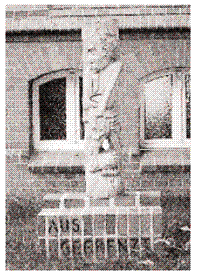
commissioned a commemorative wooden statue, which was made by the artist
Sven Domann and erected in 1991. While the Gedenkstätten für
die Opfer des Nationalsozialismus volume terms it "the first
monument to the victims of NS-'euthanasia' on the territory of former East
Germany" (p. 480), it wasn't quite that in terms of the date of its
dedication (see Grossschweidnitz, where a memorial was dedicated in 1990), but it was one of the first such
memorials nevertheless (it does not address the children’s ward
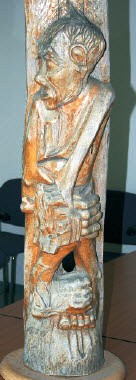
specifically). The working group's charge to the artist was to depict a
sense of being alone, unprotected, and afraid for their lives ostensibly
felt by those who were victims of "euthanasia" in the Nazi period, which
the artist realized in the depiction of a disabled person on a piece of
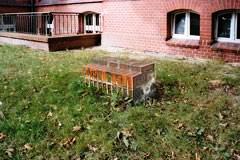
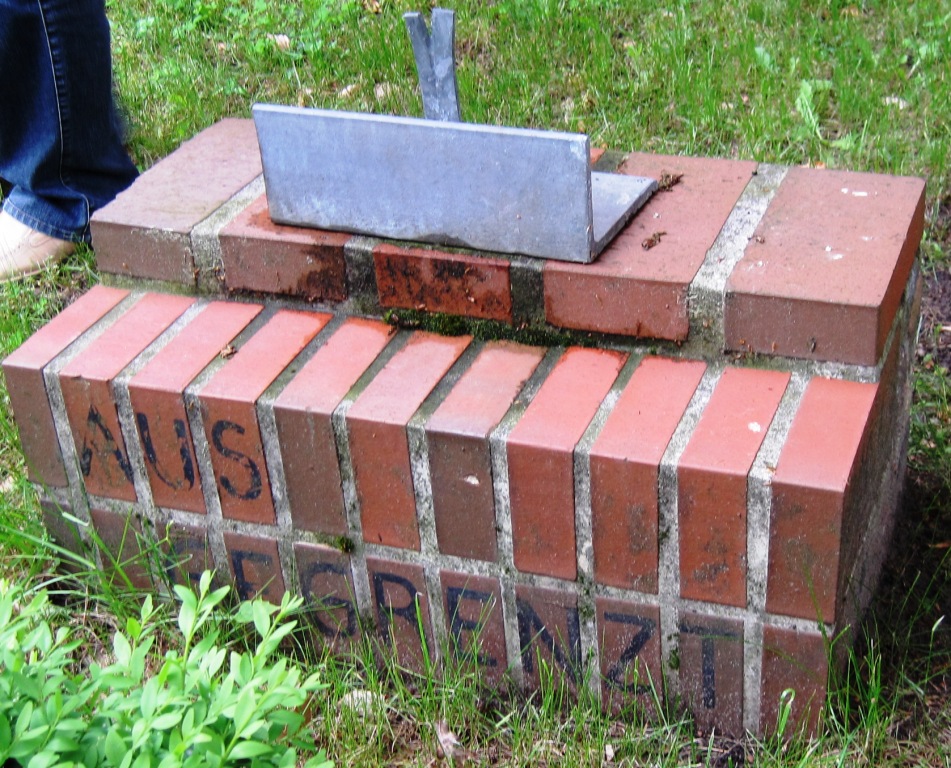
wood cut off, placed on top of a pedestal for which the same brick was
used as in the facility where the victims were murdered.
On a pedestal in the front the word "Ausgegrenzt"
(Marginalized) is shown, and on the back, the word "Vernichtet"
(Exterminated). To the left and right are the years 1933 and 1945. After
the occurrence of vandalism and heavy construction at the site, it was
removed and only shown to the public on special occasions, such as during
the clinic's open house day in various years and the anniversary events in
1999 and 2000.The memorial's removal from a public space was believed to
be temporary at first, but it turned out to be anything but. Most of the
time, it was put up in the clinic administration's conference center.
The situation remained like this until 2008, when this
researcher fielded inquiries about the status of the statue first to the
clinic and then to the Behindertenverband Ueckermuende and the Allgemeiner
Behindertenverband in Mecklenburg-Vorpommern. The two agencies consulted
with the clinic and asked that the statue be re-erected. Prior to that, in
1999, a commemorative event was held on occasion of 60th anniversary of
the first deportation of patients in November 1939; during which a
presentation alluded to the fate of the children; in 2000, on open house
day in 2000, on occasion of the 125th anniversary of the facility, one of
the lectures at a symposium and a part of a small exhibit addressed the
murder of patients in Pomerania during the Nazi period; in the same year a
chronicle of the clinic (Albrecht 2000) mention euthanasia, if only very
briefly (in reference to H. Bernhardt's studies, see p. 25); and in 2005,
on occasion of the European day of protest for equity for persons with a
disability on May 5, a wreath was laid on facility grounds to commemorate
victims of fascism persecuted on the basis of disability or race and the
60th anniversary of the end of the war on May 8.
 |
 |
 |
Source: author
A wreath was laid on 8 May 2008 at the AMEOS Diakonie
Klinikum (the clinic's current name) and an event took place to
commemorate those who were murdered during the Nazi period. A project
group “Denkmal” (“memorial”) of members of the above groups and clinic
personnel met and new foundation for the statue at a designated memorial
space on clinic property was being considered, which led to the
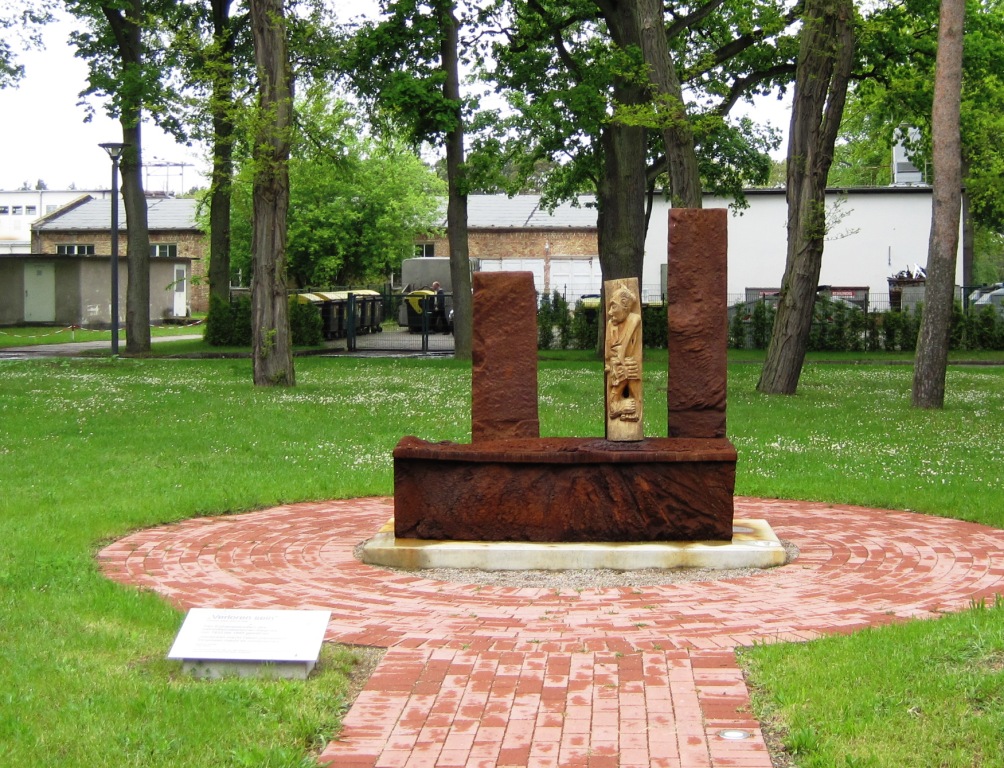
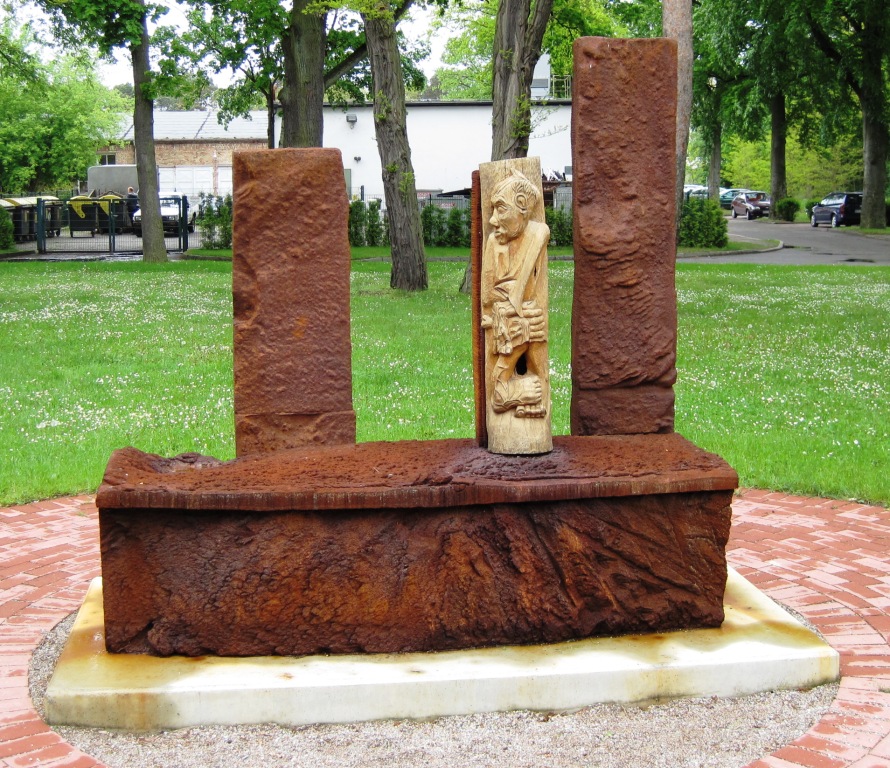
re-dedication of the memorial on 15 May 2009. It is now an iron-cast
pedestal and a three-piece stela into which the wooden piece is
integrated.
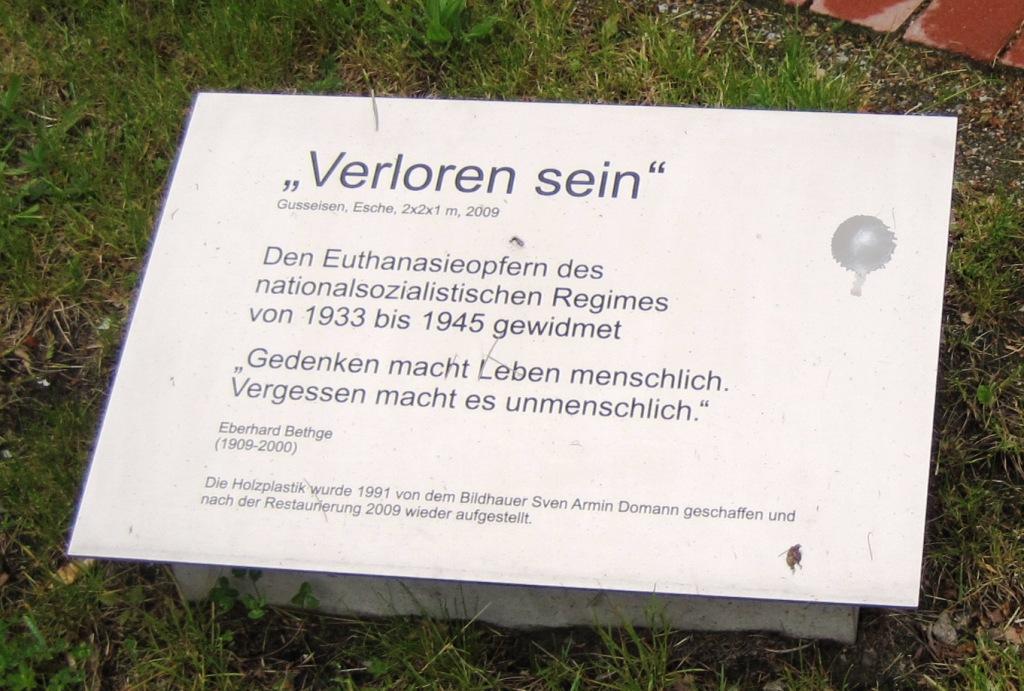
A sign states: "'Verloren sein.' Eisenguss, Esche, 2x1
m, 2009. Den Euthanasieopfern des nationalsozialistischen Regimes von 1933
bis 1945 gewidmet. 'Gedenken macht Leben menschlich. Vergessen macht es
unmenschlich' - Eberhard Bethge (1909-2000). Die Holzplastik wurde 1991
von dem Bildhauer Sven Domann geschaffen und nach der Restaurierung 2009
wieder aufgestellt" ('To be lost.'Cast iron and ash wood, 2 x 1 m, 2009.
Dedicated to the euthanasia victims of the National Socialist regime
1939-1945. 'Memorialization makes life humane. Forgetting makes it
inhumane.' [German theologian] Eberhard Bethge (1909-2000). The wood
sculpture was created by the sculptor Sven Domann and reinstalled after
its restoration in 2009).
The choice of the new context for the statue is guided by the wish to allude to the next-to-last place that houses persons before those in power decide to murder them. Children helped prepare the iron cast. .
The web page of the clinic does not refer to the memorial or Nazi "euthanasia" on its premises, but two recent issues of the Mitarbeiterzeitung (staff newsletter) have done so.
Recent commemorative activities are reported here, in detail here (published by the Allgemeiner Behindertenverband in M-V e.V.), and, for 2015, here (snapshot taken from http://www.ameos.eu/582+M56d8368ff81.html)
Literature
Albrecht, Hans-Eberhard. 2000. Das Krankenhaus am Rande der Stadt: Das Krankenhaus Ueckermünde an der Ravensteinstrasse im Wandel der Zeit von 1875 bis 2000. Ueckermünde: n.p.
Allgemeiner Behindertenverband in
Mecklenburg-Vorpommern e.V. 2008. "Mahnmal gegen das Vergessen in
Ueckermünde: Wiedereinweihung des restaurierten Mahnmals zum Gedenken an
die Opfer des Nationalsozialismus." Available at http://www.abimv.de/cms/wm-cms,58.html.
Benzenhöfer, Udo. 2003. "Genese und Struktur der
'NS-Kinder- und Jugendlicheneuthanasie.'" Monatsschrift
für Kinderheilkunde 151: 1012-1019.
Bernhardt, Heike. 1993. "'Niemals auch nur zu den
primitivsten Arbeitsleistungen zu gebrauchen': Die Tötung behinderter und
kranker Kinder 1939 bis 1945 in der Landesheilanstalt Ueckermünde." Praxis
der Kinderpsychologie und Kinderpsychiatrie 42: 240-48.
———. 1994. Anstaltspsychiatrie und "Euthanasie" in Pommern 1939 bis 1945: Die Krankenmorde an Kindern und Erwachsenen am Beispiel der Landesheilanstalt Ueckermünde. Frankfurt: Mabuse Verlag.
Endlich, Stefanie, Nora Goldenbogen, Beatrix Herlemann, Monika Kahl, and Regina Scheer. 2002. Gedenkstätten für die Opfer des Nationalsozialismus, vol. 2. Bonn: Bundeszentrale für politische Bildung. Available at http://www.bpb.de/files/AFQX24.pdf.
Klee, Ernst. 1993. Irrsinn
Ost, Irrsinn West. Frankfurt: Fischer.
Schmitz, Willi, and Harri Joschk. 1974. Provinzial-,
Heil- und Pflegeanstalt Ueckermünde: Das Neuropsychiatrische Krankenhaus
Ueckermünde. Neubrandenburg: Druckerei Erich Weinert.
Topp, Sascha. 2004. “Der ‘Reichsausschuss zur wissenschaftlichen Erfassung erb- und anlagebedingter schwerer Leiden’: Zur Organisation der Ermordung minderjähriger Kranker im Nationalsozialismus 1939-1945.” Pp. 17-54 in Kinder in der NS-Psychiatrie, edited by Thomas Beddies and Kristina Hübener. Berlin-Brandenburg: Be.bra Wissenschaft.
———. 2005. "Der 'Reichsausschuß zur wissenschaftlichen Erfassung erb- und anlagebedingter schwerer Leiden': Die Ermordung minderjähriger Kranker im Nationalsozialismus 1939-1945." Master's Thesis in History, University of Berlin.
Last updated on 20 Feb. 2015