Home
Schleswig-Hesterberg (Landes-, Heil- und Pflegeanstalt
Schleswig-Hesterberg; since January 1934
Landesaufnahme- und Erziehungsheim)
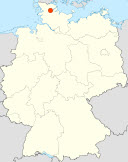
The Kinderfachabteilung at the Landes-, Heil- und Pflegeanstalt
Schleswig-Hesterberg existed between December 1941 at the latest and
February 1942. The facility on the Hesterberg was founded in 1875 and
subsequently became a home for mentally disabled children and children with
mental disorders. At the end of the 1930s, children who were considered
difficult or deviant (called 'psychopaths' for being difficult to educate)
were brought there, and in 1934 children who were wards of the state and
those who needed extensive nursing care. A year later an infant station was
added. It thus was one of the core facilities for the care of children and
youths in the Province of Schleswig-Holstein. When in May 1940 a prison of
war camp was established on the premises, conditions became cramped, and in
April 1941 106 children and youths were transferred to the facility at Schleswig-Stadtfeld.
On 3 February 1942 all remaining children were transferred there, as the
Hesterberg was used from there on as a military reserve hospital as well as
a prisoner of war camp.
The director of the institution was the administrative officer Alfred
Hartwig, but responsible for medical matters and for the special children's
ward was the physician Dr. Erna Pauselius, who transferred to the Stadtfeld
institution with the children in February 1942. Some of the children at the
Hesterberg became victims of the "T4" program and were murdered at Bernburg.
In September 1941 Dr. Pauselius took part in an internship at the
Kinderfachabteilung Brandenburg-Görden, and the number of children who died
at the Hesterberg increased significantly already in December 1940 and
stayed at a relatively high level in 1941. Both of these facts could
indicate that the special children's ward already existed before December
1941, and the latter that children were killed even before its
establishment.
A total of 216 children and youths up to 16 years of age are confirmed to
have died at the Hesterberg and Stadtfeld facilities between September 1939
and May 1945. For almost all of them, their medical records are extant. S.
Misgajski, in Der Hesterberg (pp.
50, 53), notes that the special children's ward was not physically separated
from other children's stations on the Hesterberg.
After WWII, relatives of patients who assumed that patients had been
murdered filed charges, and both the state attorney's office (in Kiel) and
committees of the diet of Schleswig-Holstein inquired into the subject
matter, but the proceedings did not result in a trial. Following the
Heyde-Sawade affair, another investigation followed between 1961 and 1965,
resulting in no charges. Dr. Pauselius died in 1989.
In the late 1980s a heterogeneous ensemble of citizens and local historians
recognized the lack of knowledge about the role of the psychiatric
facilities in "euthanasia" in Schleswig during the Nazi period, overcoming
initial resistance by the state archive to allow access to records. Symposia
in the late 1980s and early 1990s, supported by the directorship of the
clinic, and particularly the essay by the historian Klaus Bästlein on the
special children's ward established a foundation for commemoration. Also
active in the exploration of the Nazi crimes in Schlewig-Holstein, including
"euthanasia," is the Arbeitskreis zur Erforschung des Nationalsozialismus in
Schleswig-Holstein e. V. (AKENS), which was founded in 1983.
Source: Kanniess; author
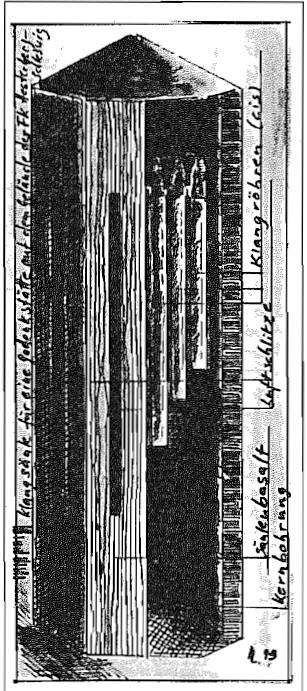
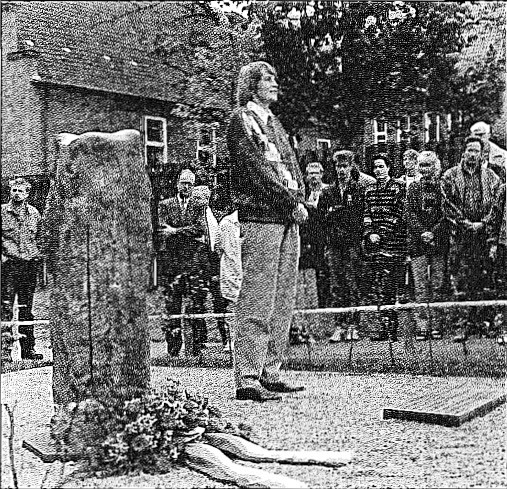
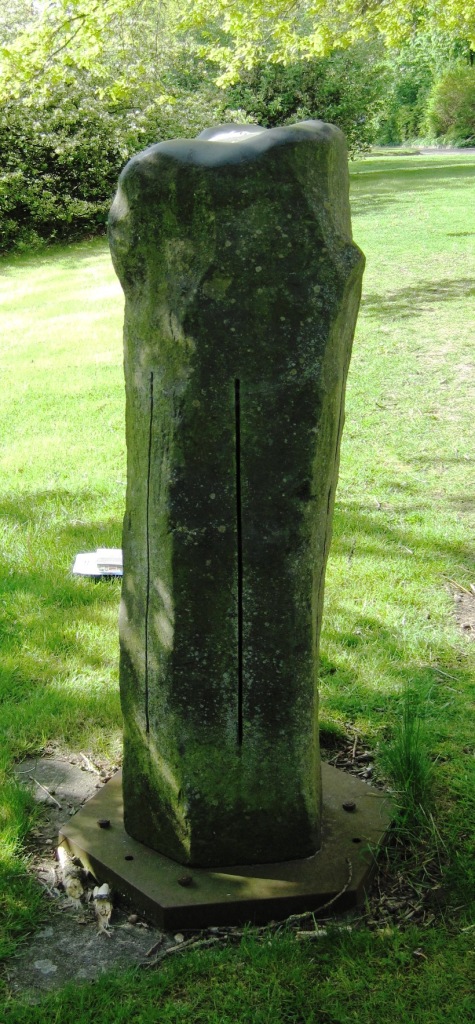
In 1993 a memorial was established in the clinic Hesterberg, a column
created by the sculptor Ulrich Lindow from which sound tubes are hung. They
are meant to resonate with the souls of the murdered children.
 Click on sound symbol to hear a recording of the sound of the tubes.
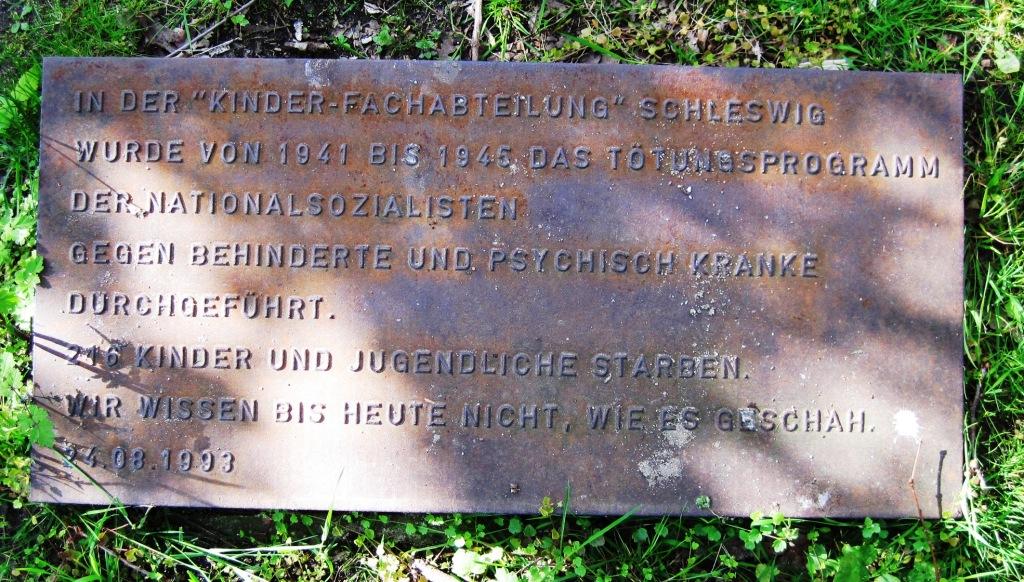
An inscription reads: "In the 'Special Children's Ward' Schleswig between
1941 and 1945 the killing program of the Nazis against disabled and mentally
ill persons was carried out. 216 children and youths died. We don't know to
this day how it happened" (In der »Kinderfachabteilung« Schleswig wurde von
1941 bis 1945 das Tötungsprogramm der Nationalsozialisten gegen Behinderte
und psychisch Kranke durchgeführt. 216 Kinder und Jugendliche starben. Wir
wissen bis heute nicht, wie es geschah).
On occasion of the 125th anniversary of child- and youth psychiatric
facilities on the Hesterberg a traveling exhibit was created (by Susanna
Misgajski) in 1997, for which an accompanying catalog and book was
published.
Both the Schleswig-Hesterfeld and the Schleswig-Stadtfeld facilities were
part of the SCHLEI-Klinikum Schleswig owned by the DAMP group before
becoming part of the HELIOS group under the same name. The company's website does not refer to history of the facilities.
Literature
Bästlein, Klaus. 1991a. 'Die "Kinderfachabteilung'
Schleswig 1941 bis 1945." Informationen
zur Schleswig-Holsteinischen Zeitgeschichte 20:16-45.
———. 1991b. "Die 'Kinderfachabteilung' Schleswig 1941
bis 1945." Schleswig-Holsteinisches
Ärzteblatt 63:18-34.
Benzenhöfer, Udo. 2003. "Genese
und
Struktur der 'NS-Kinder- und Jugendlicheneuthanasie.'" Monatsschrift
für Kinderheilkunde 151: 1012-1019.
Bergen, Hendrike van, Alfred Ebeling, and Christian
Radtke. 1998. "Der Gesprächskreis Erzählte Geschichte in Schleswig:
Erfahrungen und Ergebnisse aus der Arbeit einer lokalen
Geschichtswerkstatt." Informationen zur
Schleswig-Holsteinischen Zeitgeschichte 33/34: 219-26. Available
at http://www.akens.org/akens/texte/info/33/333417.html.
Godau-Schüttke, Klaus-Detlef. 2010. Die
Heyde/Sawade-Affäre: Wie Juristen und Mediziner den
NS-Euthanasieprofessor Heyde nach 1945 deckten und straflos blieben.
Baden-Baden: Nomos (esp. pp. 103-8).
Heesch, Eckhard. 2004. "Marylene: Ein behindertes Kind
im 'Dritten Reich'." Informationen zur
Schleswig-Holsteinischen Zeitgeschichte 43 (April): 24-63.
Jenner, Harald. 1995. Die
Geschichte einer Psychiatrischen Klinik: Schleswig-Stadtfeld.
Schleswig: Fachklinik für Psychiatrie, Neurologie und Rehabilitation
Schleswig.
Kanniess, Jens-Ulrich. 1994. "216 Kinder starben in der
'Kinderfachabteilung' Schleswig. – Staatsanwaltschaft untätig? Der
Eppendorfer: Zeitung für Psychiatrie 9:25-26.
Landesarchiv Schleswig-Holstein, ed. 1997. Der
Hesterberg: 125 Jahre Kinder- und Jugendpsychiatrie und Heilpädagogik in
Schleswig: Eine Ausstellung zum Jubiläum der Klinik für Kinder- und
Jugendpsychiatrie und Psychotherapie sowie des Heilpädagogikums in
Schleswig. Schleswig: Selbstverlag des Landesarchivs
Schleswig-Holstein.
Misgajski, Susanna. 2006. "Der Hesterberg." Pp. 68-77
in Schleswig-Holsteinische
Erinnerungsorte, edited by C. Fleischhauer and G. Turkowski.
Heide: Boyes Buchverlag.
Puvogel, Ulrike, and Martin Stankowski. 1996. Gedenkstätten
für die Opfer des Nationalsozialismus, vol. 1. 2d ed. Bonn:
Bundeszentrale für politische Bildung. Available at http://www.bpb.de/files/5JOYKJ.pdf.
Schwarz, Rolf. 1986. "Ausgrenzung und Vernichtung
kranker und schwacher Schleswig-Holsteiner: Fragen zu einem unbearbeiteten
Problem der Geschichte unseres Landes von 1939-1945." Demokratische
Geschichte 1: 317-38.
Topp,
Sascha.
2004. “Der ‘Reichsausschuss zur wissenschaftlichen Erfassung erb- und
anlagebedingter schwerer Leiden’: Zur Organisation der Ermordung
minderjähriger Kranker im Nationalsozialismus 1939-1945.” Pp. 17-54 in Kinder
in der NS-Psychiatrie, edited by Thomas Beddies and Kristina Hübener.
Berlin-Brandenburg: Be.bra Wissenschaft.
———. 2005. "Der 'Reichsausschuß zur wissenschaftlichen
Erfassung erb- und anlagebedingter schwerer Leiden': Die Ermordung
minderjähriger Kranker im Nationalsozialismus 1939-1945." Master's Thesis
in History, University of Berlin.
Last updated on 14
Feb. 2015