Home
Grossschweidnitz (Staatliche Heil- und
Pflegeanstalt Grossschweidnitz)

The Kinderfachabteilung in Grossschweidnitz was established in December 1943
as the third of (what today is the state of) Saxony's three special
children's wards and the last one known to have been established of all of
these wards. It was a replacement for Leipzig-Dösen, which took up patients
from the bombed-out university clinic in Leipzig that year. It continued to
operate until May 1945. The clinic's medical director was Dr. Alfred Schulz,
who was charged in the Dresden trial but died while in detention in 1947.
The physician responsible for the "special children's ward" was Dr.
Artur Mittag, who had previously been responsible for the ward at
Leipzig-Dösen and who committed suicide in 1946.
140 children had died in the special children's ward by the end of 1944,
based on an analysis of the registration book, with a sharp decline of
children present between January and March 1945. Based on Dr. Mittag's
statement under arrest that he was responsible for 800 killings, and the
fact that 505 killings had been documented for Leipzig-Dösen (the number has
since been revised upward), it has been assumed that at least 300 children
were murdered there. The current website of the emerging new memorial site
at Grossschweidnitz (see below) notes that "at least 270 minors who were
murdered there."
Of about 10,000 patients who were housed in the Grossschweidnitz clinic
between 1939 and May 1945, 2,400 patients were transported to T4
gassing facilities, and about 5,000 died during "wild euthanasia" as
the consequence of being killed by medication, neglect, or starvation. Both
in absolute numbers and a percentage of the overall patient population, the
mortality in this clinic was among the highest in the entire German areas.
In fact, the killing of patients by poisoning them had be authorized and
requested as early as August 1939 by the Saxon Ministry of the Interior, and
accounts exist which date the killing of children there in late 1940. The
mortality rate among the patients in 1940 was 21%, whereas in the years 1933
to 1938 it had been under 5% on average (Böhm 2002, p. 41, in Sonnenstein).
 Source: http://www.gerhard-richter.com/art/search/detail.php?5597
A prominent victim of "decentralized euthanasia" is the aunt of the famous
painter Gerhard Richter, Marianne Schönfelder, whom he painted in 1965 and
whose fate became known to the public as late as the 2000s. In the painting,
which is based on a photograph taken in 1932, she holds the infant Richter
(further information here).
In the early 1980s, a first reference was made to Grossschweidnitz in the
book of Ernst Klee. This came to the attention of the then director, Dr.
Manfred Oertel, who also received requests for information from West German
relatives of former patients who might have been transported to
Grossschweidnitz (and died there), and the director of the Katharinenhof in
Grosshennersdorf also found information that children had been
transported from there to Grossschweidnitz. Dr. Oertel and
colleagues discovered that medical records and statistics still
existed, and that on the basis of extant records these children had then
been transported to a T4 gassing facility (they were murdred in
Pirna-Sonnenstein). Such information was provided in the education of nurses
in training on site since the 1980s, and they were asked to tend to the
cemetery. The knowledge of the trauma in the past was also still present
locally then, as is evident when, for example, older patients who were
receiving outpatient care, when physicians recommended that they come in for
inpatient or stationary treatment, often rejected that recommendation
replying "I don't want to die."
Dr. Oertel and a then-medical student, Holm Krumpolt, began advocating
for a proper form of commemoration in the final years of the German
Democratic Republic. Dr. Krumpolt wrote a dissertation on the subject of
euthanasia in Grossschweidnitz.
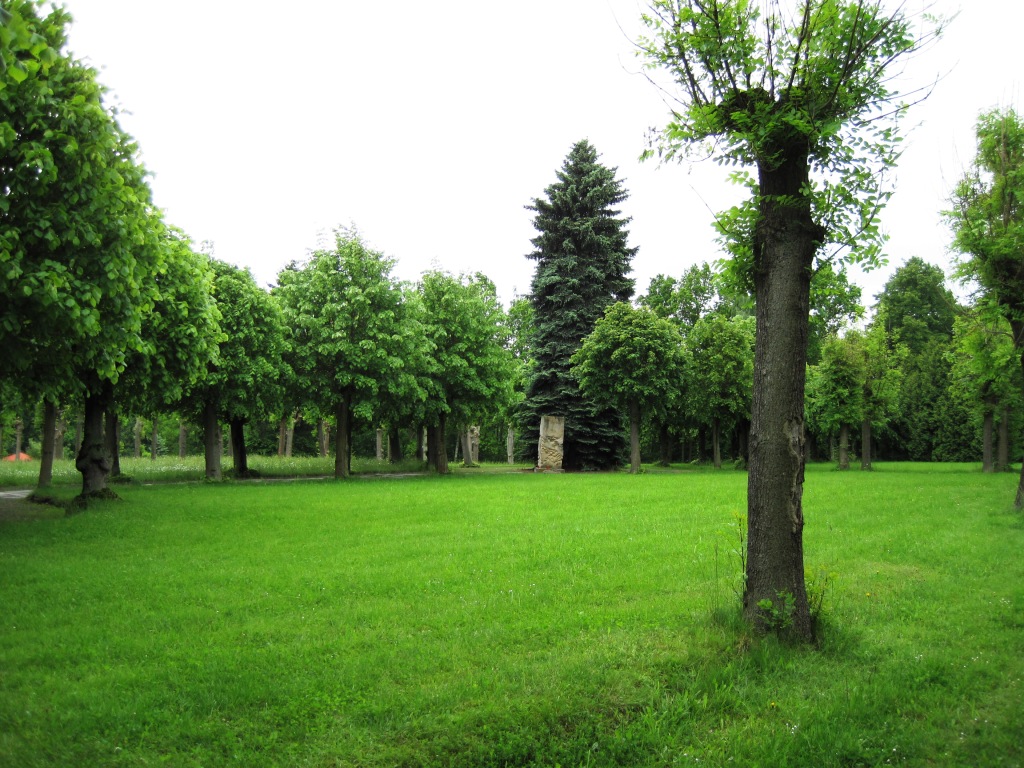
Photo credit: Detlef Hermann; author.
Funded by the clinic and reflecting a local initiative,
a memorial stone by the sculptor Detlef Hermann was placed in the clinic's
cemetery in 1990. It is conceived as a crosscut through a mass-grave (as
it actually surrounded by such a grave), unearthed and thereby bringing
murdered patients back from anonymity. The dead are covered by a thick
layer of soil, as if the past had been covered up, the memories repressed,
and the dead forgotten. The red x marks represent the desk murders at T4
and their activities as evaluators of the questionnaires and the fates of
the patients (a red plus sign meant 'treatment'). Around the memorial is a
field with a vast mass grave.
 Source: author
A plaque, which was placed at the entrance to
the cemetery at the time, reads: "Memorial - For the over 5000 victims of
'Euthanasia' 1940 to 1945, who here found their resting place in mass
graves.- Because as being sick they were 'different,' they were 'checked
and sorted out.' Their fate as a warning to the healthy for all
times. The clinic."
The book published by the clinic on occasion of the its
100th anniversary in 2002 addresses the events between 1933 and 1946
openly. The chronicle of the town on occasion of its 700th anniversay also
refers in its section on the hospital to the "euthanasia" murders (p. 14),
although in a different section it uses the term "state-mandated assisted
dying" (vom Staat verfügte Sterbehilfe; p. 36) to refer to the historical
events.
The history page of the clinic's website addresses the
historical events during 1933-1945 as well, even though the special
children's ward is not expressly mentioned.
On site, Dr, Krumpolt has offered lectures on
"euthanasia crimes" over the years and seeks to establish a museum exhibit
on "Euthanasia" crimes with the support of the mayor of
Grossschweidnitz. The town's website has begun to provide information
about the development of this undertaking on a dedicated
page. The historian who currently conducts research for the exhibit
is Dr. Dietmar Schulze.

Children who were murdered in Grossschweidnitz are
featured in two exhibits and a memorial. One of them, the life and death
of Ursula Heidrich, who was murdered in 1945 on the basis of being
disabled, is part of the permanent exhibit at the memorial
Pirna-Sonnenstein (see T4 memorials) and is also commemorated in a
"Mahndepot" (memorial depot) in Dresden. As the organizers note, "memorial
depots in Dresden mark places of memory. Only their lids remain visible: 6
cm in diameter, engraved with the word ORT (location) and a corresponding
number. Each sealed capsule contains a text with the biography of the
particular place in relation to the history of Dresden during the Second
World War as well as a current photograph." On Ursula Heidrich, see here and here.
Lothar S., who was murdered at Grossschweidnitz at age
10 on the basis of having trisomy 21, died in Dec. 1940 after being
transported from the Katharinenhof Grosshennersdorf, with most of the
other children being further transported to the extermination facility
Pirna-Sonnenstein. His story is part of the exhibit "NS-'Euthanasia' in
Court" (NS-"Euthanasie" vor Gericht) (see exhibits).
A book on what happened to children born into the the
"fount of life" (Lebensborn) includes a chapter on the child Sigune Imma
D., who was born with trisomy 21 on 18 January 1943 and thus deviated from
the ideal of the Aryan master race. She was murdered on 29 December 1943
in Grossschweidnitz (Schmitz-Köster and Vankann 2012: 305ff). The child is
mentioned in the recent documentary "Der blinde Fleck" (see below).
In 2014, there was a travel exhibit shown at the site of the future
memorial, the former pathology of the facility. It addressed the
Katharinenhof and was accompanied by a series of lectures. A report on the
exhibit and the reactions in the community is here.
There is a new website, which details current events and activities, as
well as emerging plans for the new memorial site: http://www.gedenkstaette-grossschweidnitz.org/index.php?id=2.
In 2014, the film "Der Blinde Fleck" (Blind Spot) thematized
"euthanasia" in Grossschweidnitz. It includes the career of Dr. Elfriede
Ochsenfahrt, who was accused of murdering children there. She later had a
distinguished career as a physician in the East German republic.
It also addressed the history of Helmut Gäbler, who was admitted to
Grossschweidnitz as a child in 1942 and had to demonstrate his ability to
"be educated" in order to survive. He was able to leave the facility in
1947. He was also feature in an episode in the series "Selbstbestimmt"
(Self-Determined) in 2014.
In 2015, the spring meeting of the Arbeitskreis
NS Euthanasie und Zwangssterilisation will meet there in June.
Literature
Benzenhöfer, Udo. 2003. "Genese und Struktur der
'NS-Kinder- und Jugendlicheneuthanasie.'" Monatsschrift
für Kinderheilkunde 151: 1012-1019.
Böhm, Boris. 1997. Erinnerung wi(e)der
Vergessen: Gedenkbuch für die Kinder des Katharinenhofes
Grosshennersdorf, die auf dem Sonnenstein in Pirna und in
Grossschweidnitz ermordet wurden. Dresden and Pirna: Kuratorium
Gedenkstätte Sonnenstein e.V.
Gemeindeverwaltung Grossschweidnitz, ed. 2006. Festchronik
700 Jahre Grossschweidnitz.
Grossschweidnitz: n.p.
Goldenberg, Gisela. 2001. "Zur Erinnerung an Eckhard Goldenberg."
Unpublished ms.
Krankenhaus Grossschweidnitz. 2002. 100
Jahre Krankenhaus Grossschweidnitz: Von der Königlich Sächsischen Heil-
und Pflegeanstalt zum Sächsischen Krankenhaus für Psychiatrie,
Psychotherapie und Neurologie, Grossschweidnitz 1902-2002. Grossschweidnitz: Krankenhaus
Grossschweidnitz.
Krumpolt, Holm. 1995. "Die Auswirkungen der nationalsozialistischen
Psychiatriepolitik auf die sächsische Landesheilanstalt Grossschweidnitz im
Zeitraum 1939-1945." M.D. Diss., Medical College, Leipzig.
———. 2001. "Die Landesanstalt Grossschweidnitz als 'T4'-Zwischenanstalt und
Tötungsanstalt 1939-1945." Pp. 139-74 in Der
Sächsische Sonderweg bei der NS-"Euthanasie," edited by the
Arbeitskreis zur Erforschung der nationalsozialistischen "Euthanasie" und
Zwangssterilisation. Ulm: Klemm & Oelschläger.
Manukjan, Nora. 2007. "Die Erinnerung an die Opfer der
'Euthanasie'-Verbrechen in Sachsen." Pp. 109-22 in Tötliches
Mitleid: NS-"Euthanasie" und Gegenwart, edited by the Arbeitskreis
zur Erforschung der nationalsozialistischen "Euthanasie" und
Zwangssterilisation. Ulm: Klemm & Oelschläger.
Quarch, G., M. Oertel, and A.-S. Nischwitz. 1989. "Ehemalige
Nervenheilanstalt und jetziges Fachkrankenhaus Grossschweidnitz:
Wirklichkeit und Anspruch einer psychiatrisch-neurologischen Einrichtung."
Pp. 228-30 in Das Schicksal der Medizin
im Faschismus: Auftrag und Verpflichtung zur Bewahrung von Humanismus und
Frieden, edited by Achim Thom and Samuel M. Rapoport. Neckarsulm:
Jungjohann Verlagsgesellschaft.
Schilter, Thomas. 1999. Unmenschliches
Ermessen: Die Nationalsozialistische "Euthanasie"-Tötungsanstalt
Pirna-Sonnenstein 1940/41. Leipzig: Gustav Kiepenheuer Verlag.
Schmitz-Köster, Dorothee, and Tristan Vankann. 2012. Lebenslang
Lebensborn: Die Wunschkinder der SS und was aus ihnen wurde.
Munich: Piper.
Schneider, Kerstin. 2008. Maries Akte:
Das Geheimnis einer Familie. Frankfurt: weissbooks.
Sonnenstein: Beiträge zur Geschichte des
Sonnensteins und der sächsischen Schweiz, ed. Kuratorium
Gedenkstätte Sonnenstein e.V. Issue 4. 2002.
Teuerle, Silke. 2007. "Historische Aufarbeitung der Auswirkungen der
rassenhygienischen Gesetze auf die Bewohner der grössten
Einrichtungen
der Inneren Mission in Sachsen 1933-1945." Master Thesis in Social Work,
Hochschule Mittweida (FH), University of Applied Sciences.
Topp, Sascha. 2004. “Der ‘Reichsausschuss zur wissenschaftlichen Erfassung
erb- und anlagebedingter schwerer Leiden’: Zur Organisation der Ermordung
minderjähriger Kranker im Nationalsozialismus 1939-1945.” Pp. 17-54 in Kinder
in der NS-Psychiatrie, edited by Thomas Beddies and Kristina Hübener.
Berlin-Brandenburg: Be.bra Wissenschaft.
———. 2005. "Der 'Reichsausschuß zur wissenschaftlichen
Erfassung erb- und anlagebedingter schwerer Leiden': Die Ermordung
minderjähriger Kranker im Nationalsozialismus 1939-1945." Master's Thesis
in History, University of Berlin.
Trogisch, Jürgen.
"Anne und Ursula (1929-1945)." Pp. 148-57 in Nationalsozialistische
Euthanasieverbrechen: Beiträge zur Aufarbeitung ihrer Geschichte in
Sachsen. Dresden: Michel Sandstein Verlag.
Umweltbibliothek Grosshennersdorf, ed. 2005. Kindermaterial:
Der Katharinenhof im sächsischen Grosshennersdorf während der Zeit des
Nationalsozialismus. Görlitz: Neisse Verlag.
Last updated on 13 March 2015