Home
Graz (Gau Heil- und Pflegeanstalt Graz Am Feldhof)
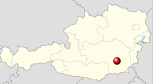
The Kinderfachabteilung in Graz existed between late 1941 or early 1942 (as
the second one of two in Austria) and 1945. The special children's ward was
not physically separated on the site of the clinic.
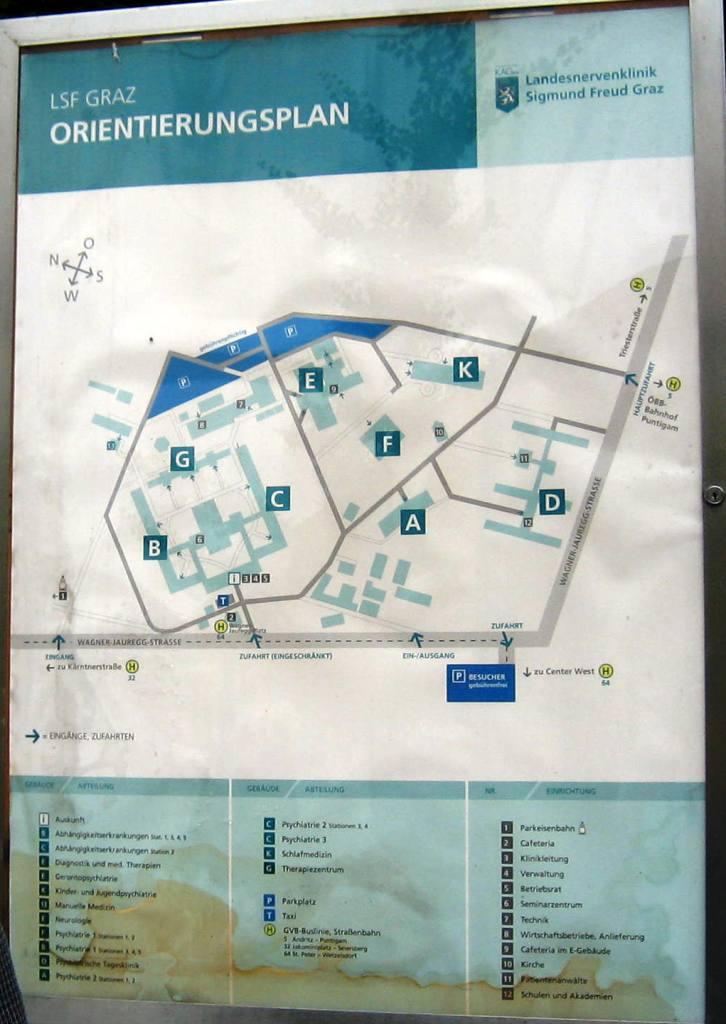
The director of the women's department, Dr. Hans Machan, had many of the
children in his department (C2), and Dr. Peter Korp, who was responsible for
the "training department," located in the satellite facility Kainbach until
summer 1942 and afterwards in castle Pertlstein, also treated children in
C2. These two physicians were assisted by Dr. Josefine Herrmann and from
1943 on Dr. Gabriele Eder. Dr. Ernst Sorger was likely involved in the
treatment of older male children and youths belonging to the special
children's ward in the men's department (stations B). After the death of
clinic director Dr. Oskar Begusch, who had been involved in establishment of
a special children's ward at the clinic in mid 1944 and may have also been
involved in individual killings until then, Dr. Sorger served as the
clinic's director. The director of the nursing department D, Dr. Hans Mayr,
may also have been involved in the killing of children.
At the beginning of 1942 the number of deaths among children and youths
increased significantly. By the end of April 1945 225 children (Freidl et
al. 2006, p. 37) had died. Recent reports put the number at 270 (see here).
After the state attorney's office in Graz conducted investigations
concerning the deportation of Graz patients in the context of T4 and the
killing of disabled children toward the end of the war, the blame fell
solely on Dr. Sorger, who had committed suicide, and the investigation was
dropped. Murders that were part of the "children's euthanasia" were not
investigated. Dr. Korp and Dr. Hermann assumed leading positions at the
clinic after WWII.
Commemoration began with the activities of the historians and film maker
Peter Nausner, who in the 1980s began reporting on Nazi "euthanasia"
murders, without receiving support or assistance from the clinic's
leadership. Only when Dr. Danzinger became the new medical director in 1996
did this picture begin to change significantly, and Dr. Danzinger became
involved in research on these past events. 1996 also marked the 50th
anniversary of the doctors' trial at Nuremberg, and on this occasion, a that
occasion a public lecture event was held, addressing medical crimes against
the disabled in Graz, and it led to a formation of a working group "The role
of medicine in National Socialism in the Steiermark" (see Halbrainer 2014,
p. 105). Members of this working group in Graz presided over an initiative
concerning the establishment of euthanasia memorial, which, as reported by
Brigitte Kepplinger, conceived of a dual place of commemoration: one that
focused on the victims, to be established in the park of the
Landesnervenklinik Sigmund Freud Graz (the clinic's name today), and one
that focused on providing information at the university of Graz in a display
(along with a further scientific analysis and documentation of the
euthanasia crimes, by Thomas Oehlschläger). At the time Graz was the last
(major) state psychiatric facility without a memorial.
Source: author
So far only the first aspect of this plan for commemoration has been
realized. A "living memorial" in the form of a garden by the landscape
architect Janos Koppandy and a dual stelae that includes a plaque with
the inscription "In memory of the far more than 1,000 patients who were
murdered in 1939-1945, during National Socialism," was established in March
2006. The gaze of the visitor, as intended by the architect, from one of the
two benches is directed to an ensemble of aspens, bushes with red
branches, and a copper beach, or literally "bloody beech" (Blut-Buche),
located at the place whence patients were transferred out to their
death. In J. Koppandy's own words:
"This double stelae, whose upper parts are 'dis-placed' (ver-rückt;
the German word also means mentally ill) and interchanged, is part of the
site: the site is meant to 'provide a place" to commemorate, to reflect, to
look back, to talk about it. Here too are two benches opposite: sitting on
one bench, one's gaze is toward the area of the Sigmund-Freud clinic,
including the school facilities, the church, the advocates for the patients.
Sitting on the other bench, the view is toward the 'plum alley.' Along this
alley patients were pushed on their last trip, 'herded' into cattle wagons,
not to return. The memory of this last sojourn is fortified by the
arrangement of a row of 'quaking aspen' and another row of dogwood bushes -
which frame this path in the winter in deep-red branches. A copper beech has
been planted at the loading station itself" (reported in Halbrainer 2014,
pp. 114-15).
As Brigitte Kepplinger notes, neither place nor perpetrators are mentioned
on the display, and the living memorial's landscape is neither
self-explanatory nor explicated somewhere to the visitor (see similarly
Halbrainer 2014, p. 115). Nor it is mentioned anywhere, one might add, that
the murders took place on site, and that in the case of child euthanasia,
victims were transferred to the
facility specifically for that
purpose.
 Source: author.
The clinic's website addresses this memorial but does not refer to
"child euthanasia" in particular. The
clinic map does not show the memorial. On
site, there are no regular commemorations.
A symposium on the topic was held in November 2011 (see here and here).
There is an exhibit on NS-Euthanasia in the Steiermark, which
included a temporary memorial (see exhibits).
Ultimately, researchers await the long-announced publication of a
book entitled Schattenseiten, by
Rainer Danzinger, which is expected to the shed new light on the subject
matter.
A recent master's thesis in history at the university of Graz provides a
succinct summary of the current state of knowledge (Kristöfl
2012, pp. 73-9; also 2013).
The story of Philipp Res, a child victim, is told by Danziger, Oelschläger,
and Freidl (in Halbrainer and Vennemann 2014).
A new scientific project on biographies of about 1500 "euthanasia"
victims in Kärnten commenced in 2014 (see here: 1
/ 2).
Literature
Benzenhöfer, Udo. 2003. "Genese
und Struktur der 'NS-Kinder- und Jugendlicheneuthanasie.'" Monatsschrift
für Kinderheilkunde 151: 1012-19.
Freidl, Wolfgang, Birgit Poier, Thomas Oelschläger, and Rainer Danzinger.
2006. "The Fate of Psychiatric Patients During the Nazi Period in
Styria/Austria: Part I: German-Speaking Styria." International
Journal of Mental Health 35(3): 30-40.
Hainzl, Joachim. 2000/2001. "Vergessene Opfer, gefeierte Täter:
NS-Euthanasie in der Steiermark" I/II. korso
(here
and here).
Halbrainer, Heimo, and Ursula Vennemann, eds. 2014. Es
war nicht immer so. Leben mit Behinderung in der Steiermark 1938 bis heute.
CLIO: Graz - see especially the chapters by Heimo Halbrainer, "Das lange
Schweigen zu den NS-Euthanasieverbrechen in der Steiermark" (pp. 103-22);
and Rainer Danzinger, Thomas Oelschläger, and Wolfgang Freidl, "Die
NS-Euthanasie in der slowenischen Untersteiermark" (pp. 59-81).
Kepplinger, Brigitte. 2008. "Gedenkstätten für die Opfer der NS-Euthanasie in Österreich."
Pp. 549-99 in Tötungsanstalt
Hartheim, 2nd ed., edited by Brigitte
Kepplinger,
Gerhart Marckhgott, and Hartmut Reese. Linz:
Oberösterreichisches Landesarchiv.
Kristöfl, Sandra. 2012. "NS-'Euthanasie':
Ihre Struktur und Systematik in Österreich." Master's Thesis in History,
Karl-Franzens-Universität Graz. Available here.
———. 2013. NS-"Euthanasie":
Ihre Struktur und Systematik in Österreich. Saarbrücken:
Akademikerverlag.
Mayer, Thomas. 2013.
"Eugenics into Science: The Nazi Period in Austria, 1938-1945." Pp. 151-74
in Racial Science in Hitler's New
Europe, 1938-1945, edited by Anton Weiss-Wendt and Rory Yeomans.
Lincoln: University of Nebraska Press. (with a section on "Eugenics in
Graz," pp. 156-60)
Oehlschläger, Thomas. 2001. "Zur Geschichte der
'Kinderfachabteilung' des 'Reichsgau Steiermark.'" Pp. 119-35 in Medizin
und Nationalsozialismus in der Steiermark, edited by Wolfgang
Freidl, Alois Kernbauer, Richard Horst Noack, and Werner Sauer.
Innsbruck: StudienVerlag.
———. 2003. "Zur Praxis der NS-Kinder-'Euthanasie' am Beispiel
Österreichs." Monatsschrift
Kinderheilkunde 10: 1033-42.
Poier, Birgit. 2003. "NS-Euthanasie in der Steiermark." Österreichische
Pflegezeitschrift 11: 29-32. Available here.
———. 2009. "NS-Euthanasie in der Steiermark." Public lecture at the
conference "NS-Herrschaft in der Steiermark" (28-30 January 2009). Available
here.
Topp, Sascha. 2004. “Der ‘Reichsausschuss zur
wissenschaftlichen Erfassung erb- und anlagebedingter schwerer Leiden’:
Zur Organisation der Ermordung minderjähriger Kranker im
Nationalsozialismus 1939-1945.” Pp. 17-54 in Kinder in der
NS-Psychiatrie, edited by Thomas Beddies and Kristina Hübener.
Berlin-Brandenburg: Be.bra Wissenschaft.
———. 2005. "Der 'Reichsausschuß zur wissenschaftlichen
Erfassung erb- und anlagebedingter schwerer Leiden': Die Ermordung
minderjähriger Kranker im Nationalsozialismus 1939-1945." Master's Thesis
in History, University of Berlin.
Last updated on 20 Feb. 2015


