Home
[Tłumaczenie
Polskie]
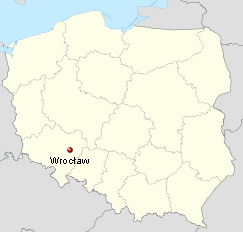
Breslau [Wrocław] (Krankenhaus Nord, Institut für praktische Psychiatrie
und psychiatrische Erbforschung Breslau)
--Deutsch: Kinderopfer der "Euthanasie" in Breslau--
The Kinderfachabteilung in Breslau/Wrocław was established in 1943 at the
latest, as the fourth and last of the special children’s wards established
in what today is the state of Poland, and as the second-to-last of all
"Kinderfachabteilungen" overall. It continued to operate until at least
until 1944. The clinic's medical director was Dr. Dr. Heinrich Tewes, who
after WWII worked as a psychiatrist in Passau and died in 1984. The
physician responsible for the "special children's ward" was Dr. Heinz
W. Neumann, who had written his dissertation in forensic medicine in Breslau
in 1932. His whereabouts after 1945 are unknown.
During WWII the facility had a capacity of about 250 beds. The operation of
the Kinderfachabteilung and the number of children who died in it remains
unknown. Since Breslau was the capital of the Prussian province Lower
Silesia between 1919 and 1945 and had a largely German population, accounts
of "euthanasia" in Poland by Polish historians typically do not address it.
For example, the publication Pacjenci i
pracownicy szpitali psychiatrycznych w Polsce zamordowani przez okupanta
Hitlerowskiego i los tych
szpitali w latach 1939-1945. Vol. 1: Szpitale, commissioned on
occasion of the 50th anniversary of the beginning of the murder of
psychiatric patients by Germans in Poland, does not list Wrocław as a
place where murders in the context of "euthanasia" were committed, and
consequently no victims are listed in vol. 2. The Kinderfachabteilung in
Breslau ranks among the special children's wards about which is known the
least.
However, based on Sadowski’s and Scheffler’s data, which they obtained from
Wroclaw’s bureau of vital statistics (Standesamt)
and the state archive Wroclaw, I calculated a total of 31 victims in the
relevant age bracket who died in the hospital’s psychiatric ward in 1943,
almost all of respiratory paralysis, broncho-pneumonia, or
pneumonia-bronchitis. Since only about 43.6% of the records for that year
are extant, I arrive at an estimate of about 60-65
child and youth victims of the Kinderfachabteilung in that year.
However, it is not possible to determine how many of them, if any, became
victims of "decentralized euthanasia." For 1944, based on similar
calculations, my estimate is about 80
victims (these children also often tended to die in time clusters).
These are conservative estimates, allowing for the possibility of a small
number of deaths having occurred due to natural causes. The total (not
including 1945, or 1942 and earlier) is at
least 145 children and youths who possibly, or quite likely, became
victims of the children’s euthanasia there.
For example, the child Bern(hard Z.) (listed no. 42) below was diagnosed
with "idiocy" and died at the age of 7 of "pneumonia."
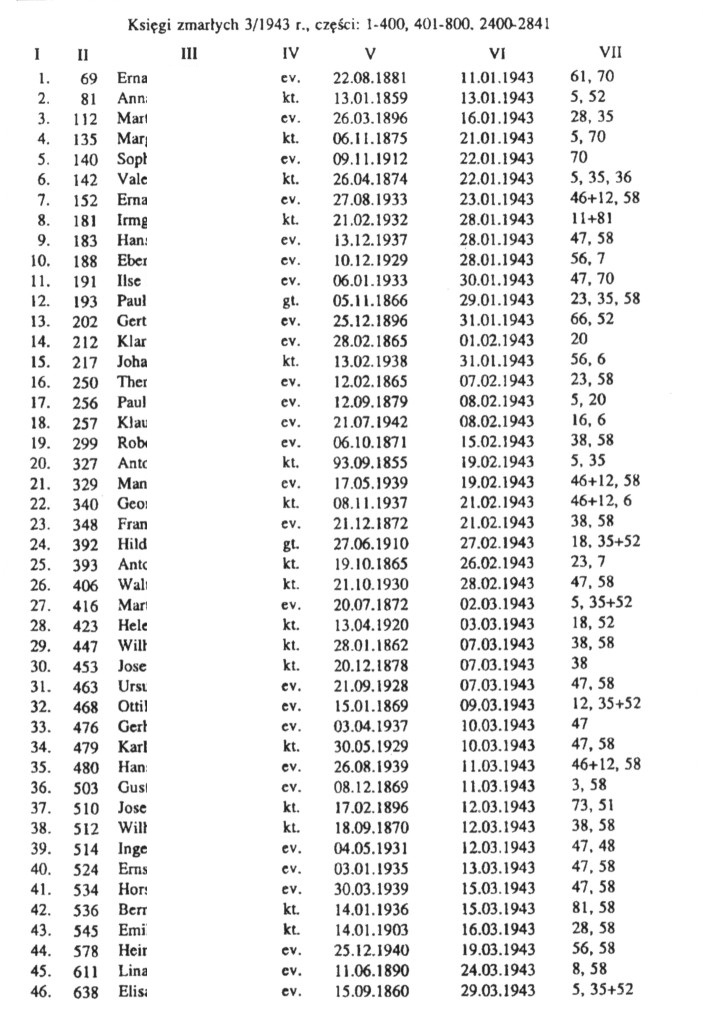 Source: Sadowski/Scheffler, p. 235
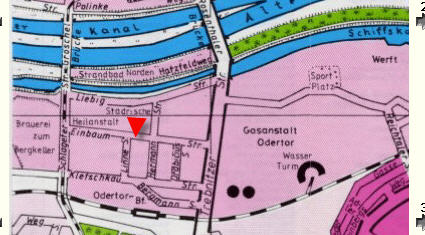
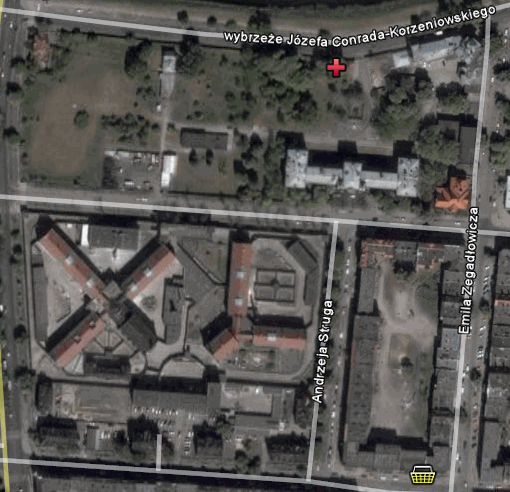
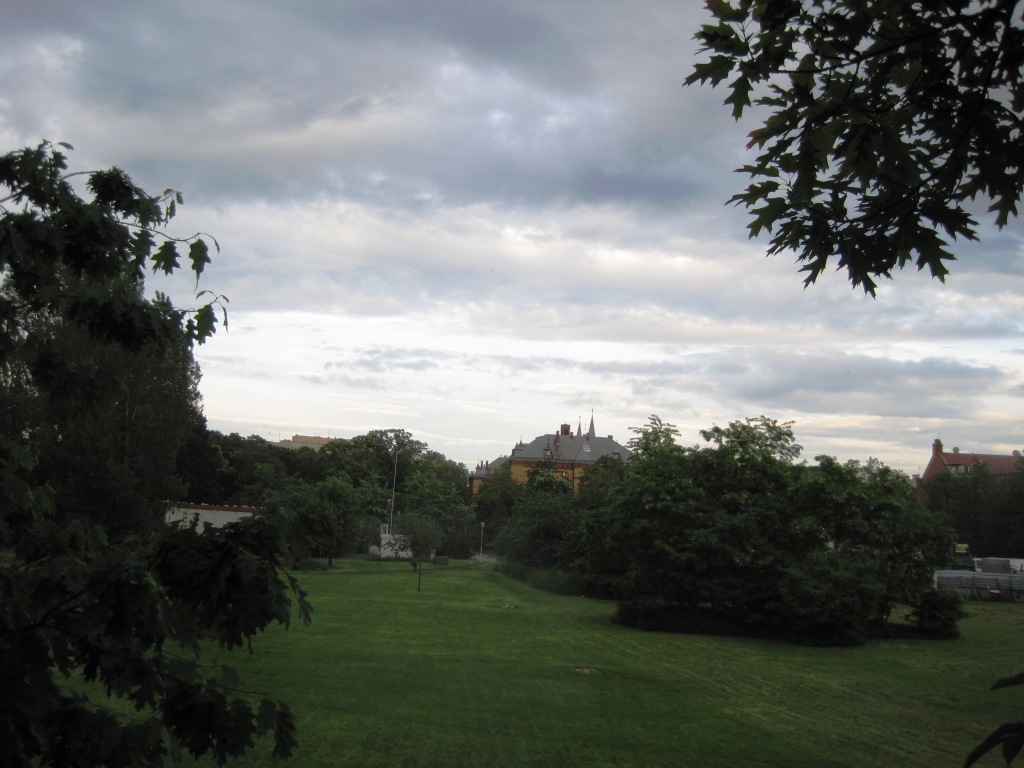
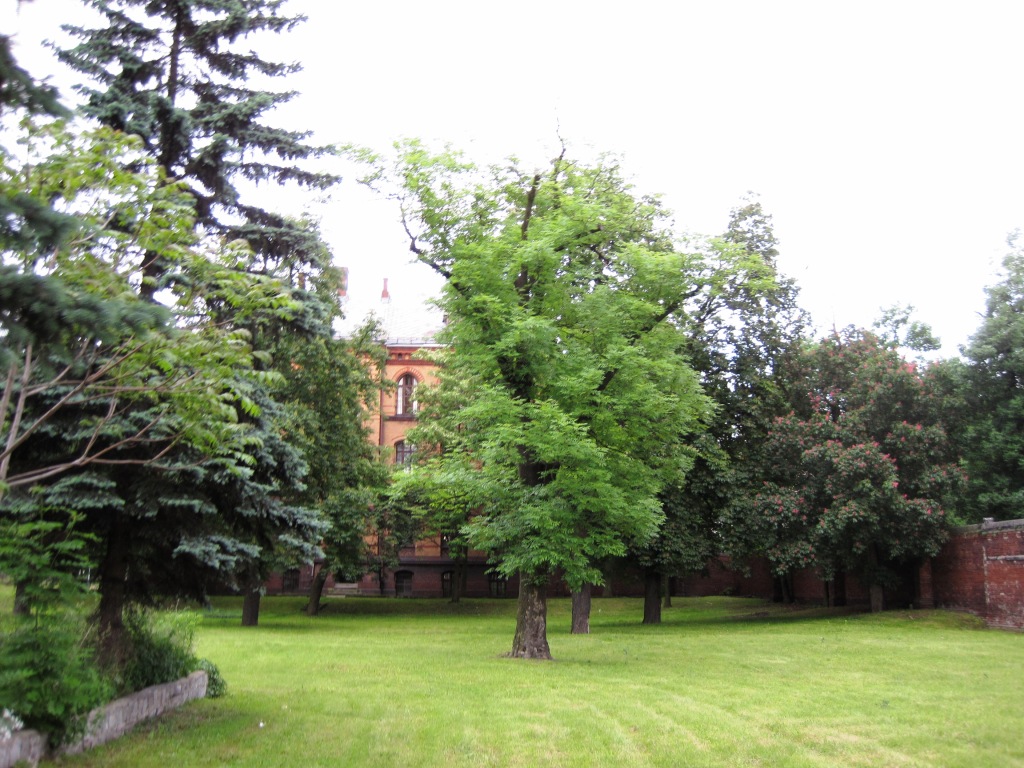
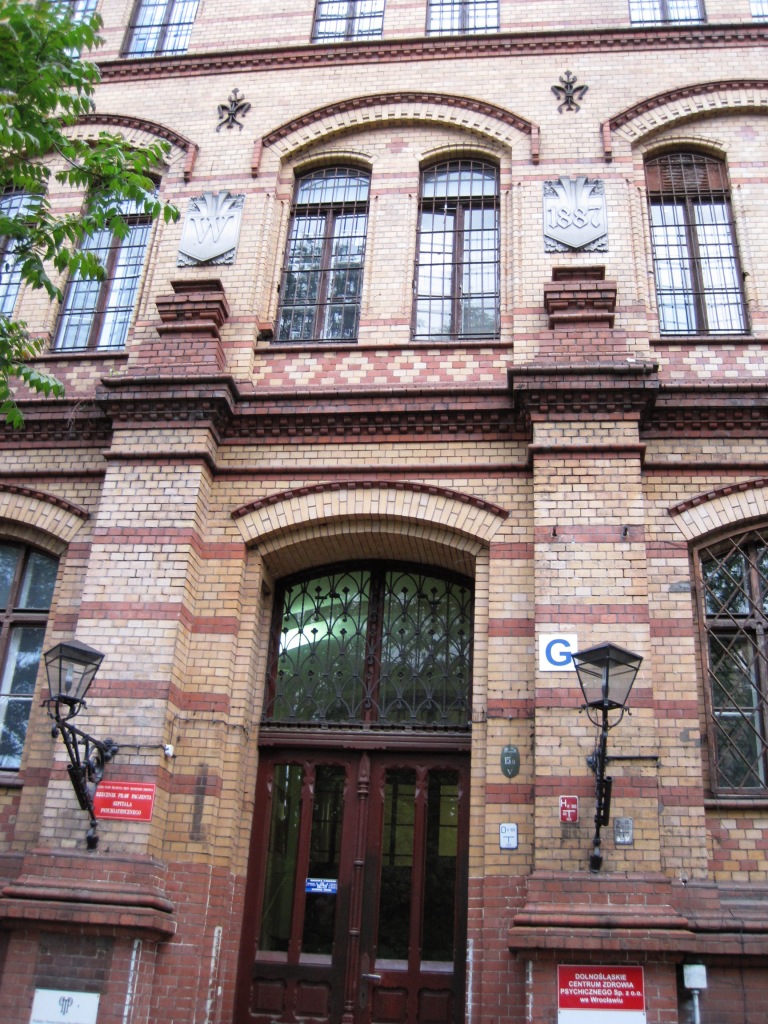
The clinic was located at the Einbaumstr. 25, which today is the Józefa
Ignacego Kraszewskiego. The clinic continues to operate, treating patients
with dependency problems and other illnesses. Only a few kilometers to the
south, in the Neurological Research Institute (Otfrid Foerster Institut;
Neudorfstr. 118/120) of the University of Breslau (today: Wroclaw), Dr.
Hans-Joachim Scherer signed over 200 pathology reports of brain and spine
tissue samples sent there from the Kinderfachabteilung
Loben.
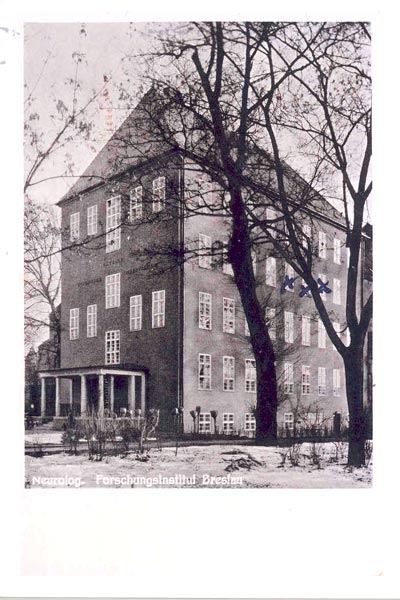 Source:
http://viktor-von-weizsaecker-gesellschaft.de/assets/images/Mitteilungen/w01.jpg
Source:
http://viktor-von-weizsaecker-gesellschaft.de/assets/images/Mitteilungen/w01.jpg
(Probably) at the turn of 1943 and 1944, he is reported having stated that
he had examined samples from over 350 disabled children (see Benzenhöfer
2007a, p. 161 n. 289) - far more than Loben alone could have supplied by
that time.
Source:
http://www.breslau-wroclaw.de/de/breslau/geographic/street/?picture=G2;
author
The previous web site of the clinic
(http://www.szpoz.wroclaw.pl/historia.html), Specjalistyczny
Zespół Psychiatrycznej Opieki Zdrowotnej we Wrocławiu, did not
refer to this part of the institution's past, nor did the
website of the university affiliated with the clinic,
Wroclaw Medical University, Dept. of Psychiatry. The new web site of the
clinic, Dolnośląskie
Centrum Zdrowia Psychicznego (Lower Silesian Centre for Mental Health
Ltd), has a short section on the history (http://dczp.wroclaw.pl/o-szpitalu/info-ogolne)
of the facility but does not address events in WWII.
Literature
Benzenhöfer, Udo. 2003. "Genese und Struktur der
'NS-Kinder- und Jugendlicheneuthanasie.'" Monatsschrift
für Kinderheilkunde 151: 1012-1019.
———. 2007a. Der Arztphilosoph Viktor
von Weizsäcker: Leben und Werk im Überblick. Göttingen:
Vandenhoeck & Ruprecht.
———, and Wilhelm Rimpau. 2007b. "Introduction
to Viktor von Weizsäcker, ''Euthanasia' and Experiments on Human Beings
[Part I: 'Euthansia'].'" Pp. 277-84 in Human
Sacrifice in Jewish and Christian Tradition, edited by Karin
Finsterbusch, Armin Lange, and K.F. Diethard Römheld. Leiden: Brill.
Jaroszewski, Zdzisław, ed. 1989. Pacjenci
i pracownicy szpitali psychiatrycznych w Polsce zamordowani przez okupanta
Hitlerowskiego i los tych szpitali w latach 1939-1945. Vol. 1: Szpitale. Vol. 2: Imienne
wykazy zamordowanych. Warsaw: n. p.
Kiejna, Andrzej, and Malgorzata Wójtowicz. 1999. Z
djiejów Kliniki Psychiatrycznej i Chorób Nerwowych we Wroclawiu: wybitni
przedstawiciele i budowle (Zur Geschichte der Psychiatrischen- und
Nervenklinik in Breslau: Bedeutende Vertreter und Bauwerke).
Warsaw: Fundacja Ochrony Zdrowia Psychicznego.
Peiffer, Jürgen. 1997. Hirnforschung im
Zwielicht: Beispiele verführbarer Wissenschaft aus der Zeit des
Nationalsozialismus: Julius Hallervorden - H.-J. Scherer - Berthold
Ostertag. Husum: Matthiesen Verlag.
Penselin, Cora. 1994. "Bemerkungen zu den Vorwürfen, Viktor von Weizsäcker
sei in die nationalsozialistische Vernichtungspolitik verstrikt gewesen."
Pp. 123-37 in Anthropologische Medizin
und Sozialmedizin im Werk von Viktor von Weizsäckers, edited by Udo
Benzenhöfer. Frankfurt: Lang.
Sadowski, Mirosław, and Tomasz Scheffler. 1996. "Z badań nad
nazistowską eutanazją we Wrocławiu." Studia nad Faszyzmem i Zbrodniami
Hitlerowskimi 19: 219-42.
Topp, Sascha. 2004. “Der ‘Reichsausschuss zur wissenschaftlichen Erfassung
erb- und anlagebedingter schwerer Leiden’: Zur Organisation der Ermordung
minderjähriger Kranker im Nationalsozialismus 1939-1945.” Pp. 17-54 in Kinder
in der NS-Psychiatrie, edited by Thomas Beddies and Kristina Hübener.
Berlin-Brandenburg: Be.bra Wissenschaft.
———. 2005. "Der 'Reichsausschuß zur wissenschaftlichen
Erfassung erb- und anlagebedingter schwerer Leiden': Die Ermordung
minderjähriger Kranker im Nationalsozialismus 1939-1945." Master's Thesis
in History, University of Berlin.
Deutsche Übersetzung zur
Opferzahl
Basierend
auf den Daten von Sadowski und Scheffler, die auf Dokumenten des
Staatsarchivs Wroclaw und des Archiv des Standesamtes Wroclaw beruhen,
fand ich insgesamt 31 Opfer in der entsprechenden Altersklasse bis etwa 18
Jahre, die in der psychiatrischen Abteilung des Krankenhauses im Jahr 1943
verstarben, fast alle an Lungenentzündung, Bronchopneumonie,
oder
Atemlähmung. Da nur etwa 43,6% der Datensätze für dieses Jahr vorhanden
sind, komme ich auf eine geschätzte Zahl von
etwa 60-65 Kindern und Jugendlichen, die möglicherweise Opfer der
Kinderfachabteilung in diesem Jahr wurden. Diese Zahlen sind konservativ
geschätzt, unter Berücksichtigung der Möglichkeit,
dass einige Kinder eines natürlichen
Todes starben. Allerdings lässt sich nicht aussschliessen, dass
darunter Opfer der "dezentralen Euthanasie" sind. Für 1944, auf
ähnlichen Berechnungen basierend, waren es meiner Schätzung nach etwa 80
Opfer (diese Kinder und Jugendlichen sind oft auch in einem Zeit-Cluster
gestorben), so dass es (ohne Einbeziehung des Jahres 1945, oder der Zeit
vor 1943) insgesamtn mindestens 145 Kinder waren, die dort
möglicherweise Opfer der Kinder-Euthanasie wurden.
Tłumaczenie na liczbę ofiar
Na podstawie danych z Sadowski i Schefflera, na podstawie dokumentów
Archiwum Państwowego we Wrocławiu i archiwum Urzędu Stanu Cywilnego we
Wrocławiu, znalazłem łącznie 31 ofiar w odpowiednim wieku do około 18,
który zmarł na oddziale psychiatrycznym szpitala w 1943 roku, prawie
wszystkie zapalenie płuc, odoskrzelowe zapalenie płuc, lub porażenia
układu oddechowego. Ponieważ tylko o 43,6% zapisów dostępne są w tym roku,
jestem na szacunkowej liczbie około 60-65 dzieci i młodych ludzi, którzy
mogą być ofiarami Oddziale Dziecięcym w tym roku były. Liczby te są
ostrożne szacunki, biorąc pod uwagę możliwość, że niektóre dzieci zmarł z
przyczyn naturalnych. Jednak nie można odrzucić, że w tym ofiary
"zdecentralizowane eutanazji" jest. Do 1944 roku na podstawie podobnych
obliczeń, to był mój szacunek o 80 ofiar (te dzieci i młodzież często są
również zmarł w terminie, klastrów), tak, że insgesamtn (nie w tym roku
1945 lub w okresie przed 1943), co najmniej 145 dzieci były prawdopodobnie
ofiary eutanazji dzieci było.
Last updated: 5 March 2015.