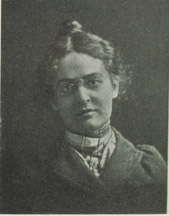
Courtesy of the Bancroft Library
Frances Hammell Gearhart (1869-1958) was born in Sagetown (later Gladstone), Illinois, on January 4, 1869, the eldest of three children. Her sisters, May Gearhart (1872-1951) and Edna Gearhart (1879-1974), were also artists, but the work of Frances, particularly her color block prints of California landscapes is much more well known and sought after. She is considered a pioneer of color printmakers in the United States.
Victoria Dailey in her essay accompanying the Cheney Cowles Museum’s 1990 exhibit “Frances H. Gearhart: California Block Prints” suggests that 1915 was a critical year for print artists in California. At that time Pedro de Lemos who had studied with Arthur Dow organized an exhibition of California printmaking at the Panama-Pacific International Exhibition in San Francisco. This major art exhibition included a large number of Japanese prints as well as the work of Dow and other artists from the East Coast. But as Ms Dailey also points out in her recent essay "Frances Gearhart and the Development of Artistic Printmaking in California" (see below for reference) there were even earlier shows in California of Japanese color woodcuts that the Gearharts probably attended.
The annual show of the Print Makers Society of California, although always first displayed in Los Angeles, also traveled to the San Francisco Bay area each year so she became more well known throughout California. In addition, five of her prints were included in the California Society of Etchers' eighth annual exhibition in 1919 in San Francisco. In the early 1920's she spent part of the summers in the Monterey/Carmel area and her work was displayed in various shows there. In 1923 she and her sister, May, had a two-person exhibit at the Los Angeles County Museum of Art. The Smithsonian included examples of her work in exhibitions in 1924 and 1928. She served on the jury of the 1926 International Print Makers and some of her prints were displayed at an exhibition in Paris in 1928. The American Federation of Arts circulated a national exhibition of her block prints in 1930. In 1933 she received the Purchase Prize at the International Exhibition of Printmakers. Around that time she was also included in exhibitions of American color block prints at the Brooklyn Museum and at the American Institute of Graphic Arts. She also developed a special relationship with fellow print makers and art collectors in Wichita, Kansas beginning in 1922 when the Wichita Art Association put together an exhibition of leading American Block Print Artists. Her work was included in this exhibit and in 1928 they initiated an annual spring exhibit of Block Print Artists from around the country. Gearhart's work was always included. In addition, between 1928 and 1937 her prints were regularly exhibited in the annual fall shows of the Prairie Print Makers Association also located in Kansas. Unfortunately, owing to failing eyesight, Gearhart had to stop her printmaking around 1940.
Gearhart obviously loved the California landscape. No other artist working in color block prints has ever done a better job of portraying both its serene and stark beauty. The images are finely drawn and striking, and the colors are vibrant. She not only renders the beauty of the landscape, but like any superior artist, she also interprets it. One can usually look at a Gearhart color block print over and over without ever getting tired of the image.
Currently, Frances Gearhart’s color block prints are in great demand, and her work can be found in the permanent collections of many museums, including the Los Angeles County Museum of Fine Art, the Fine Arts Museums of San Francisco, the Library of Congress, the Smithsonian American Art Museum, the Smithsonian Museum of American History, the Art Institute of Chicago, the Cleveland Museum of Art, the Saint Louis Art Museum, the Indianapolis Museum of Art, the Johnson Museum of Arts at Cornell University, the Whitney Museum of American Art, the South Dakota Art Museum, the USC Fisher Gallery, and the Wichita Art Museum. A large exhibition of her color block prints was mounted at the Pasadena Museum of California Art between October 4, 2009 and January 31, 2010. An excellent catalogue showing the prints on display at the exhibit and containing several scholarly essays was published by the museum and edited by Susan Futterman, who along with Roger Genser co-curated the exhibition. Most recently, in the summer of 2020, the Wichita Art Museum put together a wonderful exhibit of 43 of the 47 prints Frances Gearhart had originally brought to Wichita between 1922 and 1937 (four could not be located). They also produced a beautiful catalog of the exhibit with vivid reproductions of the images on display. The catalog also includes a very detailed and scholarly review of Gearhart's work written by the curator of this exhibit, Roger Genser. This exhibit will run through February, 2021
Bibliography
Acton, David. (1990). A Spectrum of Innovative Color in American Printmaking, 1890-1960. Worcester, Mass: Worcester Art Museum; and New York: W.W. Norton.
Dailey, Victoria. (1990). Frances H. Gearhart: California Block Prints. Spokane, Washington. Cheney Cowles Museum.
Dailey, Victoria . Frances Gearhart and the Development of Artistic Printmaking in California, Pp 9-17, In Susan Futterman (ed)(2010), Behold the Day: The Color Block Prints of Frances Gearhart. Pasadena, Pasadena Museum of California Art.
Genser, Roger, Frances H. Gearhart, Pp 10-91, In Barbara J. Thompson (Ed.) 2020, Frances H. Gearhart, Color Block Prints in Wichita, 1922-1937, Wichita Art Museum.
Green, Nancy, E. Western Grandeur: The Art of Frances Gearhart, Pp 27-41, In Susan Futterman (ed) (2010), Behold the day: The Color Block Prints of Frances Gearhart. Pasadena. Pasadena Museum of California Art.
Seaton, Elizabeth (Ed.) (2006). Paths to the Press: Printmaking and American Women Artists, 1910-1960. The Marianna Kistler Beach Museum of Art, Kansas State University, Manhattan, Kansas. Distributed by University of Washington Press.