
The purpose of this association shall be to unite the voluntary efforts of all who are interested in the charitable, correctional, and social welfare work of the state; and to promote such work by agitation and discussion, the presentation and discussion of papers upon timely topics, and the publication and dissemination of such information as will keep the people of our state informed of the work undertaken or required. |
Article 2, Constitution of the Vermont Conference of Social Work |
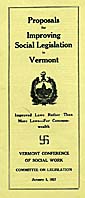 In 1916, a socially conscious group of Vermont civic leaders founded the Vermont Conference of Charities and Corrections (renamed the Vermont Conference of Social Work in 1918). Believing in the ability of Vermonters to solve their own problems in their own way, the founders chose to maintain their autonomy from the parent organization (the National Conference of Charities and Correction) rather than to serve as a local chapter.
Annual meetings provided an opportunity for social workers, government officials, philanthropists, and academics to listen to experts invited from national organizations, to share concerns and offer mutual support, and to draft proposals for social legislation for consideration by the state legislature. Since its inception, participants in the conference worried about the growing population of dependent, delinquent, and mentally defective Vermonters. Experts from Massachusetts, New York, and other states reinforced those concerns and supported the efforts of the Vermont Conference to assume a larger role in protecting Vermont's "greatest asset, it's children."
Professor Harry Perkins initially made his appeal to organize a Eugenics Survey of Vermont to this group, predicting that eugenic studies would reveal the scope and extent to which many poor Vermont families owed their circumstances to poor heredity. The Annual reports of the VCCC and VCSW in the 1920s reveal how Perkins found a receptive audience for eugenic ideas and solutions. They also document the broader social reform agenda that Perkins incorporated in his "Good Eugenics Program for Vermont" at the first meeting of his Advisory Committee in 1925. Not only did he negotiate private funding for the Eugenics Survey through the VCSW, but its leaders served on his Advisory Committee. In 1926, the VCSW endorsed the Eugenics Survey in a formal resolution.
Henry Perkins served as VCSW President in 1927 and as a member of its Executive Board throughout the 1930s. The VCSW Legislative Committee, headed by Asa Gifford, introduced the sterilization law as part of its comprehensive program of social legislation in 1927. In the 1930s, ESV Assistant Director Elin Anderson served as VCSW Vice President and helped organize programs for the annual meetings.
Annual Reports of this organization, along with relevant social welfare documents of its participants, can be found in Special Collections at the University of Vermont.