|
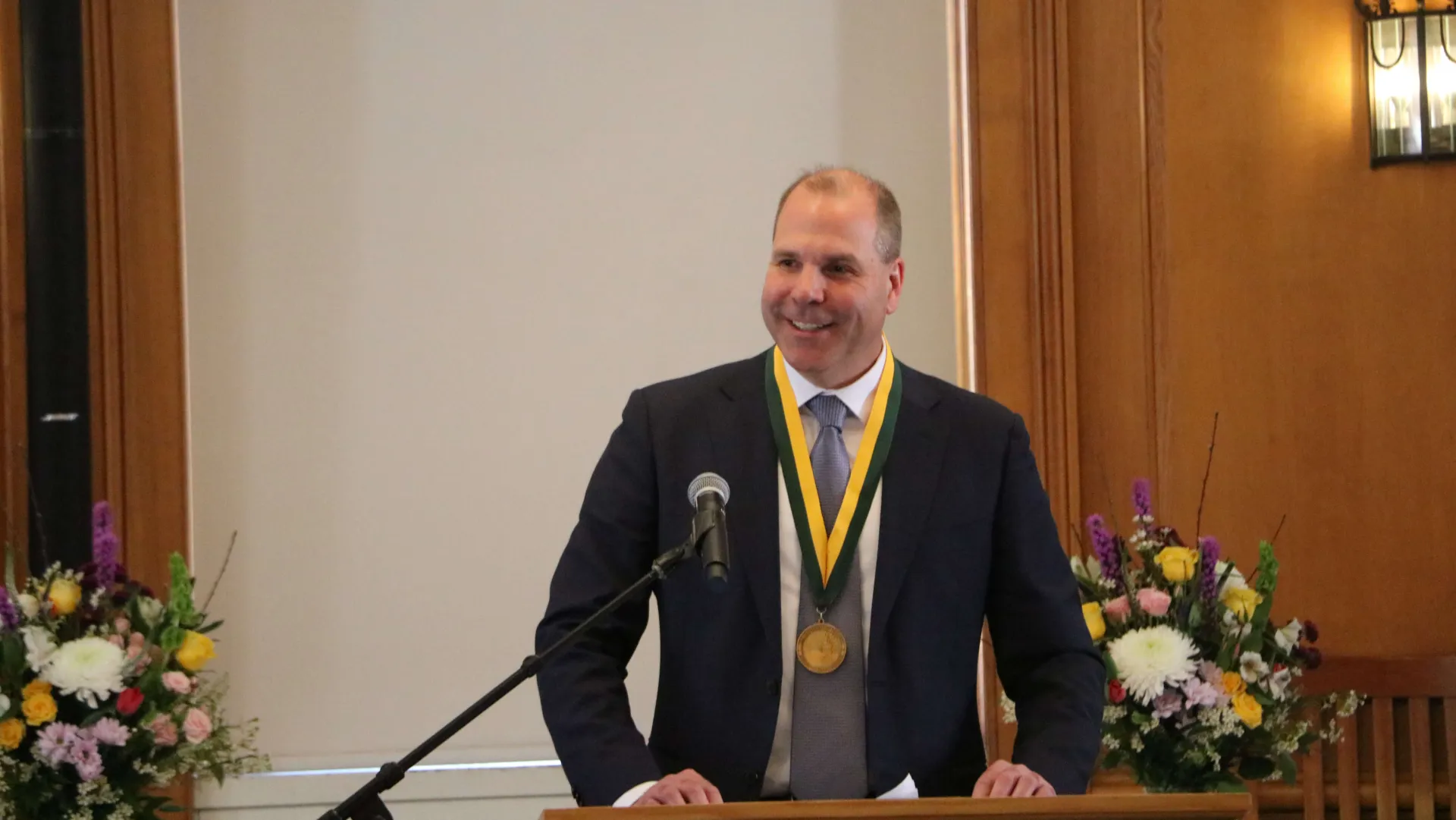
Prof. Leenstra Receives AwardWillem Leenstra, Ph.D., Associate Professor of Chemistry at UVM, received the E. Ann Nalley Award from the American Chemical Society (ACS) Northeast Region for volunteer service to the ACS. The award was presented at the 36th Northeast Regional meeting (NERM) of the ACS October 7-10, 2009 in Hartford, CT. |
|
Prof Leenstra has been as active member in the Green Mountain Section of the ACS in one capacity or another for 27 years. During that time, Prof. Leenstra has served two terms as Councilor, two terms as Chair and the two terms as Chair-elect, Secretary and Program Chair. He also shouldered the responsibility for two NE Regional Meetings (24th and 35th ) as the General Chair for those meetings. He organized symposia for the past two NE Regional meetings. Since 1997, Prof. Leenstra has progressed to participation at the national level, first as a member of the Committee on Local Section Activities. For the past five years, he has been a member of the Committee on Meetings and Expositions of which he is currently chair. He has served on several other national committees. Prof. Leenstra has been recognized for his service and leadership skill with the Green Mountain Section Emerald Award. In spite of his work at both the regional and national level, Dr. Leenstra continues to support the local Green Mountain Section as Councilor and as Editor of the section newsletter. Dr. Wayne Jones who wrote the following in support of Prof. Leenstra's nomination: "He is a dedicated volunteer that not only provides excellence in service to the chemistry community, but also seeks to help others do the same. I would gladly serve with him again in any capacity and it is right that the ACS and the Northeast Region recognize his many contributions with the volunteer service award." The purpose of E. Ann Nalley Award is to recognize the volunteer efforts of individuals who have served the American Chemical Society by contributing significantly to the goals and objectives of the Society through their Regional Activities. |
|
|
Prof. Geiger Elected into the Vermont Academy of Science and Engineering (VASE)William E. Geiger, Ph.D., Professor of Chemistry at UVM, was elected into the Vermont Academy of Science and Engineering at their annual meeting on September 22, 2009. |
|
Four distinguished engineers and scientists were honored by the Vermont Academy of Science and Engineering (VASE) in recognition of outstanding accomplishments in their fields. Included in the four was William Geiger. Prof. Geiger is an internationally recognized analytical chemist with specific expertise in electrochemistry. Prof. Geiger opened research in organometallic chemistry via electrochemistry in the 1970s making fundamental insights in this then new field. Since that time, Prof. Geiger has become arguably the world's expert in this field and in 1996, published the definitive article on the topic that has been cited some 700 times. There are 56 members in the academy. Up to 4 members from academia, engineering and science are selected annually by VASE. The Department of Chemistry has more members in VASE than any other department in the university: Professor of Chemistry & Medicine and Chair of Chemistry, Dwight Matthews, and Emeritus Professors of Chemistry, Christopher Allen, Ted Flanagan, and Martin Kuehne are all members of VASE. |
|
|
Prof. Rory Waterman Wins A Cottrell Scholar Award |
|
UVM Chemistry professor Rory Waterman was selected to receive one of the ten Cottrell Scholar Awards by the Research Corporation for Science Advancement for 2009 in recognition of his leadership in both teaching and scholarship. The award provides a $100,000 grant that Prof. Waterman will use to continue his research in finding new efficient ways to build chemical bonds of the "main-group" elements, especially phosphorous. Cottrell award winners are chosen both for their dedication to teaching and promising scholarship, reflecting a "conviction that top early career research scientists can be the most effective leaders for teaching innovation at the nation's research universities," the Research Corporation wrote in a press release. Waterman's award praised his plan to establish a computerized network of research opportunities for Vermont high school and University of Vermont undergraduate students and his development of a research-based course for first-year students. Cottrell Awards are made each year to ten beginning faculty members at leading US universities in astronomy, biochemistry, biophysics, chemistry, or physics. The awards are named for Frederick Gardner Cottrell whose invention of the electrostatic precipitator helped reduce pollution from smokestacks. Story excerpted from the Burlington Free Press 6/12/09. |
|
|
Joseph C. Wright Awarded the Hannah Howard Prize at the 2009 College of Arts & Sciences Commencement Ceremony |
|
The Hannah Howard Prize is annually awarded to the College of Arts & Sciences undergraduate student with the highest cumulative grade point in the College. Often the award goes to a student with a perfect 4.0 grade point (note: grades of "A+" are recorded as 4 grade points – the same as for an "A"). The 2009 Hannah Howard Prize was awarded to Joseph C. Wright at Commencement on May 17. Joe Wright also received a B.A. degree with a major in Chemistry and minors in physics and pure mathematics. Joe completed his undergraduate degree with a 4.0 grade point of which more than 2/3 were grades of "A+". Joe Wright graduated from South Burlington High School in Vermont. In high school, Joe loved to teach and spent a large amount of time tutoring students. He continued tutoring and working with students while in college, but never expressed plans to teach until after the fall semester of his senior year when he had the opportunity to be a teaching assistant in charge of an undergraduate laboratory section in Chemistry. This teaching experience as an undergraduate prepares students for their lives as graduate students. So it was planned for Joe. However, at the end of the semester, he decided against pursuing a Ph.D. in Chemistry, but rather wanted to pursue an Masters of Arts in Teaching degree at UVM so that he could teach chemistry at the high school level as a career. Joe will also be awarded an American Chemistry Society Hach Foundation scholarship for the academic year 2009-2010 at UVM to assist in his M.A.T. studies. This national scholarship is awarded to talented students wishing to prepare for a career in secondary education. |
|
|
Instructor Alexander (Sandy) Wurthmann Awarded a 2009 Kroepsch-Maurice Excellence in Teaching Award |
|
The Kroepsch-Maurice Excellence in Teaching Awards from the Center for Teaching & Learning recognize faculty for excellent instruction. They memorialize Robert H. and Ruth M. Kroepsch and her parents, Walter C. and Mary L. Maurice. Robert H. Kroepsch served as Registrar and Dean of Administration at UVM from 1946-56. His wife, Ruth, graduated from UVM in 1938 and her father, Walter Maurice, graduated from UVM in 1909. All four of them were teachers.
|
|
|
Jillian Davidson wins the 2009 Mariafranca Morselli Leadership Award |
|
Jillian Davidson, a graduating senior chemistry major, received the Mariafranca Morselli Leadership Award from the Women's Center. The Mariafranca Morselli Leadership Award is presented annually to an undergraduate woman majoring in a scientific discipline who has demonstrated leadership qualities, academic excellence and who has contributed significantly to the awareness on campus of the rights of women. Mariafranca Morselli was a Emerita Professor of Botany and was an international scientific leader within her field of maple research. Her unending devotion and commitment to science and the Women's Movement made her an advocate for university women and the leadership they exemplify within the local and international community. |
|
|
Prof. Rory Waterman Wins An Alfred P. Sloan AwardUVM Communications News Release, 02-17-2009 by Joshua E. Brown |
|
UVM Chemistry professor Rory Waterman was selected for a research award by the Alfred P. Sloan Foundation, one of the nation's most prestigious prizes for outstanding early career scientists. Waterman's experiments in catalytic bond formation of elements, like finding new ways to create bonds in phosphorous, have been at the forefront of an important area of basic chemistry research. His work promises to be of great value in fields ranging from drug delivery to LED lights. The Sloan Research Fellowships have been awarded since 1955, initially in only three scientific fields: physics, chemistry, and mathematics. Since then, 38 Sloan Research Fellows have gone on to win the Nobel Prize in their fields; and 14 have received the Fields Medal, the top honor in mathematics. The two-year, $50,000 award will begin in May and allow "us to do some really innovative, wacky stuff," Waterman said. "There is this debate within the chemistry community about staying on the known path versus going off the path to look for new approaches." Waterman is optimistic that the new funding will allow him and his students to go into uncharted territory to "discover things we couldn't achieve through our regular funding," he said, including using a technique called "alpha elimination" for generating a group of useful chemicals called "low valence fragments." The last UVM researchers to win the Sloan award were retired UVM chemistry professors Martin Kuehne and Hack Bushweller in 1965 and 1971, respectively, both in chemistry. "The Sloan Research Fellowships support the work of exceptional young researchers early in their academic careers, and often at pivotal stages in their work," said Paul L. Joskow, president of the Sloan Foundation, making the announcement today. Waterman, an assistant professor of chemistry at UVM, is among this year's 118 award winners from a small group of leading research universities including Harvard, MIT, Stanford, and Princeton. The Sloan awards are now granted in chemistry, physics, mathematics, computer science, economics, neuroscience, and evolutionary molecular biology. Once chosen, Sloan Research Fellows are free to pursue whatever lines of inquiry are of most interest to them, and they are permitted to employ their funds in a wide variety of ways to further their research aims. "There are no parameters yet on the kind of research we want to do," said Waterman, "it's very exciting." The Alfred P. Sloan Foundation is a philanthropic, not-for-profit grant making institution based in New York City. Established in 1934 by Alfred Pritchard Sloan Jr., then-President and Chief Executive Officer of the General Motors Corporation, the foundation makes grants in support of original research and education in science, technology, engineering, mathematics and economic performance. |
|
|
Prof. Rory Waterman's Article in Dalton Transactions is the Cover for the First 2009 Issue |
|
Prof. Waterman published a perspective article in Dalton Transactions that appeared on the web in October 2008 then in print in the first issue of 2009. The print edition issue cover art was devoted to Prof. Waterman's article. Prof. Waterman's article entitled Metal-Phosphido and -Phosphinidene Complexes in P–E Bond-Forming Reactions can be found on line along with a PDF of the cover. Enjoy reading the article. Prof. Waterman joins others in the department who have anchored the cover of other prestigious journals including
|
|
|
Prof. Matthias Brewer Selected as a Thieme Journal Awardee for 2009 |
|
The Editorial Boards of the scientific journals Synlett and Synthesis chose Matthias Brewer as one of their Journal Awardees for 2009. Individuals selected in this category are promising young professors at the beginning of their career. Each year these journals published by Thieme Chemistry award promishing scientists to receive free print and electronic subscriptions of their journals as a gesture of encouragement. |
|
![]() photo by Sally McCay |
Summer Undergraduate Fellowship Named for Emeritus Prof. Martin KuehneStory from the UVM Quarterly Fall 2008 – Alumni Connection |
|
CHANGING LIVES IN THE LAB Professor Emeritus Martin Kuehne and alumna Louise Foley '65 have kept in touch over the years. Louise had had the opportunity to undertake summer research in Dr. Kuehne's chemistry lab during her sophomore, junior, and senior years – an experience she says had a tremendous impact on her career. So it came as no surprise to Professor Kuehne when he heard from Dr. Foley this spring suggesting that they share lunch when she planned to be on campus in June. What did come as a surprise, he says, was the news she shared upon that occasion. "I knew nothing about this in advance," he says. "So I was quite surprised when she explained to me 'here's what I've done.'" What Dr. Foley had done was to establish the Martin E. Kuehne Organic Chemistry Fund to honor her former professor's many contributions to the educational experience at UVM and to the field of organic chemistry. The endowed fund will provide annual support providing a summer stipend for an undergraduate chemistry major engaged in a summer research project in synthetic organic chemistry. "At a time when women were given few opportunities, Professor Kuehne selected me to do summer research in his group and thus made it possible for me to discover my love of doing research in organic chemistry," she wrote in her description of the fund. "During my undergraduate research experience in Professor Kuehne's lab I learned from him how to read the literature, search the literature, and was shown the laboratory techniques that I used throughout my career as a synthetic organic chemist. In future years may other UVM alumni be able to acknowledge a similar impact on their lives because of the Martin E. Kuehne Summer Undergraduate Research in Organic Chemistry Award." After graduating from UVM, Louise Foley went on to earn her Ph.D. from the Massachusetts Institute of Technology and pursued a distinguished career in pharmaceutical research with Hoffmann-LaRoche, taking time in mid-career to teach chemistry at the University of New Hampshire and Fordham University. Professor Kuehne still does research in chemistry, where over the years he has focused on anti-cancer and anti-addiction compounds. "We were funded by the National Institutes of Health for forty-two years continuously on one big project," he recalls. "In fact, it was one of the ten most long-lived research grants that they have ever given, they told me once." Funding for summer research for undergraduate students has become more difficult to come by through the National Science Foundation in recent years, Dr. Kuehne says, "so the Department will make good use of this award." The research experience benefits students in a number of ways, he points out, including giving them a competitive advantage when the time comes to apply to graduate schools. "Louise told me the other day that until her last day working for Hoffmann-LaRoche she still used what she learned here." |
|
|
ACS Project SEED at UVMTwo recent news stories have appeared about Prof. Rory Waterman and his establishment of the American Chemical Society (ACS) Project SEED at UVM in Chemistry Photo from the Burlington Free Press 9-2-08 by Tim Johnson. Shown in photo is Stephanie Chan working in the laboratory of Prof. Rory Waterman. |
Burlington Free Press article published in print and on-line on 09-02-08 by Tim Johnson, Free Press staff writer Students Bond With ChemistryWhile her teenage friends were working in such jobs as a cashier or camp counselor, Stephanie Chan was spending her summer in a chemistry lab at the University of Vermont. She wasn't washing beakers or shadowing a professor, either. She was doing her own research — which centered on, among other things, the formation of bonds between phosphorus and carbon mediated by the metal zirconium. Sounds abstruse, but not so in the pharmaceutical industry, where metal-phosphine complexes are used to synthesize new drugs. Chan's mentor this summer, UVM assistant professor of chemistry Rory Waterman, knows a lot about that. Chan is content to let others worry about the applications. Her focus has been on creating new compounds and mastering the necessary lab techniques. Not bad for a recent graduate of South Burlington High School with just one chemistry course to her credit. There she was at UVM this summer immersing herself in organo-metalics — Waterman's field, which is sort of a crossover between inorganic and organic. She hasn't even studied organic chemistry. She's something of a lab veteran now, though. This is her second summer doing this sort of work under Project SEED, a program of the American Chemical Society that aims to draw more high school students into the science. Another SEED fellow this summer was one of her schoolmates, Amsal Karic, who's beginning his senior year at South Burlington High School and whose work involved developing contrast agents that could be used in MRI exams. He was co-mentored by UVM professor Christopher Landry. "The experience was definitely worth it," Karic, 17, said in an e-mail. "I plan to focus my college studies on physics and chemistry in aerospace engineering and biomedical engineering." In her junior year, when she took chemistry and found herself enjoying the lab work, Chan e-mailed Waterman hoping for a summer internship. When she arrived as a SEED fellow that summer, she said, "I thought I had a strong knowledge base" – but she soon discovered that textbook learning didn't always carry over to the lab. Now, she said, she has learned "so many chemical procedures," such as working in a "glove box" and using sophisticated equipment that can't be found in a high school lab. Chan received a stipend of $3,000 (for a second-year student) and Karic, $2,500, funded in part by the American Chemical Society, the society's local branch, and a grant Waterman obtained from the National Science Foundation. To be eligible for SEED, a student must have completed at least one high-school chemistry course and be from an economically disadvantaged family. Waterman joined the program, he said, because he was concerned about the limited diversity of professional chemists in the pool of UVM's hiring prospects. He saw SEED as a way to feed more members of underrepresented groups into the pipeline that could lead to a degree in chemistry. According to the American Chemical Society, just one-third of all Ph.D.s are held by females. Chan finished her stint last week in the UVM lab. Soon she'll head off to Dartmouth College. "I'm starting out as a chemistry major," she said. She's uncertain about a specialty — there are so many fields in the discipline. |
UVM Communications News Release, 09-03-2008 by Joshua E. Brown Seeding a New Generation of ChemistsFor most high school students, a summer job does not involve mastering Schlenk tubes, Erlenmeyer flasks, sublimators, valve-bottom flasks, or several kinds of distillation apparatus. Nor does it involve managing an original research project, nor co-authoring a scientific paper for publication. But for two students in Project SEED – a new effort at UVM run by assistant professor of chemistry Rory Waterman – it did. And with a good paycheck to boot. A program of the American Chemical Society, "SEED works to encourage economically disadvantaged high school students to pursue chemistry by providing genuine summer research opportunities," Waterman says. "This is not glass washing." The two students he mentored, Stephanie Chan and Amsal Karic, are both from South Burlington High School. This is the second year of SEED for Chan, who received a $3,000 stipend and was the inaugural member of the project at UVM in 2007. She worked for eight weeks in Waterman's lab, developing experiments to help his overall research goal of finding new ways to create bonds in phosphorous. This work advances an important area of basic chemistry that could have value in fields ranging from drug delivery to LED lights. Her efforts focused on zirconium-phosphorus bonds, part of Waterman's search to discover new metal-catalyzed bond-forming reactions. As a result, Chan is a co-author on a paper about zirconium complexes that Waterman will be submitting for publication shortly. And Karic, in his first year of the program, received a $2,500 stipend. He's beginning his senior year at South Burlington. He worked in Waterman's lab and also was mentored by Waterman's colleague, Chris Landry. "Science is not diverse enough," says Waterman, who was concerned about limited diversity in candidates coming to interview for positions in his department. "We need to be doing something about this wherever we can - and as early as we can. By the time students are in college, it's really too late." The National Science Foundation agrees. They awarded Waterman a $623,000, five-year CAREER grant in April to help develop his research on phosphorous-containing molecules. An important piece of the grant is that "underrepresented minority high school students will be encouraged to participate in summer research." Which means a lot of work for Waterman. "These are people with one high school chemistry course," he says, "there's a steep learning curve". But the investment seems to be paying off. "Before I started this, I was just mildly interested in chemistry," Chan says, now a first-year chemistry major at Dartmouth College. "But this has been really fun. I'd been thinking of a medical career, but now I'm not sure. Maybe research." |
![]() Watch the podcast where Prof. Chris Landry discusses the role of nanotechnology in improving cancer-fighting drugs or read the transcript. |
Prof. Landry featured in Public Television PodcastsVermont Public Television's newest series, "Emerging Science," features the work of nearly 20 University of Vermont researchers and entrepreneurs. Six of those professors are also featured in a series of podcasts related to the show, posted on VPT's website. University Communications releases 5-1-2008 by Amanda Kenyon Waite and 4-24-2008 |
|
Four weekly programs began on 4-30-2008 at 7:30 p.m. on Vermont Public Television. The programs focus on nanotechnology, weather and climate change, water and the landscape, and remote wireless sensing. The potential audience for the programs goes far beyond VPT's viewing area, to anyone with access to a computer that can display Web-based video. During the premiere broadcast of each "Emerging Science" episode, VPT will feature a live webcast and online chat at vpt.org. The chats will be hosted by experts featured in the programs. Additionally, the programs will be available to view as video-on-demand files on the VPT website, and related podcasts are online now. This multi-platform project will also include educational materials for Vermont high school teachers, available this fall. Funding for "Emerging Science" comes from Vermont EPSCoR, the Experimental Program to Stimulate Competitive Research. Located at UVM, Vermont EPSCoR supports Vermont scientists and business leaders – including many of those who appear in the series – through funding, outreach and technology development. Producer Vic Guadagno said, "What has been the most exciting thing about this project for me is seeing the holistic approach to science and engineering here in Vermont. Within the academic community and the private sector, diverse groups really come together to work on critical issues with global impact. Our TV series will introduce you to some of these inspiring, passionate people." The first program that aired April 30, looked at nanotechnology, the ability to engineer specific attributes of materials and machines by controlling their features at an amazingly small scale – one billionth of a meter. Prof. Landry gave a glimpse of how nanotechnology may increase the efficacy of cancer drugs, and UVM professor of engineering Darren Hitt described work on tiny satellites using nanomaterials in their fuel supply systems. Other featured professors in the "Emerging Science" podcasts include: Beverly Wemple, associate professor of geography; Lesley-Ann Dupigny-Giroux, Vermont state climatologist and associate professor of geography; Mary Watzin, director of the Rubenstein Ecosystem Science Laboratory and professor of natural resources; Christian Skalka, assistant professor of computer science; and Walter Varhue, professor of electrical engineering. Watch the "Emerging Science" podcasts, and subscribe on VPT's website. |
|
|
Prof. Matthias Brewer is Awarded an NSF CAREER GrantUVM Communications News Release, 02-28-2008 by Joshua E. Brown |
|
Matthias Brewer in Chemistry works on assembling complex molecules from simple starting materials, with an eye toward one day improving the way medicines are made. Frederic Sansoz in Mechanical Engineering studies the strength and properties of extremely small wires, an important piece of the revolution in "nanomaterials." Both are young scientists whose research promises to push forward on basic questions in science—and, in time, contribute a clear public benefit. That's why the National Science Foundation granted Brewer, Assistant Professor of Chemistry, and Sansoz, Assistant professor of Mechanical Engineering and Materials Science, Early Career Development Awards (CAREER), funding portions of their research for the next five years. This is only the second time the University of Vermont has won two of the highly competitive CAREER grants in one year. Brewer's $500,000 grant, "Synthetic Methodology for the Preparation of Polycyclic Nitrogen or Oxygen Containing Heterocycles," will begin March 1, 2008. Sansoz's $400,000 grant, "Microstructure and Size Effects on Metal Plasticity at Limited Length Scale," will begin in April. Brewer's project will develop new methods for creating organic compounds containing nitrogen or oxygen—under mild and environmentally benign conditions. This research will "provide biomedical researchers with new tools to prepare biologically active compounds that are often difficult to synthesize by current methods," he wrote. NSF CAREER awards support untenured faculty's career development not just in research but also in education. "Being a faculty member at UVM, it is no surprise that I am interested in green chemistry," said Brewer, who completed his undergraduate degree at UVM in 1996, studying with Paul Krapcho, before returning join the chemistry department three years ago. In addition to his research agenda, Brewer plans to incorporate green "concepts and experiments into the undergraduate organic curriculum to strengthen our students' education," he said. "This will lay the groundwork for the next generation of chemists to develop more efficient and environmentally friendly processes throughout their careers." "These CAREER awards are very prestigious and highly competitive," said UVM professor of biology, Judith Van Houten; she directs the Vermont EPSCoR (Experimental Program to Stimulate Competitive Research) program that will administer and support the new grants. "The challenge is to integrate teaching and research seamlessly. Our UVM faculty are particularly dedicated to teaching, in addition to being excellent scientists and engineers, and this contributes to their success with CAREER awards." Other recent CAREER grant winners at UVM include: Paul Bierman in 1997, Chris Landry in Chemistry in 1999, Naomi Chesler in 2000, Adel Sadek in 2002, and Britt Holmen in 2006. Randall Headrick and David Bucci both won CAREER grants in 2004, according the Vermont EPSCoR office. |
|
|
Prof. Geiger's Research Adorns the Cover of the American Chemical Society Journal OrganometallicsWilliam E. Geiger, Ph.D., Professor and Pomeroy Chair of Chemistry, had his publication, Organometallic Electrochemistry: Origins, Development, and Future, selected to be the cover of the November 2007 issue of the prestigious ACS journal Organometallics. The complete citation and PDF of the article can be found at Organometallics, 26 (24), 5738-5765, 2007 |
|
The publication describes Prof. Geiger's perspective on the evolution of organotransition metal electrochemistry from its origin with ferrocene to its promise in future applications is presented. Examples are given of key findings on the relationships of electron transfer to molecular structures and to the reactions of organotransition metal complexes. |
|
Prof. Matthews Elected into the Vermont Academy of Science and Engineering (VASE)Dwight E. Matthews, Ph.D., Professor and Chair of Chemistry and Professor of Medicine at UVM, was elected into the Vermont Academy of Science and Engineering at their annual meeting on September 18, 2007. |
|
Four distinguished engineers and scientists were honored by the Vermont Academy of Science and Engineering (VASE) in recognition of outstanding accomplishments in their fields: Steve Arms, President of MicroStrain Inc in Williston, VT, who has been developing micro-miniature displacement, strain, force and pressure sensors for 20 years. These sensors are being utilized in numerous applications within the medical, industrial and automotive market place. Prof. Dwight Matthews, who is an internationally recognized analytical chemist with specific expertise in mass spectrometry. He has successfully bridged many areas by applying mass spectrometry to problems in clinical medicine and nutrition. Dr. Colin Osborne, Chief Engineer of Concepts NREC, White River Junction, VT, who is a world renowned leader in the field of turbomachinery design and development. He has contributed significantly within the specific area of centrifugal compressors. Prof. George Pinder, Professor of Computer Science and Director of Groundwater Remediation Design, University of Vermont, who is considered one of the top engineers in the field of numerical simulation of groundwater contamination. His work has had a real impact on environmental problems throughout North America and the world. There are 48 members in the academy. Up to 4 members from academia, engineering and science are selected annually by VASE. UVM Emeritus Professors of Chemistry Christopher Allen, Ted Flanagan, and Martin Kuehne are also members of VASE. |
|
Last modified October 28 2009 09:51 AM