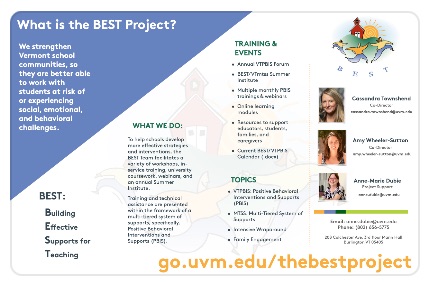
BEST: Building Effective Support For Teaching Students With Behavioral Challenges
News & events
BEST Summer Institute 2013 - Keynote Presentations
Monday
Keeping MTSS on Track: How to Identify, Repair and Prevent Mistakes to Ensure Sustainable Change.
Amanda VanDerHeyden
Most teachers, school psychologists, and principals want to be effective and want to see their instructional decision making cause students to learn more, learn faster, gain deeper understanding, and avoid academic and behavioral failures. When implemented effectively, MTSS/RTII systems can produce large returns for systems: improving efficient use of instructional resources and improving student and system outcomes. Much is known about the active ingredients of effective RTI systems, but knowing what to do and being able to do those things well are two different endeavors. During this keynote, Dr. VanDerHeyden will describe how to evaluate RTI implementation, avoid common pitfalls that can cause implementation failures or fix implementation errors that commonly interfere with and attenuate successes.

Amanda M. VanDerHeyden, Ph.D., is a private consultant and researcher who has worked as a researcher, consultant, and trainer in a number of school districts and published more than 60 scholarly articles and chapters related to RtI. She has directed numerous RtI implementation efforts and her work has been featured by the U.S. Department of Education on “Education News Parents Can Use” on PBS and The Learning Channel. Dr. VanDerHeyden serves as advisor to the RtI Action Network at the National Center for Learning Disabilities, Education Programs Committee for the National Center for Learning Disabilities, and iSTEEP (a web-based data management system). She has consulted for Renaissance Learning, Vanderbilt’s National Comprehensive Center for Teacher Quality, and several state departments of Education to offer guidance on RtI implementation and evaluate implementation effects. Dr. VanDerHeyden is associate editor for School Psychology Review and serves on the editorial boards for School Psychology Quarterly, Journal of School Psychology, Topics in Early Childhood Special Education, and Journal of Learning Disabilities. Dr. VanDerHeyden is co-editor of the Handbook of Response to Intervention published by Springer and special issues of Assessment for Effective Intervention and School Psychology Review, each focusing on RTI. Dr. VanDerHeyden is author of Essentials of Response to Intervention (Wiley), Keeping RtI on Track: How to Identify, Repair, and Prevent Mistakes that Derail Implementation RtI (LRP), RTI Applications: Academic and Behavioral Interventions (Guilford) and Using RTI Data to Diagnose Learning Disability (working title, Guilford). Dr. VanDerHeyden has given numerous keynote addresses for national organizations (e.g., Association for Behavior Analysis International) and leadership institutes (e.g., the RTI Leadership Forum in Washington, DC in 2010). Dr. VanDerHeyden is a standing panel member for the Institute for Education Sciences at the U.S. Department of Education and her scholarly work has been recognized in the form of the article of the year award in 2007 from Journal of School Psychology and the Lightner Witmer Early Career Contributions Award from Division 16 (School Psychology) of the American Psychological Association in recognition of her scholarship on early intervention, RTI, and models of data-based decision-making in schools.
She serves as research advisor to iSTEEP, a web-based data management system. Amanda lives on the gulf coast, has two young children, and is active in a number of organizations designed to improve educational outcomes locally and nationally.
Tuesday
Ganging Up on Our Problems: Collaborative Efforts to Ensure Success for Vermont’s MTSS-RtII Approach
Marjorie Y. Lipson
A diverse group of professionals has been working in Vermont to create policy and guidance documents in support of a statewide-framework for MTSS-RtII. This work is especially exciting because it has crossed traditional professional boundaries and holds promise for supporting schools, districts, and/or supervisory unions as they undertake the important work of closing achievement gaps and strengthening outcomes for all students. Dr. Lipson will provide an overview of the cross-disciplinary efforts and outcomes that have already been achieved and the plans for future collaborative work. She will highlight the importance of strong systems and good first instruction in an effective MTSS approach and will use examples from Vermont’s MTSS-RtII Field Guide, the MTSS self-assessment, and other partnership efforts to demonstrate how important concepts and principles can be realized in various local contexts.

Marjorie Y. Lipson, Ph.D., is professor emerita at the University of Vermont, where she was named University Scholar for 2008-2009. She has a continuing professional support role with the Vermont Reads Institute. She has worked with dozens of schools and school districts engaged in school improvement in the area of literacy.
Her scholarship focuses on reading difficulties, reading comprehension, and factors influencing literacy success. Her research and commentary have resulted in more than 40 publications in book chapters and journals such as Reading Research Quarterly, Elementary School Journal, Journal of Literacy Research, and The Reading Teacher. She is coauthor, with Karen Wixson, of Assessment & Instruction of Reading and Writing Difficulties: An Interactive Approach now in its fifth edition. She has served on the Board of Directors of the National Reading Conference, and on numerous editorial boards of journals. She was founding co-chair of the IRA Commission on RTI and co-editor of the book, Successful Approaches to RtI. Her strong interest in improving classroom practice resulted in a text providing guidance to teachers in grades 3-6, Teaching Reading Beyond the Primary Grades.
Prior to receiving her doctorate at the University of Michigan, she taught elementary school in a Spanish-English bilingual setting in the Midwest and for several years in Washington, D.C. She continues to work in schools and closely with teachers to improve literacy development of all students.
Thursday
Working From The Heart
Martin Brokenleg
Youth work requires a personal energy unlike other professions. The foundation of The Circle of Courage draws on Native American practices which developed skilled practices to raise resilient children. Those practices can enhance and support contemporary youth workers and educators in their demanding work today. Finding supportive strategies from resiliency codes, heart work focuses in building inner strengths in youth workers and in youth themselves. Working from the heart is the most effective means for the demands of youth work today.
Presentation: Working from the Heart (pptx)
Martin Brokenleg, Ph.D., co-founder of the Circle of Courage, consults worldwide for Reclaiming Youth International. He holds a doctorate in psychology and is a graduate of the Episcopal Divinity School. He is and Emeritus Professor and was most recently Director of Native Ministries and Professor of Native American Theology and Ministries at the Vancouver School of Theology in Vancouver, British Columbia. For thirty years, Dr. Brokenleg was Professor of Native American studies at Augustana College of Sioux Falls, South Dakota. He has also been a director of The Neighborhood Youth Corps, chaplain in a correctional setting, and has extensive experience as an alcohol counselor. Dr. Brokenleg has consulted and led training programs throughout North America, New Zealand, and South Africa. He is the father of three children and an enrolled member of the Rosebud Sioux Tribe practicing the culture of his Lakota people.
Last modified June 11 2013 01:31 PM