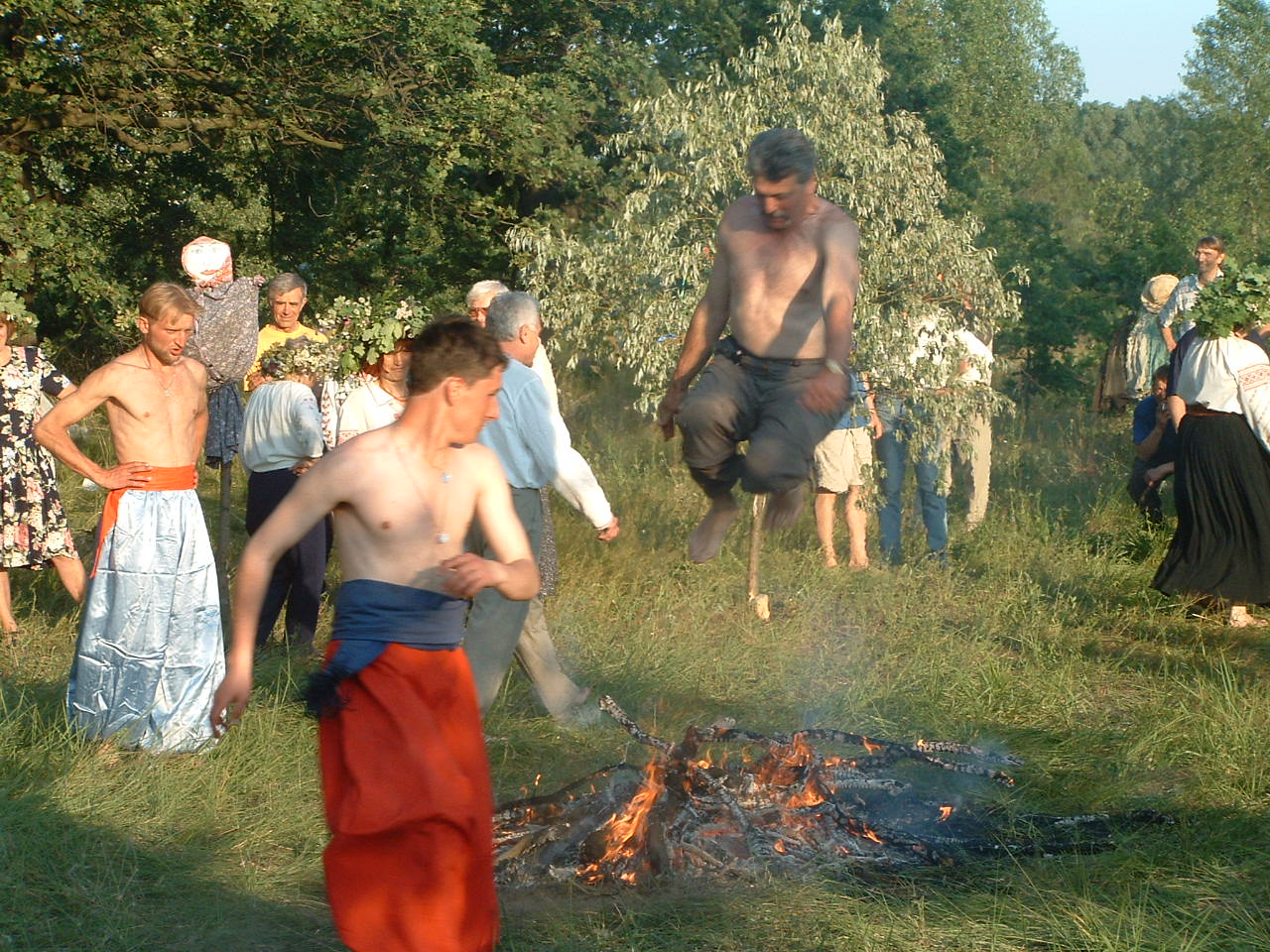
 Jumping
over the Kupalo fires,
midsummer's day, 2004, Trukhaniv Island in the Dnipro
river, Kyiv
Jumping
over the Kupalo fires,
midsummer's day, 2004, Trukhaniv Island in the Dnipro
river, Kyiv
Related articles:
Paganism is frequently cast by
Anglo-American scholars as a form of “nature religion.” Some
have also
identified its political leanings as left rather than right.
This
article tests these preconceptions against the evidence
provided by
East European, especially Ukrainian, Paganism or “Native
Faith.” The
author examines Native Faith notions of nature as land, as
“blood,” and
as “tradition,” and argues that these are underpinned by a
concept of
“territorialized ethnicity”—the belief that ethnic communities
are
natural and biological entities rooted in specific
geographical
territories. The article traces this idea to its precursors in
European
and Soviet thought, and suggests that it may be more commonly
found
around the world than Western theorists presume. In light of
such a
different understanding of nature, the concept of “nature
religion” may
need to be rethought.
In
Search
of Deeper Identities: Neo-Paganism and Native Faith in
Contemporary
Ukraine.
Nova
Religio 8 (3), 2005, pp. 7-38. (First Prize Winner
of Thomas
Robbins Award for Excellence in the Study of New Religions,
2005.)
Click
for pdf.
This article examines the
growth of
Neopaganism and Native Faith in post-Soviet Ukraine. It
traces the
historical development of Neopagan ideas and contextualizes
their
emergence within the cultic milieus of alternative religion
and ethnic
nationalism. It surveys the main contemporary Ukrainian
Neopagan and
Native Faith groups and movements, assessing their future
growth
possibilities and comparing them with more familiar forms of
Western
Neopaganism. The author argues that these Ukrainian
movements have
become caught up within a set of ideas which are
ideologically
right-wing and scientifically insupportable, but that this
represents a
phase of development comparable to an earlier phase of
Anglo-American
Neopaganism, at least in its reliance on "alternative"
scholarship and
on a strong form of "identity politics." Like those Western
movements,
Ukrainian Native Faith might overcome its present-day
limitations, but
this will be difficult as long as the country continues to
face the
economic and political struggles within which it has
recently been
mired.
"The Revival of Ukrainian Native Faith," in
Modern
Paganism
in World Cultures: Comparative Perspectives, ed. M. F.
Strmiska (ABC-Clio, 2005).
Articles in
The
Encyclopedia
of
Religion and Nature, ed. by J. Kaplan, B. R. Taylor
(ed.-in-chief), L. Hobgood-Oster, A. Ivakhiv, and M. York (2
volumes,
London: Thoemmes Continuum, 2005): "Neo-Paganism in Ukraine,"
"Russian
Mystical Philosophy and Nature" (with M. N. Epstein), "Slavic
Religion," and others.
"Scholarship
on the Ancient Eastern Slavs: A Bibliographic
Overview." Ethnic Forum (Journal of Ethnic
Studies and Ethnic
Bibliography) 15:1/2, pp. 162-175. Kent State
University, Ohio.
- This article summarizes and evaluates the major
ethnographic,
archaeological, historical and other scholarly sources on
the ancient
Eastern Slavs, their cosmology, mythology and religious
practices. I
assess some of the controversies in
scholarship on the ancient Indo-Europeans and the
ethnogenesis of the
Slavs, Marija Gimbutas's work on the matricentric "Old
European"
civilization, and the problems of reconstructing
an ancient worldview from its remnants preserved in the
Christian-pagan
"double-faith" of the nineteenth and early
twentieth centuries.
"The Cosmos of the Ancient Slavs." Gnosis 31 (Spring
1994), pp.
28-35.
- A popular presentation of the archaic Slavic cosmos, its
sense of
space and time, and the ways it has been re-emerging, and
inspiring
cultural and religious movements, since the fall of the
Soviet Union.