University of Vermont Strategic Plan
Strategic Goals | Strategic
Planning Process | Action Steps
Implementation | Performance
Indicators, Fall 2007 | Unit
Plans
Introduction
The University of Vermont is a distinguished institution
with a proud history, based on a strong intellectual community and a concern
for the quality of life in the communities that it serves. UVM combines the
intellectual resources and breadth of opportunity of a research university with
the close student-teacher interactions typical of a liberal education, and supports
its mission through the effective use of technology.
Our aspirations reflect our values,
which include:
A commitment to rigorous intellectual inquiry
and critical thinking;
An abiding concern for the environment, health, and liberal education;
A strong commitment to diversity in the student body, the faculty and
staff, and the curriculum;
A willingness to address difficult societal issues with honesty, civility,
and practicality. We are a community that values respect, integrity, innovation,
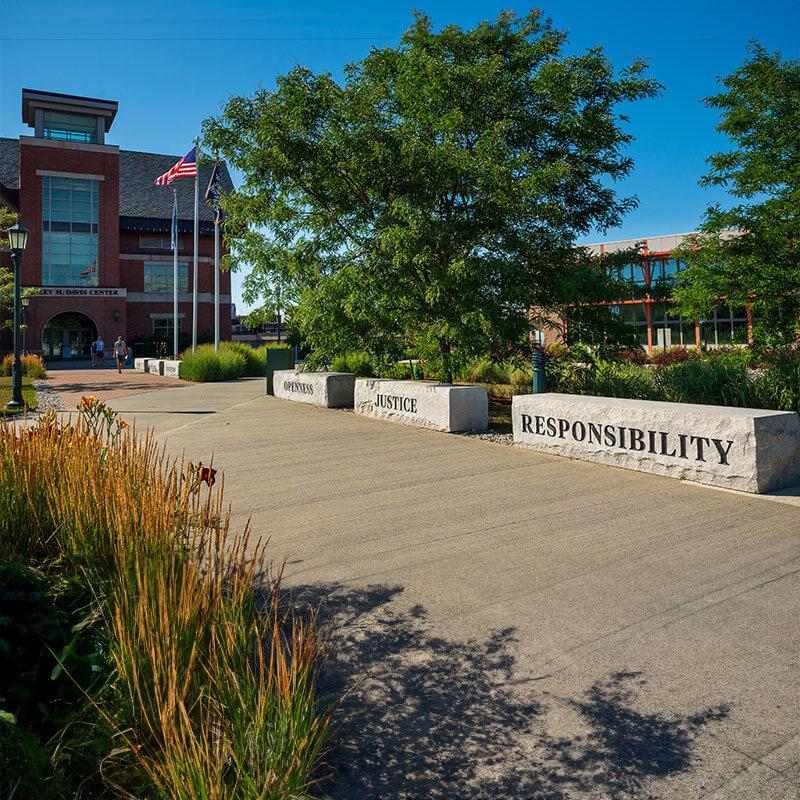
openness, justice, and responsibility and promotes the intellectual capacity
to engage in ethical decision making; and
An appreciation of our commitment to the State of Vermont and our land-grant
heritage.
VISION: To be the nation's premier small public
research university, preeminent in liberal education and the study of the environment
and health, and dedicated to providing students with extraordinary opportunities
for learning and personal development and to enhancing the cultural, social, and
economic life of Vermont, the nation and the world.
MISSION: To prepare students to lead productive,
responsible, creative lives and to create, interpret and share knowledge, applying
it for the benefit of Vermont and society as a whole.
Through our efforts the University of Vermont will have
a superior national reputation:
As a university combining outstanding teaching
with the research focus, faculty excellence, programmatic range and depth,
and societal mission of a research university;
As a vibrant, diverse, and intellectually engaged community on a human
scale;
As a place that emphasizes academic excellence and provides an exceptional
student-centered experience extending beyond the classroom; and
As a leader in liberal education and in the study of the environment
and of health.
Strategic Goals
To fulfill the university mission and vision we will
focus on seven goals, which in their totality will enrich the university, its
intellectual climate, and curricula:
Create a diverse community
Create an outstanding student experience
that promotes personal and intellectual development
Focus the human, fiscal, environmental, technological
and physical resources of the University on institutional values and priorities
Recruit and retain excellent students, faculty
and staff
Strengthen and focus academic programs, emphasizing
liberal education, health and the environment
Strengthen financial resources
Strengthen research, scholarship and the
creative arts
Action steps
-
Create a diverse community
- Develop and implement plans throughout the institution to recruit and
retain faculty, staff and students from under-represented groups.
- Strengthen international and multicultural curricular opportunities.
- Ensure that institutional policies and expectations are consistent with
and promote the climate and community enshrined in "Our
Common Ground".
- Develop institutional practices and policies that foster a culture of
inclusion, openness, and collaboration among administrators, faculty, staff,
and student
-
Create an outstanding student experience that promotes personal and intellectual
development
- Increase residential life housing capacity, renovate existing facilities,
enhance physical attractiveness, and create living/learning communities.
- Assess the quality of the traditional and non-traditional student experience
and take appropriate action assuring accountability of faculty, staff,
and students.
- Foster positive changes in student culture and behavioral norms.
- Provide undergraduate students with opportunities for rigorous and
challenging experiential learning including research, volunteerism, and
service-learning from the outset of their academic programs.
-
Focus the human, fiscal, environmental, technological and physical resources
of the University on institutional values and priorities
-
Develop mechanisms for implementing and documenting differential resource
allocations based upon support of institutional priorities and performance.
-
Create and implement comprehensive master plans for facilities and technology.
-
Develop and implement a plan for appropriate institutional growth related
to student population and the corresponding alignment of faculty and staff.
-
Recruit and retain excellent students, faculty and staff
-
Assure faculty accountability for creating an academically rigorous environment.
-
Reward excellent performance, enhance competitiveness of compensation
for faculty and staff, and improve the quality of the professional environment.
-
Increase the quality and improve the yield of admitted students through
effective enrollment management.
-
Substantially expand merit and need-based financial aid endowments and
gifts for the undergraduate and graduate population.
-
Design and develop first-rate academic advising programs.
-
Improve career and academic planning services and programs and connect
these services more effectively to academic units and programs.
-
Strengthen and focus academic programs, emphasizing liberal education,
health and the environment
-
Implement a universitywide honors college emphasizing cross-disciplinary
and interdisciplinary linkages.
-
Through faculty processes, create greater cohesion of the undergraduate
curriculum.
-
Strengthen the Academic Program Review process, emphasizing action-oriented
outcomes including consolidation/elimination of programs as appropriate.
-
Continue to improve the academic qualifications of the student body
-
Strengthen financial resources
- Expand fiscal resources consistent with the university mission.
- Perform rigorous and ongoing comparisons of our academic, financial, and
operational performance against a carefully selected and consistent set
of peer and aspirant institutions.
- Re-engineer administrative and bureaucratic policies and processes to
eliminate waste and duplication.
- Develop budget and resource allocation models that are strategic and reward
progress towards established goals and priorities.
- Successfully implement the comprehensive campaign.
-
Strengthen research, scholarship and the creative arts
- Create a collaborative environment that supports and rewards faculty achievement
in teaching, research/scholarship, and service.
- Identify and implement steps to support the development of cross-disciplinary
and interdisciplinary research and scholarship.
- Make appropriate and focused investments in the infrastructure and technology
supporting our research mission.
- Expand graduate student enrollments emphasizing Ph.D. programs, interdisciplinary
study, and the priority themes of the strategic plan.
- Create internal incentives to increase substantially the external funds
supporting graduate education.
- Increase the competitiveness of graduate student support.
- Recognize and respect the development of scholarship and curriculum within
all disciplines that broadens knowledge about the diversity of the human
experience.
Implementation of University Planning Goals and Objectives
The President charged the University Planning Council (UPC) under the leadership
of the Provost with developing and implementing a university strategic plan.
The responsibilities of the President, Provost, UPC and other administrators
are described below.
The Board of Trustees is responsible for:
- reviewing the strategic plan and for monitoring progress towards its goals
and objectives
The President is responsible for:
- ensuring that the University strategic plan and its goals and objectives
are implemented in an efficient and timely manner with keeping the Board of
Trustees well-informed about the progress being made in this regard.
The Provost is responsible for:
- reinforcing a climate of accountability for the pursuit of the plans and
achievement of priorities and goals
- ensuring that resources are allocated to institutional strategic priorities
- communicating regularly with the campus community concerning the progress
of the university towards achieving the goals contained in the strategic plan
The UPC is responsible for:
- establishing institutional metrics to measure progress towards the goals
and objectives of the strategic plan
- designing and overseeing the annual processes by which every academic, administrative
and support unit develops and updates its own plan incorporating goals and
objectives and performance metrics
The Vice Presidents, Deans, Chairs, Directors, etc. are responsible for:
- ensuring that unit plans are developed, implemented and updated consistent
with the University Strategic Plan. The expectation is that the strategic
plan will influence and shape decisions at all levels of the University and
that every member of the University community plays an integral role in the
successful completion of the strategic plan and the accomplishment of the
goals.
Strategic Planning Process
Timeframe for FY 04 and FY 05 Plans
- Vice Presidents, Vice Provosts, and Deans submit Strategic Plans to Gary
Derr by September 30, 2003 for review by the University Planning
Council.
- University Planning Council reviews plans October 2003.
- Unit plans posted on Strategic Planning Web page by November 1,
2003.
- Departments, Centers, Office, etc. submit plans to Gary Derr by December
15, 2003 for review by the University Planning Council.
- University Planning Council reviews plans January 2004.
- Department plans posted on Strategic Planning Web page by February
1, 2004.
Updates:
- All units and departments will be asked to provide a mid-planning cycle
progress report/outcomes in April 2004 in advance of May
2004 Board of Trustees Meeting.
- All units and departments will have the opportunity to provide a mid-planning
cycle update/revision to their plans in April 2004. Any updates
will be added to the Strategic Planning Web page.
Regular Cycle:
- University Planning Cycle reviews and updates Strategic Goals and Action
Steps Fall 2004.
- Vice Presidents, Vice Provosts, and Deans submit Strategic Plans to Gary
Derr by December 2004 for review by the University Planning
Council.
- Departments, Centers, Offices, etc. submit plans to Gary Derr by April
1, 2005 for review by the University Planning Council.
- Plan cycle completed by May 1, 2005.
Last modified December 21 2008 11:58 AM