home

Community-University Partnerships & Service Learning

about

A History of Service-Learning at the University of Vermont...

“Democracy has to be enacted anew in every generation, in every year, in every day, in the living relations of person to person, in all forms and all institutions.” - John Dewey, University of Vermont Class of 1879

Timeline:

Fall, 1969: Hal Woods arrives at UVM as a graduate student in the College of Education and Social Services, and serves as the Coordinator of Fraternity Affairs. Document: Hal Woods’ VIA Anniversary Keynote Address

1970: The Office of Volunteer Programs (OVP) is opened as a part of the Division of Student Affairs, with Hal Woods as Director and with the support of Campus Ministry Reverend John Perry. Three programs make up the Office: Big Brother/Big Sister, Hospital Brother/Big Sister, and a small UVM Tutoring Project. The Office sets out to recruit 20 – 30 students per project, and over 300 apply. The Office is housed in Billings Library. UVM hosts a National Student Volunteer Program Conference. The student volunteer movement is taking hold across the country.

Fall, 1970: Kake Walk is replaced with the UVM Film and Slide Festival. Students Brian Doubleday and Jim Taylor create a film about the OVP entitled, “Do Nothing with Someone.” The OVP becomes much more visible at UVM. Record numbers of students volunteer for various programs, and start to ask questions about linking their volunteer experience with academic interests and credit.

Fall 1971: OVP receives an ACTION grant to expand the University Year for Action (UYA) program, which grants academic credit and financial stipends to students involved in community-related projects. Academic credit is arranged through the College of Education and Social Services, administered through OVP, and is called the Service-Learning Internship Program (SLIP). The term “continuum of service” emerges. 30 students take part in the first UYA, and the term “service-learning” starts to be used at UVM. Elsewhere across the nation, the term is used loosely, but the movement has yet to catch on. The UVM OVP helps to open volunteer programs at Johnson State, Castleton State, and Lyndon State Colleges, Bellows Free Academy, and the Vermont Department of Corrections.

1972: The OVP is renamed The Center for Service-Learning (CS-L), the first such-named office in the country, with goals centered around partnership and reciprocity. The CS-L is moved to Mansfield House.

1972 – 1979: CS-L receives a number of grants from both ACTION and the Fund for the Improvement of Post-Secondary Education (FIPSE). The film “Do Nothing with Someone” is distributed nationally and CS-L is asked to consult with campuses around the country through the National Student Volunteer Program. CS-L Director Hal Woods testifies in Congress to help create the National Center for Service-Learning.

Fall, 1979: The many volunteer programs run under CS-L organize a Project Coordinator’s Council to oversee all of the student-run volunteer programs. The new umbrella organization is called the Student Community in Action (SCA), and then becomes known as Volunteers In Action (VIA). UVM Rescue also starts out of CS-L, based on the St. Michael’s College Rescue Squad model.

Early 1980’s: The Reagan Administration shuts down the National Student Volunteer Program and many national resources dry up, including UYA, which had supported the SLIP for many years. Student involvement in volunteering begins to diminish both at UVM and across the country. CS-L programs start to wane.

Mid-1980’s: The CS-L SLIP creates the Field Studies Program, a portable service-learning opportunity modeled after the UYA Seminar Program, and interest in service-learning begins to increase again as students are able to take their academic interest off campus, across the country or the world. Academic credit is again arranged and offered through the College of Education and Social Services.

Fall 1989: Voluntarism as supported by CS-L expands across campus. CS-L oversees VIA, and creates Alternative Spring Break Program (1990 – 1991), the Community Service TREK Program (1992), and community service programs for the Department of Residential Life, The Judicial Program, and Greek Affairs.

Spring 1990: CS-L is asked by University Advancement to write a proposal for funding from a private donor, the Sandy Hill Foundation, which is interested in funding service-learning programs. The proposal is accepted and the Volunteer Coordinator position at CS-L, previously funded with soft money, becomes endowed.

Fall, 1990: CS-L puts together the first Service-Learning Reader, a compilation of readings to support the SLIP Seminar and the Field Studies Program. After many editions, CS-L sells the rights to the Reader to the National Society for Experiential Education (NSEE), which publishes it nationally. Jossey-Bass eventually buys the rights and still publishes the reader, which is used by a number of service-learning programs across the country.

1990 – 1995: CS-L creates the Alternative Spring Break Program in FY 91, and is one of the first institutions in the country to have a funded program. In the Fall of 1991, CS-L receives a $250K FIPSE grant in conjunction with the Alcohol and Drug Education Program. The theme of the grant is that service-learning can serve as a deterrent to alcohol and drug use among college students. At the same time, CS-L experiences significantly increased numbers in SLIP (150 per summer) and also creates the Community Service TREK Program in conjunction with the Orientation Program and the Department of Student Activities in 1992. During this period, CS-L is supported by limited central funding and has very limited support or awareness outside the Division of Student Affairs. Hal Woods and then Kami Oliver retire as Directors. Staff are consolidated and programs relocated.

FY 1995: In the face of a particularly difficult budget crisis, departments across campus are asked to reduce budgets and staff. In the summer of 1995, The Center for Service-Learning is disbanded and its programs split between the Division of Student Affairs’ Center for Career Development and the Department of Student Activities. The for-credit SLIP (made up of the Seminar and the Field Studies) moves to Career Development. The strictly volunteer programs (VIA, ASB, CS TREK, etc.) move to Student Activities.

July 1, 1998: UVM’s new President, Judith Ramaley arrives on campus. Having come from Portland State University, and as President of the Board of Directors of the national Campus Compact, the new President is very committed to community engagement pedagogy and programming at UVM. She strongly encourages UVM’s application for a United States Department of Housing and Urban Development (HUD) Community Outreach Partnership Center (COPC) grant and the development of a Vermont Campus Compact.

1999: UVM representatives serve on the state-wide committee to plan and create a Vermont Campus Compact. Middlebury College agrees to house the state-wide office and a number of Presidents, lead by UVM President Judith Ramaley, provide start-up funds. Vermont Campus Compact opens in Fall 2000.

1999: Hal Woods and the UVM program are named “pioneers” of the service-learning movement in the book, Service-Learning: A Movement’s Pioneers Reflect on Its Origins Practices, and Future, by Tim Stantion, Dwight Giles, and Nadinne Cruz.

Summer 1999: UVM receives a Kellogg Foundation sub-grant with the State University of New York at Oneonta, to create the Faculty Fellows for Service-Learning Program. The grant is co-written by staff from the Centers for Teaching and Learning and Career Development.

Fall, 1999: The University is granted a Community Outreach Partnership Center (COPC) grant from the US Department of Housing and Urban Development. Projects focus on Community Leadership, Fair Share/Fair Treatment Housing, and UVM Economic Impacts. The COPC is originally housed in the Old North End of Burlington.

Spring, 2000: The first class of the Faculty Fellows for Service-Learning is taught. Nine Fellows participate.

February 2000: Representatives of the COPC, The Faculty Fellows for Service-Learning Program and the John Dewey Project on Progressive Education collaborate to write, “Community Engagement at the University of Vermont: Potentials and Immediate Opportunities,” a concept paper to President Ramaley, recommending: 1) the creation of active connections between departments, programs and projects across the campus as well as between these units and associations, institutions and organizations in the community; 2) the building of a solid research agenda that seriously addresses issues pertaining to various forms and components of engagement and their costs and benefits, functions and outcomes; 3) the active support of ongoing faculty development opportunities; and 4) the creation of a service-learning curriculum that promotes varied forms of student leadership relevant to engagement. The paper suggests the need for and a plan to: (a) integrate collaboration building, scholarly inquiry and action research, (b) high quality faculty development and a student leadership curriculum, and (c) allocate University funds to create an infrastructure that lends to the sustainability and viability of these integrated and innovative efforts. Specifically, the paper proposes the designation of a UVM facilitator/coordinator to support community engagement initiatives, and facilitate communications within the University and between the University and the larger community. Document: Concept paper, February 2000

Spring 2000: President Ramaley acknowledges a need for centralization of efforts around community engagement and service-learning at UVM, but is not yet ready to commit funds or staff.

Spring/Summer, 2000: UVM receives a FIPSE sub-grant with Eastern Michigan University to fund three more years of the Faculty Fellows for Service-Learning Program. The Grant is co-written by staff from the Center for Career Development and the John Dewey Project on Progressive Education.

Summer 2000:January 2001: Judith Ramaley resigns as President and leaves UVM. The Committee on Community Engagement continues with the interim institutional leadership.

Summer 2001: COPC does research on existing community engagement and service-related programs at UVM and barriers to advanced work, The Partnership Interview Project. The study identifies five interrelated groups of barriers to University-Community partnerships and expansion of service-learning at UVM: (1) time, (2) communication, (3) funding, (4) professional recognition & rewards at the University, and (5) group process. Respondents identify three groups of roles that the COPC and the Committee on Community Engagement could best play to further University-Community Partnership work at UVM: (1) communications, (2) evaluation and training, and (3) centralized staffing, funding, coordination, and planning. Document: The Partnership Interview Project Report, Summer 01

December 2001: The Committee on Community Engagement releases The Partnership Interview Project findings, in addition to an inventory of existing volunteer, community partnership and service-learning opportunities at UVM. Document: Examples of Service-Learning at UVM

February 2002: The Committee on Community Engagement presents its proposal for a UVM Center for Community Partnerships and Collaboration to Provost John Bramley with a proposed mission, “to facilitate efforts of UVM and community members to link and collaborate with one another on a wide range of community engagement activities. Drawing upon a strengths-based perspective of community development and a growing consciousness concerning the institutional relationship higher education institutions must have with their local communities, the center would be guided by a partnership and collaboration ethos. The focus of the Center would encompass the entire state of Vermont, and probably beyond. The Center would work to create interdisciplinary and cross-disciplinary links to Vermont communities.” Document: Draft Center Proposal for Provost, February 25, 2002

May, 2002: Upon request, the Committee on Community Engagement presents a more detailed proposal and budget to the Provost and The Office of University Advancement. At the same time, the Provost asks the Committee to draft a job description for a possible Vice President for Outreach, who might oversee service-learning and community partnership activities. Document: Campaign Priorities Table

July 1, 2002: UVM’s new President, Daniel Mark Fogel, takes office. Fogel is known for the rapid expansion of service-learning at his previous institution, Louisiana State University. In September, 2002 President Fogel hosts a Recognition Reception for the third class of the Faculty Fellows for Service-Learning, expresses his interest in and support for service-learning pedagogy

October, 2002: The Committee on Community Engagement meets with the President and members of his cabinet to propose a new center of activity to focus on service-learning and community partnerships. President Fogel encourages the Committee to refine its proposal and resubmit.

Fall, 2002 – Spring, 2003: The Committee on Community Engagement, working closely with COPC and the Faculty Fellows Program, refines its proposal to the President. In December, 2002, in a second meeting with President Fogel, the Committee on Community Engagement presents its revised proposal for a Center to build capacity for UVM-community partnerships for service and learning by: (a) expanding the base of UVM and community involvement (e.g., via networking, promoting collaboration); (b) enhancing the “leadership pool” and skills in collaborative partnerships and service-learning (e.g., via individual and group training and organizational development); and (c) expanding the resource base (e.g., via brokering resources and information, dissemination and diffusion of service-learning and partnership models, experimentation, and research and development). President Fogel is very supportive of the proposal, and suggests further revision. A final proposal is submitted to the Provost in February 2003 outlining the Mission, Overview and Budget of the UVM Community Partnerships for Service and Learning Center of Activity. The mission reads: “to promote high quality service-learning opportunities for UVM community members and an infrastructure to foster and sustain such opportunities. This infrastructure includes active, collaborative UVM-Community partnerships.” Documents: 1) Final Response to President Fogel 2) January 30, 2003 Proposal

September, 2003: UVM President Daniel Mark Fogel officially opens the Office of Community-University Partnerships and Service-Learning (CUPS) during a two-day service-learning conference on campus. He commits three years of funding. The goals of the new office are: 1) to Foster UVM-Community Partnerships by helping to publicize and connect potential university and community partners; broker resources and information regarding networking opportunities for both the campus and community groups; write and support grants relating to these functions; 2) to Support Faculty and Curriculum Development, such as the Faculty Fellows for Service-Learning Program, speaker series, and other professional development opportunities for UVM faculty and interested staff; 3) Promote Student Leadership Development, for example, train students to serve as teaching assistants in service-learning courses, and provide workshops for students on community-based research and service-learning pedagogy; 4) to Support Development of University Policy that strengthens community-based scholarship and service-learning at UVM; and 5) Pursue Research and Evaluation on topics such as service-learning and community-based scholarship and their relationship to student learning, faculty development, institutional change, and community function. The former Committee on Community Engagement is disbanded with the establishment of this new office. Document: One Page Overview

September, 2003: President Daniel Mark Fogel announces the opening of the UVM Office of Community-University Partnerships and Service-Learning (CUPS). COPC funding comes to an end and COPC programs become a part of the new CUPS.


CUPS has goals and objectives in the following five categories. Accomplishments in Year 1 are as follows:

  1. Foster UVM-Community Partnerships by helping to publicize and connect potential university and community partners; broker resources and information regarding networking opportunities for both the campus and community groups; write and support grants relating to these functions.

    • Designed a training program for Community Partners to be delivered in October 2004 to representatives from an estimated 25-30 community organizations that wish to partner with UVM.

    • Submitted and was awarded a Vermont Campus Compact Infrastructure Grant ($4,000 in each of three years for an expected total of $12,000) for a series of campus-community initiatives that define, cultivate and celebrate campus-community partnerships and service-learning collaboration.

    • Helped to broker more than 15 new collaborative partnerships between UVM faculty and community organizations that subsequently served service-learning and community-based research collaborations.

    • Hosted both fall and spring receptions that brought a total of over 200 UVM faculty, staff, students and community partners together focus on the value of service-learning and community-UVM partnerships.

    • Cosponsored Burlington’s Neighborhood Night of Success (April, 2004) at City Hall that hosted approximately 250 community residents.

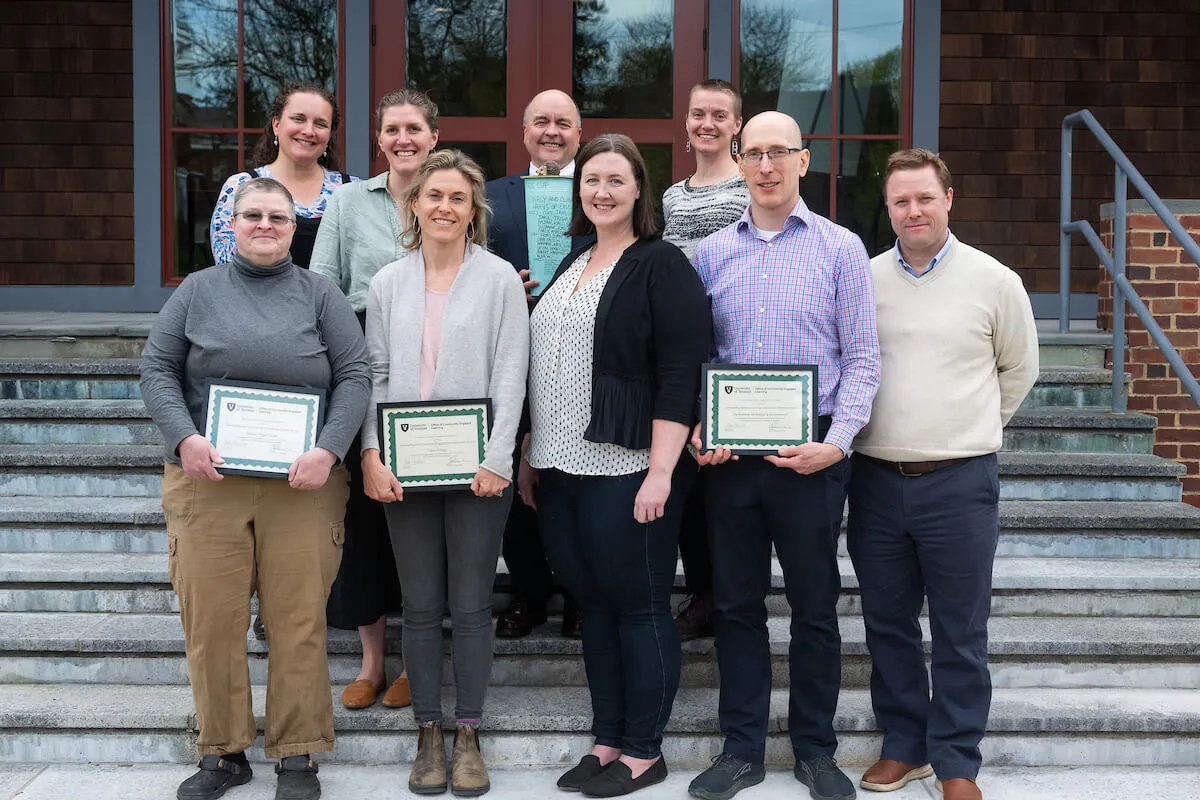
    • Established an annual Awards and Recognition Program to acknowledge outstanding accomplishments in service-learning by community partners; in May 2004 we honored 23 nominees for Outstanding Service-Learning Community Partners at our first Annual Awards and Recognition Ceremony.

    • Nearly completed a website that guides community members, faculty, staff, and students in seeking UVM support for establishing UVM-community partnerships for both credit-bearing and non-credit-bearing student community service activities.

    • Established a working network with other UVM offices that support various forms of community service and outreach.

  2. Support Faculty and Curriculum Development, such as the Faculty Fellows for Service-Learning Program, speaker series, and other professional development opportunities for UVM faculty and relevant staff.

    • Coordinated a two-day Service-Learning Institute (Sept. 2003) featuring consultant Dr. Edward Zlotkowski (National Campus Compact) that provided lectures and workshops to over 80 UVM faculty, staff and administrators as well as to a similar number of faculty, staff, and administrators from neighboring colleges.

    • Hosted a 2½ day Service-Learning Institute (March 2004) featuring consultant Dr. Patti Clayton (North Carolina State Univ.) that provided a series of workshops and discussions for approximately 55 UVM faculty.

    • Hosted a semester-long Faculty Fellows Training Seminar (spring, 2004) that provided in-depth training in service-learning pedagogy to 8 UVM faculty each of whom will now teach a new service-learning course reaching an estimated 200-250 additional students.

    • Established a curriculum development small grants program for faculty developing service-learning courses that disseminated approximately $7,000 to nine faculty to support the development and/or implementation of seven service-learning courses that reach an estimated 150 students.

    • Established an annual Awards and Recognition Program to acknowledge outstanding accomplishments by faculty teaching service-learning courses; in May 2004 we honored 18 nominees for Outstanding Service-Learning Faculty at our first Annual Awards and Recognition Ceremony.

    • Conducted a campus-wide web-based survey to identify UVM service-learning courses, community partners, resource and training needs and priorities (of the 225 respondents, 95 indicated that they taught one or more courses in which students work with individuals and/or groups/organizations in the community; although many of these do not fulfill all the criteria of “service-learning.”

    • Established a website and several list serves that regularly disseminate information relevant to training and professional development opportunities in service-learning and community-university partnerships.

    • Began collaborations with St. Michael’s College for jointly offering international service-learning courses in sites around the world.

    • Met individually with Deans of 9 of the 12 units at UVM to discuss establishment of service-learning initiatives in their respective units.

    • Provided group workshops/presentations to faculty & advisory committee members of two colleges/units regarding service-learning.

    • Created a resource library on service-learning and community-university partnerships available for use by faculty, students, staff, and community partners.

    • Supported nine UVM faculty, staff, and students to travel to regional service-learning conferences for professional development.

  3. Promote Student Leadership Development, for example, train students to serve as teaching assistants in service-learning courses, and provide workshops for students on community-based research and service-learning pedagogy.

    • Developed a new Service-Learning Teaching Assistant Americorps Education Award Program that will train undergraduate teaching assistants for service-learning courses and will pay them up to $2,362 per semester for their work through Americorps/Vermont Campus Compact during AY05.

    • Assumed supervisory responsibility for the UVM Community Service Scholars Program through which 80 Vermont students provided 9,205 hours of community service during the 2003-2004 academic year.

  4. Support Development of University Policy that strengthens community-based scholarship and service-learning at UVM.

    • Commissioned a white paper titled “Review, Promotion and Tenure Guidelines and the Civic Mission of Higher Education” to guide UVM’s deliberations re incorporating service-learning into the RPT process.

    • Began research into issues regarding legal liability pertaining to service-learning and UVM-community partnerships.

    • Developed a no-tuition/no credit audit policy for community members that was passed by the Faculty Senate (vetoed in the President’s Office).

    • Neared completion in establishing criteria for identifying and demarcating UVM service-learning courses on the Registrar’s home page.

  5. Pursue Research and Evaluation on topics such as service-learning and community-based scholarship and their relationship to student learning, faculty development, institutional change, and community function.

    • Designed and in the process of conducting a major research study of the impact of various components of service-learning courses on student, faculty, and community partner outcomes.

    • Conducted an assessment of collaborative partnerships between UVM and area schools.


Awards

It is noteworthy that several individuals associated with CUPS, including the CUPS Director, Associate Director, and an affiliate, received significant regional awards that recognize their outstanding leadership in service-learning. This brings increased recognition to UVM as a site that provides leadership in this area.

Last modified December 21 2010 11:05 AM

Contact UVM © 2013 The University of Vermont - Burlington, VT 05405 - (802) 656-3131