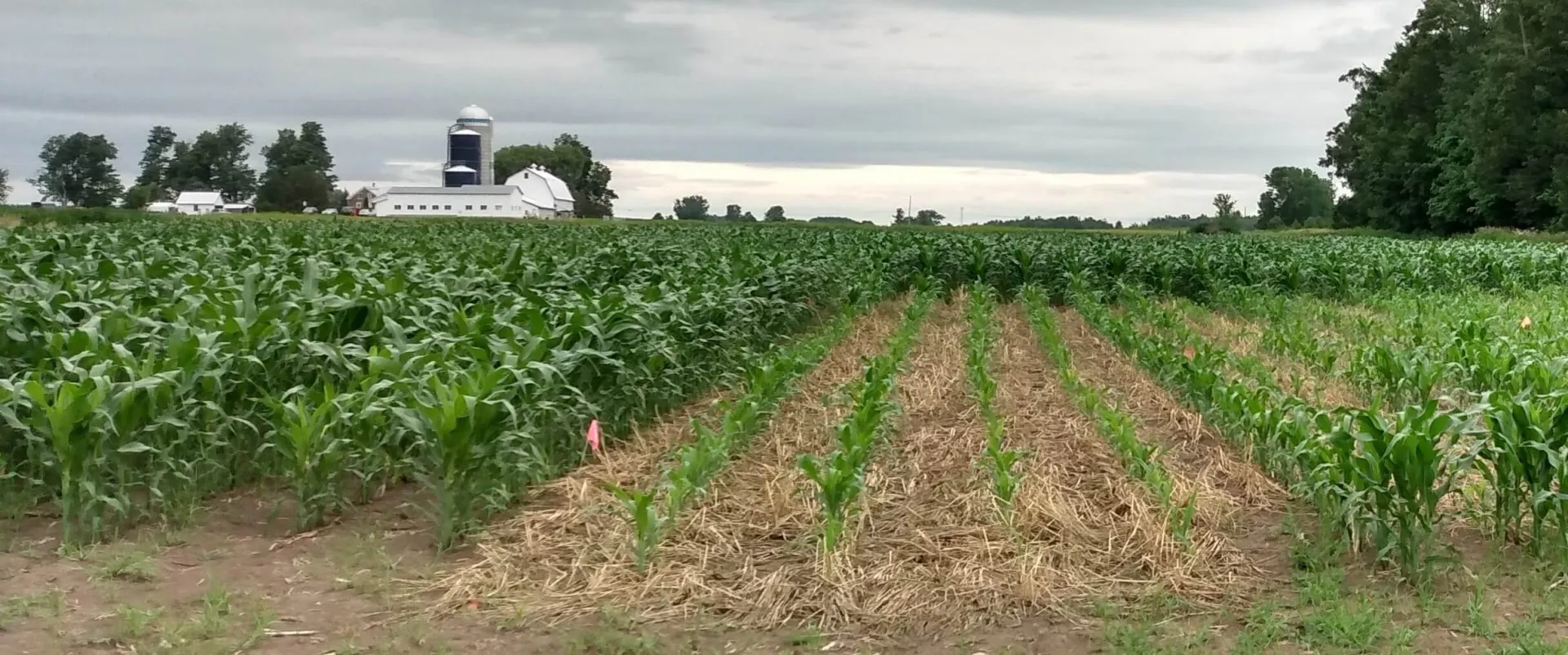
Cover crops can offer many benefits, including improved soil health, weed suppression, and erosion control. They can also contribute nitrogen to cash crops, reduce the need for herbicides, and conserve soil moisture. These benefits can contribute to higher yield and quality of cash crops. However, a cover crop’s biomass (quantity of plant material) and growth stage impact these benefits.
In the UVM Extension Northwest Crops and Soils Program (NWCS) 2024 report “Impact of Cover Crop Termination Timing on Grain Corn Productivity,” we describe our research to assess the impact of cover crop termination timing on weed biomass, corn seedling populations, vigor, pest damage, and grain corn yield. From 2020 through 2022 at Borderview Research Farm in Alburgh, VT, we assessed four cover crop management practices:
- no cover crop (Bare),
- planting Brown (cover crop terminated 3 to 4 weeks before corn planting),
- planting Green/Brown (cover crop terminated 2 to 8 days before corn planting), and
- planting Green (cover crop terminated 3 to 5 days after corn planting).
The study was one of 16 conducted in the Northeast, Midwest, and South, coordinated by the Precision Sustainable Agriculture, a national network funded by the USDA’s National Institute of Food and Agriculture from 2019 to 2025.
The full NWCS report on the Vermont study is 10 pages long, so we thought this short summary might be helpful to grain corn growers during planting season.
The Research Design
The soil type at the research site was a Covington silty clay loam with a 0-3% slope. We planted winter rye (var. AC Hazlet) at 70 lbs ac-1 at the end of September or early October each year and measured its biomass just prior to termination with a glyphosate herbicide. We terminated Brown cover crop treatments at the end of April, Green/Brown cover crop treatments in mid-May, and Green cover crop treatments at the end of May. In each plot, we assessed corn seedling populations and vigor when corn was in the third leaf stage (V3) and weed biomass when corn was in the fifth leaf stage (V5).

We seeded a 95-day relative maturity corn at a rate of 30,500 seeds ac-1 in 30” rows. At planting, we applied starter fertilizer to all corn plots, and we later applied sidedress nitrogen according to PSNT test results. See the full report for more on the research methods and materials.

Summary of the Results
Weather Data: Overall, the 2020-2021 cover crop and corn growing seasons were drier and warmer than the historical average during the critical growing periods: October to May for cover crops, and May to August for corn. The 2021-2022 growing seasons were more variable: warmer than usual during cover crop growing periods, and normal for corn, though cooler and wetter in June. The 2022-2023 seasons were on average warmer and wetter than normal, with periods of drought and deluge.
Cover Crop Biomass at Termination: We found significant difference by year in cover crop biomass at termination, as well as year-by-treatment interaction, indicating that conditions (e.g., weather) influenced cover crop biomass. To understand general performance, we averaged cover crop biomass across years. Green termination produced an average of 1,931 lbs ac-1 more biomass than the Green/Brown treatment and averaged 3,336 lbs ac-1 more than the earliest terminated treatment, Brown. On average, the Brown treatment produced 1,405 lbs ac-1 less than the Green/Brown treatment.

Corn Populations and Vigor Results at V3: Considering all years at once, seedling vegetative stage was significantly more developed in the Bare treatment than any other. The Brown treatment had a more advanced growth stage compared to Green/Brown or Green treatments. The Green/Brown and Green treatments had statistically similar growth stages. These findings indicate that no or low cover crop biomass does not inhibit corn seedling germination or growth.
Weed Biomass at V5: Conditions (e.g., weather) also influenced the amount of weed biomass. In 2021, it was relatively low, and there was no difference among cover crop treatments. However, there were significant differences in 2022 and 2023 and in the overall multi-year average. Weed biomass was significantly lower by more than 60 lbs ac-1 in the Green/Brown and Green treatments than in the Bare and Brown treatments. The increased cover crop biomass of later terminated cover crops likely shaded the soil, decreasing weed germination and growth.
Corn Pest Damage Assessment Results at V5: There was a significant difference among years in the percentage of corn population impacted by pests and a significant year-by-treatment interaction. Conditions (e.g., weather) influenced pest populations and subsequent crop damage. In addition, percent pest damage varied by year. When we combined data across years, there was no significant difference in pest damage among the treatments, indicating that weather may influence the impact of cover crop biomass on corn pest damage.
Grain Corn Yield Results: When we considered yields across years, there was a significant difference in average grain corn yields among treatments. It was significantly higher in the Brown treatment than in the Green/Brown and Green treatments, but Brown had similar yields as Bare. These data indicate that cover crop termination timing and cover crop biomass can impact grain corn yields. The average Bare and Green treatment yields were similar to the Green/Brown treatment yields, but average Bare treatment had 22 bu ac-1 higher yield than the Green treatment.

Key Takeaways
We found that cover crops can gain significant biomass in the spring, and biomass can differ when termination timing differs by as little as seven days. It was difficult to parse out how much cover crop biomass directly impacts grain corn yield.
Cover crop biomass was statistically different in all years, but grain corn yields were not. Although weather varied by year, 2022 and 2023 were considerably cooler and wetter during critical corn growing periods. When cover crop biomass was lowest in 2021 and highest in 2023, there was no difference in corn yields. These data suggest that cover crop biomass may impact grain corn yields in certain weather conditions. However, overall, corn populations and vigor were significantly higher in Bare and Brown treatments than in Green/Brown and Green treatments. These outcomes may have contributed to yield differences we observed at the end of the season because it is possible that cover crop biomass decreased populations and delayed growth early in the season by blocking sunlight and reducing photosynthetic capabilities. It is also possible that the winter rye cover crop impacted nitrogen availability. Winter rye scavenges extra soil nitrogen in the fall, holds it until termination, and releases it as it decomposes. The rate of decomposition is slower in later terminated (more mature) winter rye than in earlier terminated (less mature) winter rye. The total amount and availability of nitrogen released from the winter rye depends on the cover crop’s maturity and quantity at termination.
Impacts of pest damage by cover crop treatment varied across years, and there was no statistically significant impact when data was averaged across years. There were some tradeoffs associated with higher cover crop biomass: Weed biomass was significantly lower in later terminated cover crops, which may decrease the need for additional early season herbicide applications or tillage passes.
The findings indicate that the combination of cover crops and weather can impact grain corn yields in multiple ways: through increased competition for sunlight (weed biomass), reduced weed pressure (weed biomass), growth suppression (populations and vigor), and increased pest incident (percent damage). Long-term studies would clarify the weather’s influence and what impacts cover crop termination date consistently has on grain corn yield. The same study on corn grown for silage may have different outcomes because the whole plant is harvested.
For more information, see the NWCS 2024 report “Impact of Cover Crop Termination Timing on Grain Corn Productivity,” or email Heather.Darby@uvm.edu or Lindsey.Rhul@uvm.edu, or call 802-524-6501. Visit Precision Sustainable Agriculture to learn more about the project that supported this work.